

Last Thursday was a big day for me in terms of animal news.
First thing that morning, the face above greeted me on the front page of my newspaper.
I LOVE that face.
Who could not love that face?
When I saw it, I burst out singing that wonderful song by Anthony Newley and Leslie Bricusse, Look at that Face:

Look at that face, just look at it!
Look at that fabulous face of yours,
I knew first look I took at it,
This was the face that the world adores.
Look at those eyes,
As wise and as deep as the sea,
Look at that nose,
It shows what a nose should be!
As for your smile, it’s lyrical,
Friendly and warm as a summer day,
Your face is just a miracle,
Where could I ever find words to say?

The way that it makes me happy,
Whatever the time or place,
I will find in no book,
What I find when I look
At that face!
OK, I didn’t exactly “burst out singing” – to spare my husband. He encourages me to sing all I want, as loudly as I want…
Whenever he’s out of the house.

Anyway, I love that little guy’s face.
And we’re neighbors!
OK, we’re not exactly neighbors, but we both live in San Diego County, the little guy at the San Diego Zoo.
And he is a he, an orangutan, born on January 4 and named Kaja, “in honor of an island in Kalimantan, Borneo, where orangutans are rehabilitated before being released into the wild,” according to this article in the San Diego Union-Tribune:

The headline talks about “critically endangered orangutans” but I’m not going to talk about that and no I’m not in denial it’s just that I watch a lot of animal shows and every animal on every show is endangered except maybe mosquitos and that’s enough talk about endangered species without my adding to it.
OK – I mean that, exactly.
Orangutans, I learned, are interesting – they spend most of their lives in trees, and live exclusively in Sumatra and Borneo in Southeast Asia:

Kaja and his kind are the only great ape found outside of Africa, and they have babies only every seven to nine years – the longest birth interval of any land mammal.
Orangutans can live to over 30 years old, and sometimes to age 50. When Kaja grows up, he’ll have a very different look than he does now, if he resembles his father, also pictured:

Those flaps on the side of Dad’s face are fatty tissue called “flanges,” and turn the male into a chick magnet.
I wish Kaja a long and happy life, and very full flanges.
So – that was the morning’s animal news, and then that evening, the local TV news announced this:

I love penguins! But I didn’t know that January 20 was Penguin Awareness Day, which, according to this website…

…is not the same as World Penguin Day, on April 25.
Penguins are so cool, they get two international days of recognition!
As one website put it:
“We love penguins for lots of reasons: They walk around in tuxedos, they have a cute waddle, and they’re unique! When they get in the water, they transform, losing all awkwardness as they become mini-torpedoes.”
One local station took that “unique” to a new level with a story about a penguin species I’d never heard of:
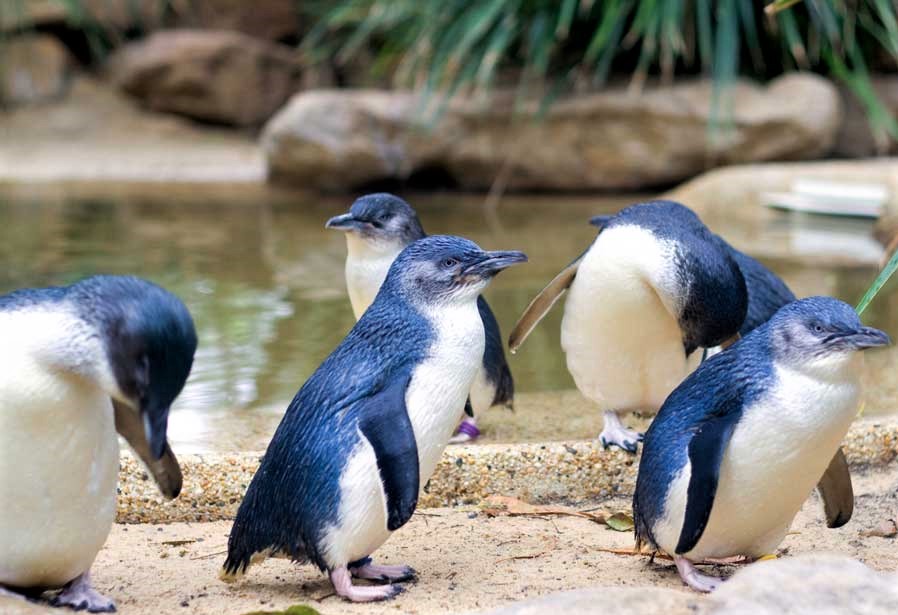
These guys are waddling around in blue tuxedos, hence their name: little blue penguins. The “little” comes from the fact that they’re the smallest penguin species, only 12-13 inches tall and weighing around three pounds. “About the size of a burrito,” as one TV station put it.
Little blue penguins mostly live in Australia and New Zealand, though they’ve been spotted in Chili and South Africa, and they sometimes go by other names: little penguin and fairy penguin.
Something else unique about little blue penguins, according to AnimalDiversity.org, is their courtship displays:
“Males take a particular stance, with heads facing up and wings back, while braying to females. If the female accepts, she will join the male in a courtship ‘dance’ where they march in circles together and make braying calls.”
After which most become monogamous, meaning that during every breeding season they work the crowd…

…until they find each other, do a little dance, make a little love, and hatch one or two of these cuties:

I don’t have little blue penguins for neighbors at the San Diego Zoo, but the Zoo does have African penguins.
And how’s this for synergy?

In April 2020 when the Zoo was closed to visitors due to the pandemic, the staff let some of the animals go on field trips, and a penguin visited the orangutans:

“The orangutans and penguin both enjoyed getting to know one another, approaching the glass to get a closer look.”
So…
I enjoyed all things animal last Thursday, and I enjoyed researching and writing this post, as well.
It was a nice break from the ongoing bad news about endangered animals, and all the other ongoing bad news.
And I’m betting you know what I mean…

 I Hate Houseguests