When It Comes To Compensating Victims Of Catholic Clergy Sexual Abuse, Here’s The Church’s Playbook:

Interspersed in this article are pictures of U.S. Catholic clergy who have been convicted of sexual abuse.  While there apparently is no database that tracks these convictions, the most recent estimate I could find lists more than 6,400 U.S. priests or other Catholic Church personnel who have been accused of sexual abuse, and that only “three percent of all priests against whom allegations were made were convicted and about two percent received prison sentences.”

The above image is of Robert McElroy, Bishop of the San Diego Roman Catholic Diocese, holding the playbook referenced in the title of this post.

What prompted that image was this story:

On February 11, San Diego Union-Tribune readers were greeted with this front-page headline:

“The Roman Catholic Diocese of San Diego is warning it may have to file bankruptcy in the future because of the potential fallout from hundreds of pending lawsuits alleging sexual abuse by clergy over the past 75 years.”

The article noted this wasn’t the first time the Roman Catholic Diocese of San Diego filed for bankruptcy for the same reason:

Richard R. Lavigne, convicted 1992.

“The warning comes nearly 16 years to the day since the diocese last sought the sanctuary of the bankruptcy code, filing for Chapter 11 reorganization in the face of 144 claims of sexual abuse by clergy.  The bankruptcy was dismissed eight months later, after the diocese reached a settlement with the victims for $198 million.”

So, not the first time for this diocese, nor the first time for a U.S. diocese (or archdiocese or religious order) to file for bankruptcy in response to sexual abuse lawsuits.

Let’s go back to when this tragedy first became public.

It began with this, in January 2002:

The Boston Globe story spread across the country, and people began coming forward, talking about how they’d been abused by Catholic clergy.  At the time of the abuse, many were male and female children, but male and female adults claimed abuse as well.

And the accusers weren’t just talking about their abuse by clergy.  They were also talking to lawyers, and demanding justice.

So the church hierarchy put their red-beanied heads together…

And they also hired lawyers, and came up with a strategy:

A mere two years after the Boston Globe story, the first Catholic diocese filed for bankruptcy, according to this article:

“Archdiocese of Portland Oregon – filed 7/6/04 – $75 million settlement.  At the time the archdiocese filed for bankruptcy, almost 170 people had filed suits alleging abuse.”

That same article lists – at #5:

“Diocese of San Diego, California – 2/27/07 – $198 million.  144 victims.”

And now the Diocese of San Diego may make the list again.

Gilbert Gauthe, convicted 1985.

Going back to the Union-Tribune article, here’s one of the catalysts for this new slew of lawsuits:

“…the main driver behind a possible bankruptcy was the passage by the state Legislature in 2019 of AB 218, a law that reopened for three years a window for filing sexual abuse claims which occurred long ago and would otherwise be barred by legal deadlines.  The law applied not only to churches but any organization.  That window closed at the end of 2022.

“The law, which was signed by Gov. Gavin Newsom in October 2019, also contains a provision allowing a tripling of any monetary damages awarded if the organization was proven to have engaged in a cover-up.

Barry Ryan, convicted 2004.

“…the majority of the claims date from 50 to 75 years ago, and no cases have been filed alleging abuse by a clergy member this century.  No current priests are named in the suits…”

In my research for this post I came across an organization called ChildUSA.org, whose website says:

“Our mission is to employ in-depth legal analysis and cutting-edge social science research to protect children, prevent future abuse and neglect, and bring justice to survivors.”

This led me to a 2021 report from ChildUSA.org that I think is worth quoting:

“Starting in 2004, Roman Catholic dioceses started to explore the use of Chapter 11 bankruptcy filings to deal with the many victims of the Catholic clergy sex abuse crisis.  To date, 29 Archdioceses and dioceses have filed for Chapter 11.”

(That number of 29, according to the Bishop-Accountability.org website, is now 31 as of 12/2/22.)

James Porter, convicted 1993.

“Resorting to bankruptcy when facing civil abuse liability for child sexual abuse (CSA)…now has become a preferred choice for institutions facing liability for CSA.”

“The bankruptcy system was not established with child sex abuse victims in mind.  Chapter 11, in particular, exists to manage assets for an organization going through difficult times.  The purpose of a Chapter 11 filing is to stay actions against a debtor and its property so that the value of the estate can be distributed to creditors in the orderly manner provided by the Bankruptcy Code.

“In a cruel, though unintended, irony in these CSA cases, the focus is on the well-being of the institution that covered up child sex abuse and on providing victims with as little financial compensation as possible.”

And that’s exactly what the Diocese of San Diego is once again contemplating – “providing victims with as little financial compensation as possible.”

The Union-Tribune article talks about attorney Irwin Zalkin, who represents about 120 of the 400 plaintiffs who have filed suits in San Diego Superior Court

Oliver O’Grady, convicted 1993.

Zalkin filed the first case, and it’s set to go to trial in July.

The Union-Tribune article explains.

“Filing for bankruptcy prompts an immediate halt to any lawsuits against the person or entity filing for bankruptcy protection.  That stay remains in effect for the duration of the bankruptcy.

“If the diocese were to file in late spring or early summer, it would be similar to what happened in February 2007, when the diocese went into bankruptcy court just hours before a trial in the first of the 144 cases was set to begin.  The trial never happened because the settlement resolved all the cases.”

“Resolved all the cases” – but “with as little financial compensation as possible.”

The Diocese of San Diego 2007 settlement was $198 million for 144 victims.  That works out to an average of $1,375,000 per victim.

John Geoghan, convicted 2002.

Which sounds like a lot of money, until you subtract substantial lawyers’ fees and possibly taxes…

And add in what can happen to the victims of clergy sexual abuse after they’ve bravely come forward, talked about the abuse, and are then subjected to “bankruptcy judges [who have no] training on the trauma inflicted on children by sex abuse or the details of sex abuse, sex trafficking, and organizational dysfunction in dealing with child sex abuse victims”:

“The result is the re-traumatization of many victims, either through the way the process works, or through the feeling of being re-victimized by the institution that caused their problems, which typically include depression, PTSD, substance abuse, failed relationships and marriages, and suicidal ideation, as well as suicide itself. 

“Other difficulties for victims in the legal process can include challenges in acquiring evidence as well as experiencing emotional hardships such as shame, or mistrust of the judicial system.”

When you consider this kind of long-lasting – often permanent – damage…

That money awarded in 2007 to the 144 victims is a pittance.

Especially when you consider this February 2023 article:

“If you’re looking at the Catholic Church alone, ‘God’ has at least – and we’re putting a huge emphasis on ‘at least’ – $73 billion in assets.”

If the 400 plaintiffs who have filed suits now are awarded the same settlement as in 2007, the total bill would be in excess of $550 million.

Paul Shanley, convicted 2004.

Keven Eckery, the communications director for the Diocese of San Diego was quoted as saying,

“And frankly, we don’t have that kind of money.”

Tsk, tsk, Kevin.

Are you unfamiliar with the 10 Commandments, #9 of which is:

“Thou shall not bear false witness.”

This means:

Do not lie.

Eckery also said any bankruptcy filing would be so all people who claimed they were abused would be treated fairly.

“Treated fairly”?

Catholic clergy at all levels have done an immeasurable amount of damage to their victims, but instead of doing the right thing, the church is going to weasel out of as much responsibility as it possibly can.

So, Mr. Eckery, here’s your assignment:  Pick up the chalk and write 100 times…

It’s hard to know who to feel sorriest for in this tragedy – the victims of sexual abuse…

Or the 1.3 million Roman Catholics who go to church in the 98 diocesan parishes in San Diego and Imperial counties.  Who give their – in most cases – hard-earned money to the church…

 …so the church can provide spiritual comfort and guidance, provide outreach to the poor and the marginalized, and do other good works.

Instead, in 2007 San Diego Catholic Church members saw their money go to this:

And today’s San Diego Diocese church members may soon see the same again. 

During the first weekend in February the above pictured Bishop Robert McElroy sent a letter to parishioners, which said in part:

“…the Diocese must face the staggering legal costs of responding to these new lawsuits.  In 2007, the Diocese paid out $198 million to settle 144 claims of abuse that had been brought during an earlier lifting of the statute of limitations.  This depleted most of the assets of the Diocese.  Even with insurance, the Diocese will not be able to pay out similar sums now.  This challenge is compounded by the fact that a bill has now been introduced into the Legislature that seeks to eliminate the statute of limitations entirely, leaving the Diocese vulnerable to potential lawsuits forever.

“For all of these reasons, we may be facing a moment where the Diocese enters into bankruptcy in the coming months…  

Did somebody say…

“Weasel”?

I call it like I see it.

And in the meantime, the hits just keep on coming.

Here’s one from last month:

Just When You Think There’s Nothing New To Know…There Is!

One of my favorite topics for reading and viewing is English and Scottish royal history – fiction, nonfiction, biographies, and films.

I’m always on the lookout for new information, but when we’re talking about people who lived centuries ago, new information seldom surfaces.

So while I’m always on the lookout for new information, what I usually encounter is old information with an author’s new spin on it.

For example, Natalie Grueninger has a new biography by about Anne Boleyn (born early 1500s, died 1536), the second wife of Henry VIII.  The book is coming out in March, and the description says,

“Through close examination of these intriguing events considered in their social and historical context, readers will gain a fresh perspective into the life and death of the woman behind the tantalizing tale.”

“Fresh perspective”? 

Maybe.

But new information?

Doesn’t sound like it.

And a novel about Henry VIII (1491-1547) is due out in May.  The author is Alison Weir, who’s written many novels and biographies about English and Scottish royal history, but…

Will Weir have anything new to say?

Maybe.

Or will she just give us a new spin on old information?

Probably.

So I keep hoping…

I keep hoping that somewhere out there is a treasure trove of royal history-related materials.  A treasure trove that for centuries has lain untouched somewhere – in the attic of an old English country house, in a box hidden behind a wall in a Scottish castle, in an archive on a bottom shelf in a museum…

And someone will discover it.

And now, someone has discovered a treasure trove!

“Lost Letters by Mary, Queen of Scots”! 

This is HUGE news!

Mary, Queen of Scots, lived from 1542 to 1587, and the letters referred to in the headline – 57 of them – were written by her between 1578 and 1584, and apparently were mislabeled:

“Deep in the archives of France’s national library, an assortment of coded letters listed as Italian texts lay untouched for more than 400 years. 

“Deep in the archives…untouched for more than 400 years…”

And,

“One leading biographer of Mary described the discovery as the most significant in the study of her life for more than a century.”

THIS is what I’m talking about.

THIS will be new information.

The letters were written during Mary’s imprisonment by her cousin, Queen Elizabeth I and, says this article:

“In the letters, Mary complained about the conditions of her captivity and her poor health.  She lamented that her negotiations with Elizabeth I to be released weren’t carried out in good faith.  Mary detailed her dislike of Walsingham [Elizabeth’s spymaster] as well as Robert Dudley, Earl of Leicester – a favorite of her cousin.  Mary also tried to bribe the queen’s officials.”

OK – I’ll admit the content of the letters doesn’t sound all that interesting to me.

I was hoping for love letters to and from Mary’s third husband, James Hepburn, 4th Earl of Bothwell:

In the newly discovered letters it actually sounds like Mary did a lot of whining, but then – she had a lot to whine about.  Elizabeth I jailed Mary because Elizabeth believed Mary was a threat to Elizabeth’s rule, and: 

“After 19 years as a prisoner, Mary was eventually executed in 1587, at age 44, accused of involvement in a Catholic plot to assassinate the Protestant Elizabeth.”

Mary wrote her letters in cipher, and the whole story about the discovery of the letters, and the team that deciphered them, is fascinating reading.  As detailed in this Smithsonian article:

The trio of code breakers were George Lasry, a computer scientist and cryptographer based in Israel; Norbert Biermann, a German pianist; and Satoshi Tomokiyo, a Japanese physicist and patents expert. 

They started with the ciphered letters – here’s an excerpt from one of them:

The Smithsonian article says,

“First, the men transcribed the documents, rendering the 150,000 symbols readable by a computer.  Then they employed a hill-climbing algorithm, in which a computer tries out different cipher keys, making small changes to high-scoring keys before attempting to decipher the text again.

“Put simply, codes involve simple substitutions, with specific symbols standing in for letters, numbers or words.  Ciphers are more complex, using algorithms to transform messages into seemingly random strings of symbols.  Mary’s letters fall under this second category.”

Whew!

The New York Times headline referred to these guys as “amateurs,” but they sure don’t sound like amateurs to me.

Eventually the team accomplished this, with the ciphers translated into French:

There was a lot more to the process, including discovering who wrote the letters, since Mary didn’t identify herself. 

So, three guys from three different backgrounds broke Queen Mary’s code, including identifying her as the writer.  In addition to their computer work, much of that labor required an old, reliable process:  trial and error.

“‘Breaking the code was not a eureka moment – it took quite a while, each time peeling another layer of the onion,’” Lasry [pictured below] said.

“‘This is like solving a very large crossword puzzle,’ he continued.  ‘Most of the effort was spent on transcribing the ciphered letters (150,000 symbols in total), and interpreting them – 50,000 words, enough to fill a book.’”

Lasry hopes to “work with historians to produce an edited book of Queen Mary’s letters deciphered, annotated, and translated,” so – a new book, and this time with new information.

This discovery does encourage me to keep hoping that somewhere out there are other treasure troves of royal history-related materials. 

Somewhere…I hope people are looking in the attic of that old English country house… and for the box hidden behind a wall in that Scottish castle…and in an archive on that bottom shelf in a museum…

Or in this case, in their back yards:

“An important hoard of Tudor coins – some of which shine light on the marriage history of Henry VIII – has been found by a somewhat startled family weeding their garden.

“…the unnamed New Forest family dug up 63 gold coins and one silver coin dating from the 15th and 16th centuries.  ‘They were out turning up the soil and all of a sudden these coins popped out of the ground…miraculously,’ said Ian Richardson, treasure registrar at the British Museum.  ‘It is quite a shocking find for them and very interesting for us.’

“Probably hidden in about 1540, they include coins from Henry VIII’s reign, which are unusual in that they also, separately, feature the initials of three of his wives – Catherine of Aragon (K), Anne Boleyn (A) and Jane Seymour (I).”

This Is Why I – And I Suspect Others – Are Watching Less Local News

KUSI-TV in San Diego is something of a vanishing breed:

It’s an indy.

That means KUSI is an independent television station, the sole property of McKinnon Broadcasting Company (MBC), based in San Diego.

That means no network affiliations, so no programming or news from ABC, NBC or et cetera.

That means there’s lots of airtime to fill with programs like these:

And programs like these:

And lots of time for locally produced news programs.

This post is about the former co-anchors of two of those KUSI news programs, Andrea Maas and Allen Denton:

Mass started at KUSI as a morning anchor in 2004.  Denton joined KUSI in 2010.  The pair co-anchored the station’s afternoon and evening news broadcast for six years.  Denton retired in early 2019, and in May 2019 Maas was informed that MBC would permit her employment contract to expire.

Which is another way of telling Maas…

The backstory:

According to various articles, in 2017, Maas began to suspect Denton was being paid more than she was.  A former manager confirmed Maas was making at least $80,000 less a year than her co-anchor, who was earning $240,000 a year.

In April 2018 Maas wrote a letter to management highlighting her 35-year broadcasting career and “more than a dozen Emmy nominations.”  Maas said no reason existed that “my compensation should be less than multiple male counterparts at KUSI.”

Shortly after her departure from KUSI in June 2019, Maas sued KUSI’s owner for $10 million, alleging her contract wasn’t renewed because she sought the same salary as her recently retired co-anchor, Allen Denton.

Now the story is back in the news because Maas’ lawsuit trial has begun.  She alleges gender and age discrimination, and accuses KUSI-TV of violating California’s Equal Pay Act:

What caught my attention in various articles were the reasons for not renewing Maas’ contract.  Here are some of those reasons from depositions, lawyer statements and et cetera:

“The company argued that it treated and paid her fairly, and said that in her last few years at the station Maas was ‘not a good team member or journalist.’”

Maas in court during opening statements.  Maas’ attorney said there was no evidence of any such feedback or complaints.

“Maas’ on-air performance was excellent, but that off camera she was ‘disengaged, difficult, and disinterested.’”

“The company said in filings that Denton had more experience, more awards and worked harder.”

“Maas had less experience, worked fewer hours and was ‘not as dedicated to the news’ as Denton.”

“KUSI was moving toward a fresh news format, with more banter and conversation, and the news director decided ‘she was not right for the role.’  It was a ‘casting decision based on her style.’”

Let’s take a look at that last reason.

It appears that Maas wasn’t up to snuff when it came to the “banter and conversation” that KUSI wanted in its “fresh news format.”

“Banter and conversation.”

If you watch local news, you know what they’re talking about. 

It’s when two news anchors stop reading the news from the teleprompter and start chatting like they’re Best Friends Forever.  All topics are welcome – their personal opinions, their personal lives, their personal hygiene.

It sounds like this:

Melody:  Jack, that story you just did about the double murder in Sanford Park?  Have you been to the merry-go-round in Sanford Park?  I took my daughter there – right after we moved here!

Jack:  Really!  Did she enjoy it?

Melody:  Oh, she loved it!  But then the merry-go-round stopped and she started to cry and she was all, you know, boo-hoo and…

Jack:  How old is your daughter?

Melody:  She was five then.

Jack:  That’s such a cute age.

Melody:  Oh, it is.  She’s eight now, and – wait… (reaches under the news desk for her phone) …Here are some pictures!  Yeah, I know – I’ve got a Mom’s Brag Book on my phone.  Oh, here’s my daughter in her soccer uniform!

Jack:  Aw, what a sweetie!  They grow up so fast, don’t they?  It seems like one day my son was learning to walk (Jack starts to tear up) and the next day he was off to college.  And speaking of college…

Melody:  Yeah, Jack, that awful mass shooting at Michigan State University…

Jack:  That’s right!  Stay with us, and we’ll have that story and more right after this break.

(The break concludes with a commercial I expect you’ve seen – the bent-carrot-standing-in-for-a-bent-penis/Peyronie’s disease commercial:)

Melody:  Ooooh, that Peyronie’s stuff sounds so painful – it gives me the shivers!  And I don’t even have a…uh…you know, a…a…ummm…

Jack:  And Melody, do you know where Peyronie’s disease got its name?  It’s named after French surgeon François Gigot de la Peyronie, who described the condition in 1743! 

Melody:  Wow, Jack – you seem to know a lot about it!

Jack:  I do, Melody.  And I’m now sharing with you and (nods toward camera) our viewers – for the first time – that I have Peyronie’s disease, or PD, as it’s also known.  I was diagnosed about two years ago, and…

This is why I – and I suspect others – are watching less and less local news:

“Banter and conversation.”

And apparently this is one of the reasons Sandra Maas lost her job as a KUSI news anchor.

She lacks that banter-and-conversation ability that news directors and TV station owners think is so appealing to local news viewers:

“Honey, I wish Melody shown us the pictures of her daughter!”
“Gosh, I love when they do stuff like that!”
“Honey, she almost said ‘penis’ on the air!””
“Gosh, I love when they do stuff like that!”

What the jury will decide in Maas’ lawsuit trial of her banter-and-conversation deficiency – and the other reasons for her being let go – remains to be seen.

And as for me, I’ll stick with these folks: 

They don’t have anyone to banter and et cetera with.

Multitasking:  How To Rob A Store And Make A Fashion Statement At The Same Time:

I’m trying to figure out what was going through this woman’s mind…

As she got dressed to go rob a 7-Eleven in San Diego.

“Let’s see,” she’s thinking, “the last time I robbed a 7-Eleven I wore the grey t-shirt and black sweatpants.  Fashionistas never wear the same thing twice, so this time I’ll go white t-shirt and gray sweatpants.”

She nods, satisfied, then considers her footwear.  “Darn!  All I have are black running shoes!”  She grabs a pen and paper and writes, “Buy white running shoes after this robbery.”  She peruses her closet for a moment, then smiles.  “Got it!” she says jubilantly:

“Slippers!  SO not-obvious.  Nobody robs a store in their slippers.  Talk about a fashion statement!”

I’m making light of this, when I know there’s nothing funny about it.

Here’s the full version of the above image of the woman:

We can’t see her slippers, but we can see what she’s holding in her hand.

According to the Union-Tribune article, the woman was holding a “black semi-automatic handgun,” and it appears she’s pointing it straight at the poor employee behind the counter.

Was the gun real?  Was it loaded?  Did she own it legally?

Doesn’t matter.  When someone’s pointing a gun at you, you don’t spring a pop quiz on them.

The employee – wisely – gave the woman an undisclosed amount of money, and the woman left.

Here are the two pictures from the Union-Tribune article, from the store’s camera:

This woman means business.

Is she brazen?  Stupid?  She’s got to know she’s being videotaped, yet she made no attempt to conceal her face:

If she was nervous, it wasn’t apparent. 

I’m guessing this wasn’t her first robbery.

And since this happened on January 19, and the story ran more than two weeks later, and now it’s been a month, and San Diego police are still…

“…hoping someone will help them figure out who and where she is.”

She’s either left town, or is really good at hiding.  Or her friends/acquaintances are too afraid of her to call the police.

But…why was she wearing slippers?

Is it possible…

That this woman had never committed a crime in her life – never – and was just sitting around at home one day, wearing her comfortable clothes and slippers, cleaning her gun as conscientious gun owners are wont to do, and suddenly a light bulb goes on…

And she thinks…

“I could use my gun to rob a store!”

And she walked out her front door (being careful to make sure it was locked – you just can’t trust people nowadays), strolled a couple of blocks to her neighborhood 7-Eleven, and…

Walked out with the cash?

Is that possible?

Doubtful.

The police described the woman as “roughly 25 to 30 years old,” and if she’s caught and convicted…

What’s in store for the robber-in-slippers?

Prison time, and possibly a lot of it.

According to this California law firm:

“Robbery is a Felony punished in First and Second Degrees. If convicted of First-Degree Robbery, you face up to nine years in state prison.  If convicted of the Second-Degree form, you can serve up to five years in a state prison. You also face fines of up to $10,000 or fines and a prison sentence with both forms.

And from this law firm:

“California has a law known as “10-20-Life” that applies to convictions when a gun is used during the commissioning of a violent crime.  Also known as the ‘Use a Gun and You’re Done’ law, it adds extra prison time to the sentence of anyone who is convicted of using a gun while committing a robbery.

“Under this statute convicted felons who used a firearm or other weapon to cause intimidation and instill fear during a crime may face up to ten years in a California state prison on top of the sentence for their crime.  This means that someone who commits first-degree robbery may face 19 years in prison without even firing the gun.”

But in San Diego, says this October 2022 article:

“The annual mid-year report…showed 6,182 violent crimes, including 51 homicides, 475 rapes, 1,355 robberies and 4,301 aggravated assaults in the first six months of the year.”

So many crimes, never enough police to solve them all.

Our robber-in-slippers may never be brought to justice.

And we may never know why she went on that day and that time and to that store…

And in her slippers.

But we do know this:

She’ll go down in the annals of 2023 crimes in San Diego as the…

The First Republican Brave Enough To Announce They’ll Take On Trump And Run For President In 2024…Is A Woman

On February 14 CNN provided a photomontage that included Trump, plus the people whom the media consider potential Republican candidates for president in 2024:

Donald Trump, Nikki Haley, Ron DeSantis, Mike Pence, Tim Scott, Ted Cruz, Glenn Youngkin, Chris Sununu, Kristi Noem, Greg Abbott, Larry Hogan, Chris Christie, Asa Hutchinson, Mike Pompeo, Liz Cheney, and Will Hurd.

The fact that any of them would consider opposing Trump renders them brave in my opinion:

Brave – because by announcing they’ll seek the GOP’s nomination for president, they’ve invited a nonstop fusillade of Trump denigrations, insults and lies about their character, values, heritage, appearance, and any other facet Trump takes aim at.

So I’ll credit anyone who is considering opposing Trump with being brave.

There are 16 images in the photomontage from CNN – Trump, three women and 12 men.

But only one is the bravest of them all.

This one:

And – if I’m being unfair, so be it – I’m imagining, in the time since Trump announced he was running back in mid-November, at least some of these potential candidates texting each other:

“You announce first.”
“No, YOU announce first.”
“I don’t wanna be the first!”
“Well, I’m not gonna be first!”

The first to announce they’ll oppose Trump – the bravest of them all, braver than any of the men – is a woman:

Nikki Haley.

In a 3½-minute video that aired on February 14 Halley said, “I’m Nikki Haley, and I’m running for president.”

This article:

Noted that Haley…

“…was a rare figure to leave the Trump administration while earning praise from Mr. Trump rather than a parting insult.”

“That the former president has so far not coined an insulting nickname or otherwise attacked Ms. Haley is a sign, perhaps, that he does not perceive her as a major threat.”

But that was then, and this is now.

Now it’s official:  Haley is running for president.

And here’s what she’s in for.

Let’s do a refresher of just some of the insults Trump has hurled at women in recent years.

I’ll start with the numerous women who have accused Trump of sexual misconduct.  Here’s a story from 2016:

“Donald Trump vowed Saturday to sue the women who have accused him of sexual misconduct in recent weeks.

The endless list of women Trump has insulted include E. Jean Carroll…

“‘Every woman lied when they came forward to hurt my campaign,’ Trump said during remarks in Gettysburg, PA.  ‘Total fabrication.  The events never happened.  Never.  All of these liars will be sued after the election is over.’”

Trump never sued, of course.

He’d end up in a courtroom under oath, and his keepers would never allow that.

…Hilary Clinton…

To continue with Trump’s denigrations of women:

“Horseface,” “fat pigs,” “slobs,” “crazed, crying lowlife,” “liar,” “face of a pig,” “bimbo,” “disgusting,” “Miss Piggy,” and “dogs.”

“Wacky and deranged,” “off the wall, a neurotic and not very bright mess,” “very insecure,” “totally lying,” and “crazy and very dumb.”

…Omarosa Manigault Newman…

“How do the breasts look?”

“She’s certainly not hot.”

“Nasty woman.”

“…that fat, ugly face of hers.”

“You could see there was blood coming out of her eyes.  Blood coming out of her wherever.”

…Cher…

“Sadly, she’s no longer a 10.”

“Extremely unattractive (both inside and out).”

“Look at that face, would anyone vote for that?”

“I’m not allowed to talk about her ugly face or body…”

“An extraordinarily low IQ person.”

…Carly Fioriana…  

“…bleeding badly from a face-lift.”

“Does she have a good body?  No.  Does she have a fat ass?  Absolutely.”

“…if you like a woman with a bad complexion who is built like a linebacker.”

…Megyn Kelly…  

“Why don’t they go back and help fix the totally broken and crime infested places from which they came.”

“And when you’re a star, they let you do it.  You can do anything…Grab ‘em by the pussy.  You can do anything.” 

After that list, I need to wash out my eyes – and brain – with soap.

…Alicia Machado…

How about you?

And because Nikki Haley is regarded as “nonwhite,” and she herself said (of her early life) “I was a brown girl, in a Black and white world,” well…

That gives Trump even more opportunities for insults.

Trump’s first response to Haley’s announcement apparently was low-key, though he’d hurled pre-announcement insults at Haley on February 2, according to this article:

…and now, Nikki Haley.

“Trump said Haley was a ‘very ambitious person’ and that ‘she just couldn’t stay in her seat.’

“‘Nikki suffers from something that’s a very tough thing to suffer from:  She’s overly ambitious,’ Trump said later in the interview.”

“Stay in her seat?”

The “seat” Trump designates for her?

In Trumpworld, women should know their place, and stay there.

In Trumpworld, ambition in men = good/ambition in women = bad.

But if Trump’s response to Haley’s February 14 presidential bid was low-key, here’s a Trump toady who didn’t hold back, according to this February 14 article:

“MAGA Inc. executive and former Trump spokesman Taylor Budowich (pictured) released a statement on behalf of the super PAC mocking Haley and her presidential bid.

Trump Toady.

“‘Nikki Haley is just another career politician,’ Budowich said.  ‘She started out as a Never Trumper before resigning to serve in the Trump admin.  She then resigned early to go rake in money on corporate boards,’ Budowich wrote.

“‘Now, she’s telling us she represents a ‘new generation.’  Sure just looks like more of the same, a career politician whose only fulfilled commitment is to herself,’ Budowich wrote.”

So begin the insults.

OK:  It’s unlikely I’ll vote for Haley or any Republican.

But I salute her for being the first to announce – and the bravest.

And when Haley is asked – as she inevitably will be – if she is willing to be Trump’s running mate, I hope she responds…

I Love This Word:

“Oxymoron” is such a great word.

And it came to mind recently when I was reading this article:

The first oxymoron in the article that popped out at me was this:

“Employee happiness.”

Who in the world came up with the idea that “employees” are supposed to be “happy”?

No employer, that’s for sure.

Employees are supposed to show up, be on time and functioning.  In return, employees get a paycheck.

And maybe benefits.  Or maybe not.

But “happiness”?

I’m pretty sure that when companies look at their year-to-date balance sheets…

“Employee happiness” appears nowhere on it.

Assets and liabilities and bottom lines, yes – but employee happiness?

I think not.

Here’s another oxymoron from the article:

“Fulfilling workplace.”

Who in the world came up with the idea that a being in a “workplace” is supposed to be “fulfilling”?

A “workplace” is just that:  A place where people work. 

I’m pretty sure not one of these…

Ever has or ever will say anything about the employer providing a “fulfilling workplace.”

It appears that the quest for “employee happiness” and a “fulfilling workplace” was at least part of the reason for what’s come to be called…

The “Great Resignation.”

According to the article:

“About 50.5 million people quit their jobs in 2022, besting the prior record set in 2021, according to the federal JOLTS [Job Openings and Labor Turnover Survey] report.”

“Most people quit to take new jobs, not to leave the workforce altogether.  Ample job prospects, higher wages and remote work helped fuel the trend.”

So it’s not that people don’t want to work, but because of those “ample job prospects” out there, they’re looking for higher wages and the opportunity to work remotely?

Yes, but – there are many reasons for the Great Resignation, says this May 2022 article:

“The top reasons workers gave for quitting were a toxic company culture (62%), low salary (59%), poor management (56%), and a lack of work-life balance (49%).

“Other reasons included:

No remote work options (43%).
Burnout (42%).
No flexible schedules (41%).
Limited advancement opportunities or career progression (37%).
No benefits or poor benefits, such as health insurance or a 401(k) plan (31%).
Limited personal time off or sick leave (27%).”

Whew. 

All that seems like a lot to ask of any employer.

The employer, after all, only offered you a job

Not a “to have and to hold from this day forward, for better, for worse, for richer, for poorer, in sickness and in health, to love and to cherish, until death do us part” kind of arrangement.

And those 50.5 million who quit their jobs in 2022?

Did some of them perhaps make the proverbial out-of-the-frying-pan-into-the-fire move, as suggested in this recent article:

“…mental health professionals are seeing a new trend among many known as ‘layoff anxiety.’”

“That anxiety is well-founded, according to Hightower Las Vegas economist Mike PeQueen.  ‘In the last month or two, we’ve seen some very big-name tech companies lay off tens of thousands of people,’ PeQueen said.

“As that happens, layoff anxiety has the potential to become more widespread.  ‘They have to know that the possibility [of being laid-off] is out there,’ said licensed therapist Trey Tucker.”

This could be a lot of…

As the economist in the 3News article said – and this February 7 article reiterates – a lot of “very big-name tech companies” have laid off people:

“The tech industry started the year with a wave of job cuts, around 50,000 in January alone, and there doesn’t appear to be any let up this month.  The computer maker Dell said Monday that it’s cutting about 6,600 jobs.”

And it’s not just big-name tech companies – let’s add Morgan Stanley, Goldman Sachs, PepsiCo, CNN, 3M, DoorDash, Stitch Fix, Dow Chemical Company, Yankee Candle, Compass, and now this, also from February 7:

“Boeing plans to cut about 2,000 white-collar jobs in finance and human resources, and it will be shifting some of that work to an outside contractor in India.”

And this, from February 8:

And this, yet another tech company, from two days ago:

Let’s circle back to that New York Times article for more language, not oxymorons this time, but still ideas I find somewhat fanciful:

“…workers say they are not fulfilled at their jobs.”
“…unfair treatment at work.”
“…not inspired by your work.”

My responses to those:

Look for fulfillment outside of work – family, friends, hobbies, take a trip, take a class, take a nap.
“Unfair”?  Life isn’t fair, so why would work be?
I challenge you to find one definition of “work” that includes the word “inspire.”

You won’t find “inspire,” but when it comes to definitions of “work,” you will find these words:

Are we employees – perhaps – asking too much of our employers?

Trust me – I’m not pro-employer in any way.  Just the opposite. 

But to expect to have better pay and fabulous managers and work-life balance and flex time and remote options and career opportunities and incredible benefits and happiness and fulfillment and fair treatment and inspiration and

All from your employer?

All from a place where you’re there only – only – because they’re paying you to be there?

Otherwise, you wouldn’t be there.

Maybe we should just accept this reality:

And this is no oxymoron:

Meet Marjorie:  The Mouth That Roared

Marjorie Taylor Green was in typical form at the February 7 State of the Union Address.

She heckled the President of the United States:

Gave the President a thumbs-down:

And called the President a “Liar!”

You’ll notice that she cupped her hands around her mouth, megaphone style.

Not that Marjorie needs anything to enhance her voice volume.

Every time Marjorie Taylor Greene opens her mouth – which is way, way too often – I wonder,

First: “Is she really speaking for the people in her district?”

Second: “Who are the people in her district?”

Marjorie has been elected twice by the residents of Georgia’s 14th congressional district, so we have to assume that Marjorie is saying what they want to hear.

Including her rant about the “gazpacho police” patrolling the Capitol building in Washington, DC, mixing up the famous cold Spanish soup gazpacho with the Gestapo – the brutal Nazi-era secret police in Germany.

Which prompted a Twitter storm, and a plethora of helpful clarifications including this:

Our Marjorie is a Republican in the House, elected in 2020, and re-elected in 2022.

Here’s Georgia’s 14th congressional district, in the northwest corner of the state:

The population is around 777,000 people, and regarding that population, says this article:

“Georgia’s 14th congressional district is an overwhelmingly white and rural area, where most residents have just a high school education and the median household income is about $10,000 less than the national average, per Census figures.

“The district is considered the 10th-most Republican district in the nation, with Republicans averaging 32 more points in Georgia’s 14th than nationally, according to a Cook Political Report analysis of 2012 and 2016 presidential election results.

“Luke Martin, the Floyd County Republican Party chair, said conservatives in the district look for candidates who are pro-life, pro-gun, pro-business, and support a limited government.”

The article goes on to say,

“What voters liked about Greene was her likeness to Trump, who was popular in the district.  (He won the 14th’s counties by over 80% in the 2020 election, per state public records.) 

“‘She’s an in-your-face type and people really warmed up to that,’ Tim Shiflett, Democratic Party chair for Georgia’s 14th congressional district, said.  ‘They like that because they like Donald Trump.’” 

Here are Marjorie and Trump…

…Best Friends Forever…

Until she pisses him off.

And that’s unlikely, especially since, as this and many other recent articles suggest:

Our Marjorie is aiming to be Trump’s running mate:

Then all she has to do is sit back, keep her fingers crossed, and hope that Trump dies in office.

Or better yet – bypass Trump and make our Marjorie president in 2024!

These folks have started the ball rolling, right here on Amazon:

Forgive And Forget? Not Me. Here’s What I Want:

One of my family’s ways of displaying our dysfunction has to do with politics.

If we have a family get-together, and we still want to be speaking to each other at the conclusion of the gathering…

We…

Do not.

Talk.

Politics.

Ever.

There are five of us siblings.  Two are Trumpers, and the other three are sensible, clear-thinking, wise liberals.

Obviously I say this because I’m in the latter group.

Sadly, several years ago at Thanksgiving dinner, one of the liberals violated the no-politics rule.

They did one of those “if-then” statements.  As in, “If you did this, then you are this.”  A simplified version might be, “If you eat turkey, then you are not a vegetarian.”

Our Thanksgiving dinner didn’t become a food fight – but it was close.

At Thanksgiving dinner, the liberal stated, “Trump is a racist; if you voted for him, then you are also a racist.”

I disagreed, but kept my mouth shut, declining to be drawn into what became a maelstrom of anger, shouting, and finger-pointing.

I disagreed, and here’s why:

Close to 63 million people voted for Trump in 2016, and they are not all racists.

And my two Trumper siblings are not racists.

I’m of the opinion that we vote for the person we believe is the best candidate for the office, even if we disagree with some of their beliefs and actions.

Sometimes it may be despite some of those beliefs and actions.

I voted for Biden in 2020.

And yet I strongly disagreed with Biden on this issue:

Biden was up front about his intentions, according to this article:

“When President-elect Joe Biden was asked whether student loan cancellation figured into his economic recovery plan, he declared, ‘It should be done immediately.’

“‘[Student debt is] holding people up,’ Biden said on November 16, 2020. ‘They’re in real trouble.  They’re having to make choices between paying their student loan and paying the rent.’”

“On the campaign trail, Biden had pledged to cancel at least $10,000 of student debt per person.”

I strongly, hugely disagree with Biden’s forgiveness of all or any part of federal student loan debt.

The talk became big headlines in August 2022:

And so did the big price tag:

“Biden’s decision to move ahead with $10,000 in student debt cancellation for borrowers who earn under $125,000 will cost the federal government around $244 billion, according to higher education expert Mark Kantrowitz.  The $20,000 in relief for Pell Grant recipients may add around $120 billion to the government’s costs.”

Let’s be clear here.  Student loan forgiveness doesn’t “cost” the federal government anything.

The federal government gets its money from our…

It’s we taxpayers whose money goes to student loans, and forgiving $360 billion+ – according to the above estimate – means that money just…

Vanishes.

Here’s why I strongly, hugely disagree with forgiveness of all or any part of federal student loans.

I had a federal student loan, and I paid it off.

I attended college for two years, and each year I received a federal student loan.

At the end of two years I dropped out of college, for a variety of reasons.  One of them being – I hated going further into debt.

What I didn’t realize when I dropped out of college was that my federal student loan debt would automatically become due, meaning making a payment – plus interest – every month, payable by a certain date, starting immediately.

The amount, in today’s dollars, was $23,000.

My God – I’d never been in debt in my life, and now I owed $23,000.

The amount seemed insurmountable.  I had no degree, a minimum wage job, and limited prospects of getting anything better.

How?  How would I ever pay this off?

I found a better-paying job, and sometimes worked two jobs. 

Eight years later I was still making those federal student loan payments – plus interest – and eventually I did pay off my debt.

Now:  I realize I sound like that old cliché about,

“You young people today!  Why, when I was your age, I got up at 3am and chopped a week’s supply of wood, milked the cows, then walked 10 miles to school in the dead of winter!”

I don’t care if that’s how I sound.

I paid my debt, and today’s students should, too.

And as for people currently in college or considering college, I say this:

First, have you exhausted all scholarship possibilities?

If you have, then why do we see headlines like this?

“The National Scholarship Providers Association reports that as much as $100 in million in scholarships also go unclaimed each academic year.”

And headlines like this, regarding Pell Grants:

“A study from the National College Attainment Network found that Class of 2022 seniors left close to $3.6 billion in Pell Grants because they didn’t complete the Free Application for Federal Student Aid (FAFSA).  Pell Grants, which are distributed to low-income students, can only be acquired one way:  by filling out the FAFSA…The act of leaving financial aid money on the table is still happening.”

(And yes, Pell Grants are just that – grants, not loans. And the money comes from our tax dollars. But that’s etched in stone, and Biden’s forgiveness plan is not.)

Second, due to the pandemic, federal student loan repayments were suspended in March 2020 and the freeze has been extended seven times, now “until 60 days after Biden’s forgiveness program goes into effect or 60 days after June 30, 2023, whichever comes first,” according to paeaonline.org.  By my count that’s 41 months with no loan payments. 

Have you been stashing your loan repayment money in a savings account – or spending it?

And third, if you can’t afford to go to college without borrowing money, then go to work, save your money, and then enroll.  If you run out of money after your first year, go back to work, save more money, and return to school. 

Sure, it will take longer, but you’ll graduate from college debt-free…

Instead of being one of these statistics:

  • 42.8million borrowers have federal student loan debt.
  • The average federal student loan debt balance is $37,787.

Now, Biden’s federal student loan forgiveness plan may never happen – it’s been challenged:

“Republicans and conservative groups have now brought at least six lawsuits against the president’s plan, arguing it is harmful and an overreach of executive authority.

“The U.S. Supreme Court has agreed to hear oral arguments later this month [on February 28] for two of those challenges, one brought by six states and another backed by the Job Creators Network Foundation, a conservative advocacy organization.”

Many people have many objections to federal student loan forgiveness, and here’s one objection that’s especially on my mind:

“Sixty-four percent of Americans oppose forgiving $10,000 per borrower if it raises their taxes…”

Of course federal student loan forgiveness will raise our taxes!

That $360 billion+ I talked about earlier?  Rest assured that the government had plans for that loan repayment money.  You can’t allow $360 billion+ of the federal budget to just vanish – it must be replaced.  And who will have to replace it?

Looking at you, kid. 

And me.

The people with federal student loans did not borrow money from “the government.”

They borrowed it from me.

And I want that debt repaid, damnit.

So:  If the Biden plan survives the Supreme Court and comes to fruition, I’ll be angry.

But I’ll vote for Biden if he runs in 2024.

Because despite what my liberal sibling said at that dreadful Thanksgiving dinner…

You can vote for a person even if you disagree with some of their beliefs and actions.

OK, this rant has gone on long enough.

And I’ve wood to chop and…

Stereotyping, Sexism, Ageism, Weightism, And More – You’ll Find Them All Right Here, In The…

I was reading a newspaper article on a page that happened to be adjacent to the comics page.

Normally I don’t read the comics, but something caught my eye and I took a closer look.

It was this:

I was sorry I’d looked.

This – thing – is an example of ageism, and sexism, and stereotyping.

Let’s unpack it.

Ageism:  The man is portrayed as elderly – balding, thick glasses, his expression bewildered.  His appearance suggests that because he’s elderly, he’s therefore also feeble.  He’s dressed in a tuxedo, suggesting he’s wealthy, and they’re drinking champagne, which also suggests his wealth.

Sexism:  The woman is much younger, slender, and large-breasted, with long, curling hair.  She’s wearing a showy necklace, and a headband the likes of which I’ve never seen on anyone except Wonder Woman.  Her statement suggests that she is a rapacious gold digger, willing to commit short-term, while hoping for the man’s speedy demise so she can inherit his wealth.

Stereotyping:  Elderly people are feeble, and women are rapacious gold diggers, preying on wealthy, elderly, feeble men.

Who is the creator of this travesty?

His name is Vic Lee, and the above image is his Pardon My Planet, a daily single panel cartoon syndicated in many newspapers and available online.  Various websites describe Pardon My Planet as:

“…a feature in which Lee showcases his ironic view of the world and the eccentricities of the human race.”

Pardon My Planet is a visual record of the nincompoopities of the human spirit.  This imaginatively sly panel peeks under the veil of the taboo and paints smiley face on the shroud…gives us a rubbernecker’s eye-view into the boarded-up attic of the human psyche.”

“…this laugh-out-loud strip that deftly balances the tightrope of political correctness.”

As to the last, I wasn’t laughing out loud. 

Instead, I was picturing a kid looking at this:

And the kid coming away with the impression that the world is full of greedy women who prey on old (feeble) guys for their money.

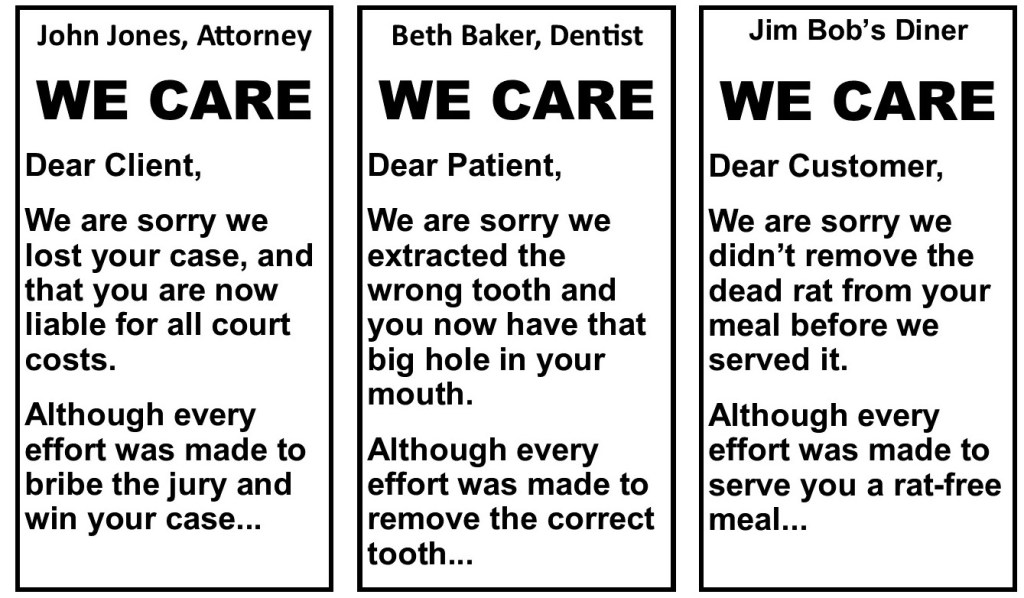
So to counterpoint the stereotyping, I’ll offer a dose of reality:

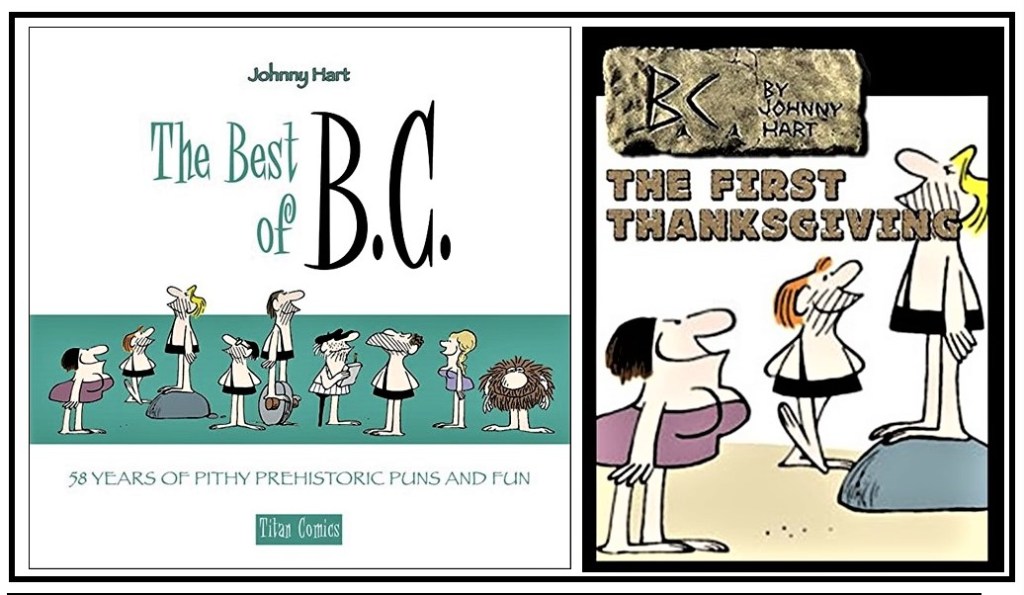
I don’t know why I – unwisely – let my eyes stray further on the comics page, where I encountered this:

And what do we have here?

“Fat dude”:  Body shaming.  Also known as “weightism.”

“In the saber-toothed muumuu”:  Suggesting a “dude” wearing a muumuu is somehow…wrong?

And that a wheel vehicle with an awning is also somehow…wrong?

And that only a “fat dude” in a “saber-toothed muumuu” would have an awning on his vehicle?

Stereotyping.  Marginalizing.  Confirming “otherness” as a bad thing.

The names above the B.C. image identify the creators as “Mastroianni and Hart,” and according to this website:

Mastroianni is the grandson of John Hart, creator of B.C., which made its newspaper debut in 1958.  Apparently another Mastroianni grandson is involved as well.

Like Pardon My Planet, B.C. is syndicated in many newspapers and available online.

Also available are B.C. books and videos…

T-shirts and posters…

And – unfortunately – images, including this one:

Once again, I was picturing a kid looking at this.

Kid’s takeaway:

Body shaming:  Good.

Being different:  Bad.

And once again, I’ll offer an alternative:

Pardon My Planet and B.C. and other comic strips like them aren’t just in the…

They’re seven days a week, in print (including comic books) and online:

And they’re one of many – however unintended by their creators – ways that harmful ideas are perpetuated.  Send these messages often enough, and they become ingrained:

“All elderly people are feeble.”
“All women are gold diggers.”
“All overweight people are disgusting.”
“All people who are different are wrong.”

For adults, it reinforces their negative thinking.

And for kids…it’s one more part of the indoctrination.

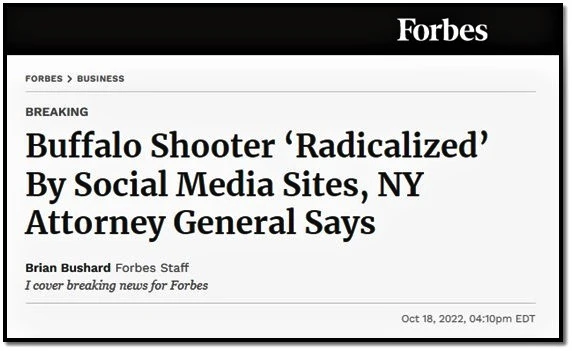
It takes no imagination on my part to connect the dots, from kids’ indoctrination to – in a few years’ time – young adults being receptive to this…

The alleged shooter, Payton Gendron, was only 18 at the time of the shooting.

And finally…

My takeaway:

Next time something catches my eye on the comics page…

I’ll ignore it.

Not doing so makes me…

Are You Getting Two Raises A Year?  The Post Office Is, So They Can Continue Doing This…

It’s so easy to mock the United States Postal Service – USPS.

It’s so easy, it’s like…

I’ve mocked USPS six times in this blog, and I never run out of inspiration.

Here comes #7.

*****

My husband and I like to get our taxes done as early as possible.  “Get ‘em done and forget about it,” is our motto.

That won’t be possible this year, because we’re waiting for a tax document from a financial institution.  I can’t access the document online because we closed the account last year.

In hopes of finding a workaround I called the company.  Their recorded message advised that the tax documents were mailed on January 31, and “should be” delivered in “seven to 10 business days.”

Seven business days is more than a week.  Ten business days is two weeks, unless there’s a holiday in there – then it’s longer.

So our tax document may not arrive via USPS for a week, or two weeks.

Or three weeks.

Or maybe three months.

Or maybe in 100 years, like this piece of mail in Belding, MI:

Regarding the hundred-year-delayed mail, according to a USPS employee:

“‘…there are a few things that could have happened here,’ said Mindy Ponover, who works for the Postal Service in Michigan.

“Her best guess is that the postcard got stuck behind a baseboard, a crack in the floor or a piece of machinery in an old post office that was recently renovated.”

“There’s a very good possibility of that,” said Ponover.

A higher-up USPS employee was quick to jump in and say:

“But ‘in most cases these incidents do not involve mail that had been lost in our network and later found,’ added Sara Martin, a USPS public relations representative.”

Or maybe our tax document will arrive – shredded – in one of those USPS pre-printed apology bags:

Seriously – can you name another organization that screws up so frequently, it has pre-printed apology bags?

Just imagine…

So – what was I referring to in this post’s title, about USPS getting two raises a year?

This:

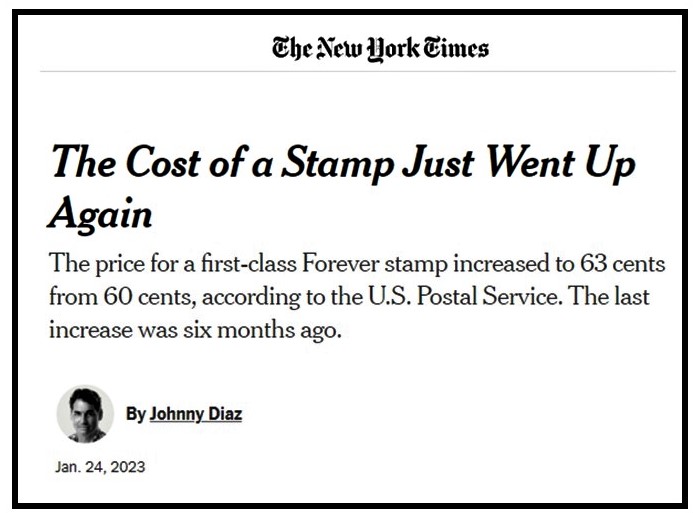
“The price for first-class Forever stamps increased to 63 cents from 60 cents this week, a 5 percent price jump that stemmed from rising operating expenses and losses for the Postal Service.”

“Officials have said that customers can expect price increases twice a year at least through 2024.”

And it’s not just the cost of Forever stamps that’s increased:

“The new rates also include increases in the prices of one-ounce metered mail, to 60 cents from 57 cents, and domestic postcards, to 48 cents from 44 cents.  Sending a one-ounce letter overseas is now $1.45, up from $1.40.”

And what do we get, in exchange for these increased rates?

More of this:

And this:

And this:

The New York Times article went on to say,

“‘As operating expenses continue to rise, these price adjustments provide the Postal Service with much needed revenue to achieve the financial stability sought by its Delivering for America 10-year plan,’ the Postal Service said, referring to its plan to become ‘self-sustaining and high performing.’ 

“The agency said in 2021 that it projected $160 billion in losses over the next 10 years that it hoped to mitigate.”

Three notes:

First:  I’m no expert, but I’m pretty sure “$160 billion in losses over the next 10 years” is not a good business model.

Second:  Regarding the second paragraph and that USPS “hoped to mitigate…’’

Third:  Regarding that “Delivering for America 10-year plan…”

I’ve never heard of it.

Have you?

Apparently USPS published the Delivering for America plan – all 60 pages of it –on March 23, 2021:

Here’s the front cover:

And on page 58, a message from everyone’s favorite millionaire/Trump crony, Postmaster General Louis DeJoy:

Here’s a recent USPS-related headline:

“A Minnesota congresswoman wants to know what’s causing days-long delays in mail delivery in the Twin Cities’ southern suburbs.

“Democratic U.S. Rep. Angie Craig sent U.S. Postmaster General Louis DeJoy a letter on Friday saying she was frustrated with reports that her constituents regularly go up to four days without mail, with some saying they haven’t gotten any mail since December 16, the St. Paul Pioneer Press reported.

Let’s see…

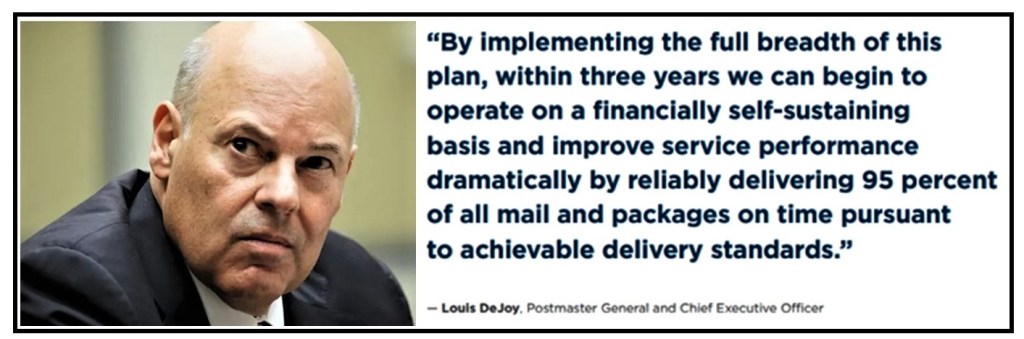
The Delivering for America plan was announced on March 23, 2021, coming up on two years ago.  In his statement, DeJoy talked about “within three years” and “95 percent” mail delivery “on time.”

Yet some Minnesotans were regularly going “up to four days without mail.”

Maybe according to Louis DeJoy, four days without mail is the new “95 percent on time”?

I confess I did not read everything – or anything – between the Delivering for America front cover and Louie’s message, but I did open option #2, what USPS calls its “Plan at a Glance PDF.”

And in both documents I couldn’t help but notice the words “service excellence.”

It appears that it’s just now occurring to USPS that “service excellence” is something they ought to consider including in their goals.

Especially since USPS:

  • Raised its rates in July 2022 (first-class stamps rose from 58 to 60 cents).
  • Has now raised first-class stamps from 60 cents to 63 cents.
  • Will continue to do this “twice a year at least through 2024.”

And oh, by the way:

“‘The Postal Service expects that, in each subsequent year, it will implement price changes for all Market Dominant classes in January and July of such year,’ the Postal Regulatory Commission said in a report about rate schedules.  It was not clear how much they would go up each year.”

There you go:  For the foreseeable future, USPS gets two raises a year.

Whether USPS is providing “service excellence…”

Or more of this:

And in the meantime, my husband and I have no choice but to wait for USPS to deliver our tax document.

To wait and watch for USPS…

And wonder if…

Or will out taxes be…

Book Review: These Two Are Too Awful To Spend Time With

Publication Dates:  June and July 2020

Review, short version:  All skunks, all the time.

Review, long version:

I read two books back-to-back and they were so awful, I decided to kill two birds with one stone, or in this case, trash two books with one review.

The books are The Lies That Bind by Emily Griffin and Things You Save in a Fire by Katherine Center.

Griffin’s lead character is Cecily Gardner, 28, and the setting is New York in 2001.

  1. Cecily’s in a long-term relationship with Matthew, but Matthew isn’t ready to commit, so Cecily dumps him.
  2. A month later Cecily meets Grant, immediately knows he’s The One, and they become lovers.
  3. Grant dies in the 9/11 attack.
  4. Cecily discovers Grant was married, so apparently he wasn’t The One.
  5. Cecily reunites with Matthew, they get engaged.
  6. Cecily discovers she’s pregnant, but neglects to advise fiancé Matthew that he might not be the father.
  7. Cecily discovers Grant is still alive, but hiding from the Feds because of his involvement in an insider trading scheme.
  8. Cecily confesses everything to Matthew and he is understandably upset.
  9. Cecily has the baby.
  10. Grant serves his prison time.
  11. Cecily and Grant reunite and are happily ever after.

This list isn’t the bare bones of the story – it is the story.

Now for Things You Save in a Fire.

Center’s lead character is Cassie Hanwell, 26.  The setting is a mythical town near Boston.

  1. Cassie is tough.
  2. No, seriously, Cassie is really tough.
  3. Tougher than tough.
  4. Cassie’s been hurt, so she shut down her emotions and got tough.
  5. Have I mentioned that Cassie is tough?
  6. Cassie’s mother is dying of brain cancer, but that’s OK, because Cassie is tough.
  7. Cassie is a firefighter, and the other all male firefighters don’t like having a female in the department.
  8. But that’s OK, because Cassie is tough.
  9. Then she’s attracted to one of the male firefighters, Owen.
  10. Owen gets injured on the job.
  11.  Her mother dies, Owen lives, Cassie and Owen are happily ever after.

Yup, that’s it.

Here’s the category I’d give to these two books:

You know how, on Amazon, books are categorized as Biography or Young Adult or Women’s Contemporary Fiction and so on? Here’s my category:

“Millennial Neurotic Lead Character’s Life is All Screwed Up Until She meets Mr. Right and Then All Her Issues are Resolved in the Last 20 Pages.”

Although come to think of it, that really isn’t a new category after all…

Some People Can’t Find A Career – While This Woman Has Five?

If you’re a fan of audiobooks, you have lots of company.

According to statista.com, around 45 percent of adults listen to audiobooks.

And it’s no surprise – in part because it’s so easy.  There are many ways to listen, says this article…

“Most audiobooks are available to listen to on your smartphone, tablet, smartwatch and desktop or laptop – how to listen to audiobooks depends mostly on which device you have and which apps can be downloaded on it.  Both Apple and Android devices will allow you to access virtually every audiobook app.”

And if your choice is audiobooks on CD with a CD player (pictured) – that works, too.

You can listen to audiobooks at home, in your car, on the bus, on the subway, on an airplane, while walking or running or doing almost anything anywhere, with or without headphones.

Just be careful not to drop your device in what many consider their favorite reading room…

But wherever and however you listen to audiobooks, did you know that the voice you’re hearing is called an “audiobook narrator”?

And it’s quite possible that you’ve heard the voice of this audiobook narrator:

This is Julia Whelan, and it’s her – and her five careers – I’m referring to in the title of this post.

According to this article in my Sunday Union-Tribune:

“Julia Whelan is a bestselling author, a screenwriter, an actor, a Grammy-nominated audiobook director, and an award-winning audiobook narrator.”

Yup. Julia has five careers.

Hardly seems fair, does it?

What’s that?  You think you’re hearing envy in my voice?

Envy?  Moi?  Because Julia Whelan has fabulous careers she loves, she’s won tons of awards, is very likely rich, and was profiled not only in the San Diego Union-Tribune, but in The New York Times?

Envy? No. 

OK, maybe.  A little.

But – curiosity, too.  I started doing some research, and now…

Let’s unpack Julia’s many hats.

Julia, a bestselling author:

Kirkus Reviews, considered a “credible, industry-renowned resource among authors, publishers, the media, libraries, booksellers, and readers,” said this about My Oxford Year:

“Whelan has created a beautiful, romantic story that focuses on big ideas – love, death, poetry, and what really matters in the end.”

And this about Thank You for Listening:

“A compulsively readable story about self-discovery with plenty of laughs and spice along the way.”

I hadn’t heard of her books, and I’m going to give Thank You for Listening a try.

Julia, a screenwriter:

I found many online references for Julia as a “screenwriter” but was unable to find any references to screenplays she’s written, on her website or elsewhere.

However, I did find a reference to her being “tapped to work on the screenplay for My Oxford Year,” so we’ll see if the movie happens.  

I’ll consider that career a “maybe.”

Julia, an actor:

This was much easier – her website says:

Julia (left) in “Once and Again.”

“Whelan’s breakout role came at the ripe old age of fourteen when she was cast as Grace Manning on ABC’s critically acclaimed Once And Again.

“Among her numerous guest-star roles, she has appeared on NCIS:LA, Castle, and an ABC pilot, Warriors.  On a special episode of The Closer, she received accolades for her portrayal of a bipolar, homeless rape victim.  She has also had leads in the TV movies Fifteen and PregnantThe Secret Life of Zoey, and The Confession…Most recently, she was the leading actor in two short films, Avalon and Ghosts of New York.”

Julia’s bio on IMDb confirms this, from her 60 episodes of Once and Again (1999-2002) to her last TV appearance on NCIS in 2017.

Julia, a Grammy-nominated audiobook director:

What the heck is an “audiobook director”?  Doesn’t an audiobook narrator just sit in front of a microphone and read? Who needs a director?

According to this article:

“As the [audiobook] director, you’re there for the technical and the artistic.  For the technical, you’re making sure that nothing is missed, words are pronounced correctly, you’re running on schedule, stumbles are re-recorded, and diction is clear.  With the artistic, you’re there as a listener and responding as a producer/editor, engaging with the text and making sure the interpretation is coming across clearly.  It’s a balancing act.”

Who knew? Not me, until now.

As for the “Grammy-nominated” audiobook director language, again – I found many online references using that language, but when I searched for Julia on Grammy.com I got…

Surely if she’d been nominated, she would have been somewhere on Grammy.com?

Maybe the “Grammy-nominated” is one of those phrases that one person used online, and someone else repeated it online, then 10 other people repeated it…

I’ll consider this another “maybe.”

Now let’s get to the big-ticket item in Julia’s career:

Audie Awards, 2019:  Julia and fellow narrator Edoardo Ballerini.

Julia, an award-winning audiobook narrator:

Again, from her website:

“Having narrated over 400 audiobooks in all genres, Whelan is, by industry standards, considered one of the top narrators recording today.  She’s repeatedly featured on Audiofile Magazine’s annual Best-Of Lists.  She was named Audible’s Narrator of the Year in 2014…She has acquired multiple Audies and SOVAS (Society of Voice Arts) Awards, including for the performance of her own novel, My Oxford Year.   She has won dozens of Earphone Awards, the Audie Award for Best Female Narrator of 2019, and was presented with Audiofile Magazine’s Lifetime Achievement Golden Voice Award in 2020.”

I was able to confirm some of these awards, but not all of them.

Perhaps Julia…or her webmaster…or someone…did just a bit of resume embellishment…you know – like what’s his name…

But “award-winning” – yes.

I can also confirm that Julia has narrated many, many books.

This article from 2020:

Lists some of the audiobooks Julia has narrated:

“Newly honored Golden Voice narrator Julia Whelan is known to listeners of all ages for her performances in a broad range of subjects.  For listeners of young adult audiobooks, Julia is a favorite for Girl in Pieces by Kathleen Glasgow, I’ll Give You the Sun by Jandy Nelson, and Plus One by Elizabeth Fama.  Lovers of fantasy might know her for Nora Roberts’s Chronicle of One trilogy, or Laurie Forest’s The Black Witch Chronicles

“Julia also stands out for her recordings of literary fiction like Flights by Olga Tokarczuk and My Year of Rest and Relaxation by Ottessa Moshfegh.  And let’s pile on the wonderful romance titles Julia has brought to listeners – more Nora Roberts, and Beach Read by Emily Henry.  My personal favorite in recent months is Julia’s wonderful performance of The Giver of Stars by Jojo Moyes.”

And for those who like visuals – that would be me – here’s an image of some of audiobooks Julia has recorded:

Note the “344 more” in the lower-right corner.

Now let’s go back to that first quote about Julia, this time with my edits in bold:

“Julia Whelan is a bestselling author, a screenwriter (maybe), an actor, a Grammy-nominated (maybe) audiobook director and an award-winning audiobook narrator.”

But even if Julia has only three (confirmed by me) careers – author, actor and narrator – that still means she’s darn busy pursuing her work of choice.

So busy that, when the author of the Union-Tribune article asked her:

Q:  Do you have time to read for pleasure?

Julia’s response was:

A:  Ha, no.  My list is massive and I don’t see getting to it until retirement.

And with that, I found my envy fading.

Because even though Julia Whelan has fabulous careers she loves, has won tons of awards, is very likely rich, and was profiled not only in the San Diego Union-Tribune and The New York Times

It seems that I have the time to do something that Julia does not:

Listen to audiobooks: