

Many of San Diego’s 1.5 million residents refer to their home as “America’s Finest City,” and with good reasons:



But there are some people – residents and visitors alike – who disagree.
Some of those are people who – unfortunately – make headlines like this:

Because they injured themselves when they fell on a San Diego sidewalk that looked like this:

It appears that San Diego has a lot of sidewalks – around 5,000 miles – and many of those sidewalks are extremely funky
According to the San Diego Union-Tribune, an assessment in 2015 found 108,706 sidewalk repairs were needed. As of mid-January 2019, just over 27,000 of those repairs had been completed, leaving 81,000 more.
Plus any new problems that have arisen, and we can assume they have arisen:

Sidewalks aren’t something most of us think about. We stroll on them, jog on them, walk our dogs on them, go to work or out to dinner or to the grocery store on them.
All without thinking about them.
Sidewalks are just there, and we rarely look down at them.
Perhaps that’s what happened to bicyclist Clifford Brown in central San Diego in 2017 – he was watching where he was going instead of looking down at the sidewalk.
Specifically, this sidewalk:
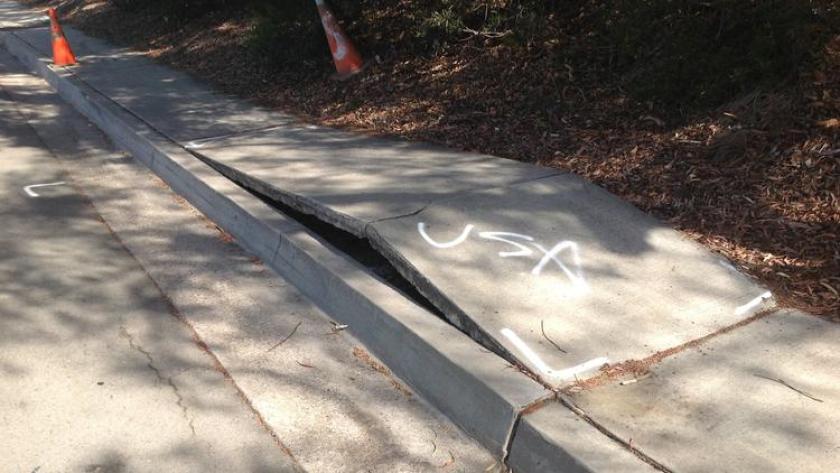
Brown was launched 28 feet on his bike which tore some of his spinal cord ligaments, knocked out several teeth and caused brain damage that left him incapable of functioning independently.
Not all injuries are as serious as Brown’s, and few, if any, settlements are as big as Brown’s – $4.85 million.
But even with smaller settlements, San Diego has been forced to cover more than $11 million in injury payouts for sidewalk lawsuits over the last five years.
To be accurate, “San Diego” didn’t pay more than $11 million – taxpayers did.
But who is responsible for sidewalks that look like this?

The answer: “It depends,” said one helpful lawyer.
Again, according to the Union-Tribune:
“While the city is responsible for sidewalk damage caused by vehicle crashes, water main breaks and trees within the right-of-way, state law makes property owners responsible for the normal wear and tear of sidewalks adjacent to their property.”
OK, so property owners are responsible, and…
“Upon notification of a broken sidewalk, the city will mail the abutting property owner a notice of liability.”
And you, as a good citizen, start looking into fixing that #*%!#*! sidewalk.
Then, from San Diego comes this surprise:

More than $2,000 in city permit fees before you fix your sidewalk:
“While permit fees vary by location, city officials said they typically amount to more than $2,000 per repair. That includes a traffic control permit, a right-of-way permit, a mapping fee, a maintenance fee, a records fees and an inspection.”
That’s right.
In San Diego you can’t just be a good citizen and hire a contractor to remove the broken sidewalk and replace it.
You must secure city permits as listed above.
 Let’s delve a bit into just what all that bureaucratic bullshit is for:
“Traffic control permit”: This is the San Diego city employee in a hard hat and orange safety vest who, during your sidewalk repairs, stands at the curb next to the sidewalk, waving traffic by while he plays AdventureQuest 3D on his phone.
“Right-of-way permit”: These are two city employees in hard hats and orange safety vests who will drive to the broken sidewalk location, look at it and say, “Yup, that sucker needs fixing.”
“Mapping fee”: This is the city employee back at City Hall who uses Google Maps to pinpoint the exact location of the broken sidewalk, needed by the two “right-of-way permit” guys (above) before they go look at the sidewalk, even though they have GPS in their city vehicles.
“Maintenance fee”: These are 16 city employees in hard hats and orange safety vests  who stand around watching your contractor and crew repair the sidewalk, all the while debating if the San Diego Padres will still suck this season.
“Records fees”: These are the five city employees in the Records Department playing AdventureQuest 3D on their phones with the “traffic control permit” guy, and will get around to recording your sidewalk repair…eventually.
“Inspection”: These are the eight city employees in hard hats and orange safety vests who stop by after the sidewalk work is completed and say, “Yup, that sucker is fixed.”
So the property owner is hit with permit fees plus the cost of the sidewalk repair, and what often happens is…

“…the average repair cost to the homeowner is over $3,000, which is simply too costly for many homeowners. As a result, very few residents pay to fix city sidewalks, and the backlog continues to grow, especially in low-income communities.”
And when you see all those fees San Diego tacks on to get your sidewalk fixed, you may very well think, “Nah. If somebody gets hurt, let ‘em sue the city.”
Here’s the interesting twist. Even though you, the property owner, are responsible for sidewalk repairs…
“According to the current policy and state law, the city remains liable for injuries that result from broken sidewalks.”
As mentioned above, San Diego taxpayers have been forced to cover more than $11 million in injury payouts for sidewalk lawsuits over the last five years.
But somehow, somewhere, a light bulb came on and someone said, “I’ll bet more people would fix their sidewalks if we got rid of those #*%!#*! permit fees!”

And – hallelujah – that’s exactly what San Diego recently announced:

There are some catches, of course:
“The city will temporarily waive more than $2,000 in permit fees that property owners have been paying to fix sidewalks. The fee waiver will take effect within 90 days and extend through the end of 2020, city officials said.”
But even with the time limit, I’m hopeful.
Perhaps in the upcoming months we’ll see a lot more of this:

And a lot less of this:

And this:

Update January 28, 2020:
Like cities across the country – like the entire country, in fact – San Diego has infrastructure problems.
And likewise, not enough money to fix the problems – as in, a $2 billion gap, according to this article:

The article says,
“To get a better handle on how dire the situation is, city officials for the first time divided the backlog of projects into two categories: priority needs and discretionary needs.
“Priority needs are projects required by state mandates or that affect community health and safety.”
I thought that seemed like a reasonable first step and, of course – the sidewalks situation is something that affects “community health and safety.”
But the article continues:
“Discretionary projects are still deemed necessary for the city to achieve appropriate service levels in its neighborhoods. But they are somewhat less urgent projects, such as sidewalks repairs, bike lanes and new library branches.”
San Diego, seriously?
As mentioned earlier, taxpayers have spent more than $11 million settling sidewalk injury lawsuits over the past five years.
But San Diego is putting sidewalk repairs in the same group as bike lanes – optional – and library branches, also optional?
No wonder this guy is smiling…









 white specks on its skin that create ‘the image of stars against red sky,’ writes WSU. The reality is perhaps a little less romantic; as Ellen Gutoskey of Mental Floss points out, the dots are lenticels, or ‘porous openings that allow the apple to exchange gases with its environment.’”



































































 and hospital care.
 “In 2012, Bishop Robert W. Finn of the Diocese of Kansas City-St. Joseph became the first Catholic prelate in the country to be convicted of protecting from prosecution a priest who had child pornography. A judge found Finn guilty of a misdemeanor for failing to tell police that one of his priests collected lewd images of young girls on his computer. Finn was sentenced to two years of probation.








 Unfortunately, it appears Champion-Cain was less than honest about the money she received from 50 investors.
 veterans, and their families



 Now a federal judge has sentenced Turk to a month in prison, followed by five months of house arrest.

 then known as squibs. His name was Phineas T. Barnum.”











 Scammers pretend to be a representative from a bank, a debt collector or cable company who needs to discuss “an important business matter” such as debt collection and billing information.


 check out some dating sites. He met a woman a half-world away, and they seemed to click. Their conversations transitioned from chats to extended skype exchanges.
 And she’d promised to pay the money back, all of it.
 you aware that your name and address is listed as the most likely location for her. At this point (name? unintelligible) still has the legal right to contact the Proceedings Office filing the case to update her information. However, once this case is filed, that will no longer be an option. The phone number to that legal department is gonna be 855-337-4536. When she calls, she’ll provide her case number 605233. This is considered legal notification by telephone and Christina will be located at your residence unless I am (unintelligible) otherwise.”
 with the order of location for Christina (unintelligible) at your residence. Understand that she still has the legal right to contact the office filing the case. I’ll provide that information to that office once again, just so there’s no way for you, or her, to say you had no prior knowledge of this matter. That phone number’s gonna be 855-337-4536. Her case number is 605233. This is considered a final legal notification by telephone, and Christina (unintelligible) will be located at your residence unless I am (unintelligible) otherwise.”


 Has a family member, friend or acquaintance ever shown up at your door, uninvited?
 holidays, and deciding to include us in the fun.
 have been prepared, and I could have spiffed myself up a bit instead of appearing to one and all in my bathrobe.
 my book club on Messenger, or offer a friend a digital “shoulder” to cry on.





 And the purging has been surging ever since – this from the Brennan Center article:
 zillion.
 times his margin of victory.









 frown lines, crow’s feet and forehead lines look better in adults.”












 Ann is the divorced mother of two pre-teens, and happily remarried to a divorced man, also with two children – a blended family. Their income is adequate for their family of six, and they tend to spend every penny they earn.
 If I did ask, and did hear that reason, I’d have had further questions:


 I Hate Houseguests