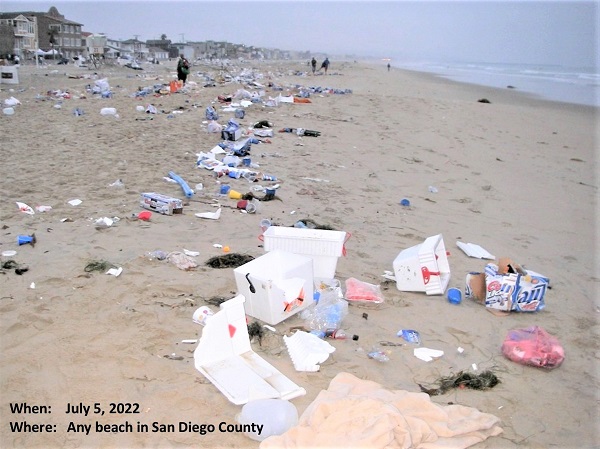
In San Diego We Love Our Beaches – So Why Do We Leave Them Looking Like This?

(A few weeks ago I did a post about raw sewage and trash from Tijuana contaminating San Diego beaches.  The mess in this post isn’t from a foreign source – it’s local.)

San Diego County has beautiful beaches, and in the summer they’re a prime destination for residents and visitors.

On July 4 that influx of people expands, enjoying the water and sand and sun all day…

And fireworks at night, including the Big Bay Boom:

And the next morning our beaches look like the picture at the top, and like this:

There’s even an official name for it:

The “Surfrider Foundation” in the above image is a nonprofit that:

“…is dedicated to the protection and enjoyment of the world’s ocean, waves and beaches, for all people, through a powerful activist network.”

For a number of years Surfrider has hosted the July 5 Morning After Mess Beach Cleanup Series:
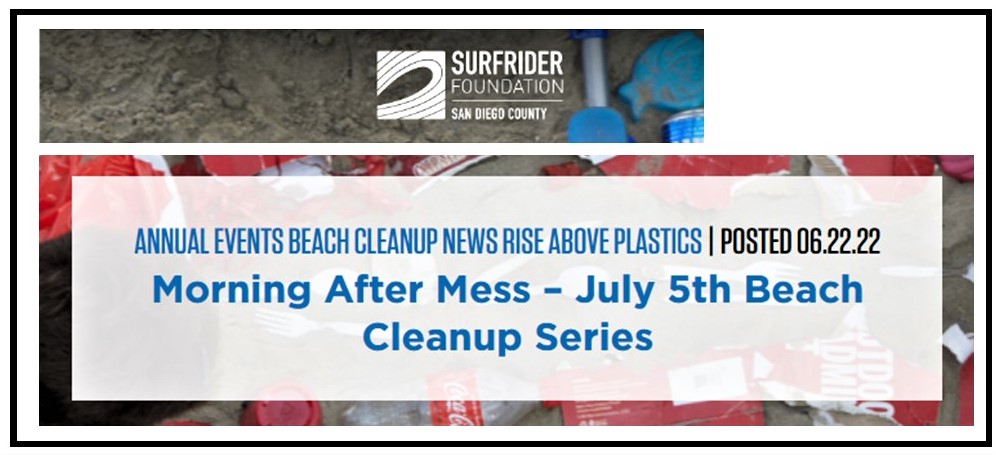
And every year – unfortunately – there’s always plenty of litter to clean up on San Diego’s beaches.  For July 5, 2022:

Volunteers – bless them – turn out every year to clean up what others leave behind.  This year 429 volunteers picked up the better part of a ton of trash from the seven beaches with the highest concentration of beachgoers and reputations for post-Fourth of July trash.

Who are those volunteers?

They’re all sorts of people of all ages, including families:

And they’re willing to spend their time and energy cleaning up after others, changing our beaches from dumping grounds back into attractions.

What were those volunteers finding?

Much of the litter is single-use plastic – bags, drink cups, straws, utensils, plates, containers – mixed with food packaging, abandoned toys and clothing, flyaway balloons, fireworks, grills, chairs, broken boogie boards, shoes, sunglasses, backpacks, metal scissors, action figure parts, and food waste, food waste and more food waste, like this:

And – to my surprise – this:

This surprised me since smoking isn’t allowed on most San Diego beaches.  Yet according to this headline:
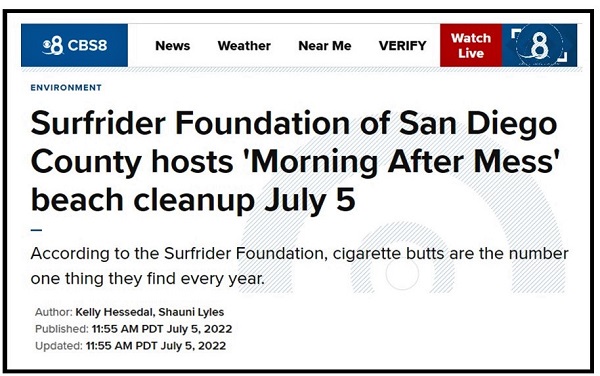
Cigarette butts are the number one thing the Surfrider volunteers find every year.

And lifeguards and law enforcement – understandably – are too busy to enforce the no-smoking law.

So some beachgoers abandon their trash, despite exhortations from the environmentally concerned, from the media and others to “pack out what you pack in” – in other words, bring garbage bags, pack up your trash and take it home.

Take some responsibility, for $@!%#$@* sake!

So, who’s leaving their trash behind…

And why?

It turns out that wiser heads than mine (of which there is a countless number) have been studying people who litter for many years.  And since I was curious about the who and the why, I did some online reading of articles like this:

From this and other articles I learned that while lots of people wouldn’t dream of going to a beach and leaving their trash lying on the sand – including me – at the same time, lots of people – including me – have gone to a movie theater and done this:

Me, a litterer?

Litter is litter, whatever its location.

The theory here is that “the decision to litter is based on the actions of other people – for both good and bad.  If an area is already highly littered, people are more likely to add more litter, while the cleaner an area already is, the less likely people are to disrupt the scene by littering.”

We go to the movies and know other people are going to leave behind their drink cups and popcorn containers and candy wrappers, so we do it, too.

Another theory has to do to with the location of trash cans:

“…the distance to a trash receptacle is a strong predictor of littering, so the farther away you are from a trash can or a recycling container, the more likely you are to litter.”

Now, San Diego beaches have many trash cans:

Plus, early on the morning of July 4, the Clean Beach Coalition puts many of these trash and recycling boxes in place:
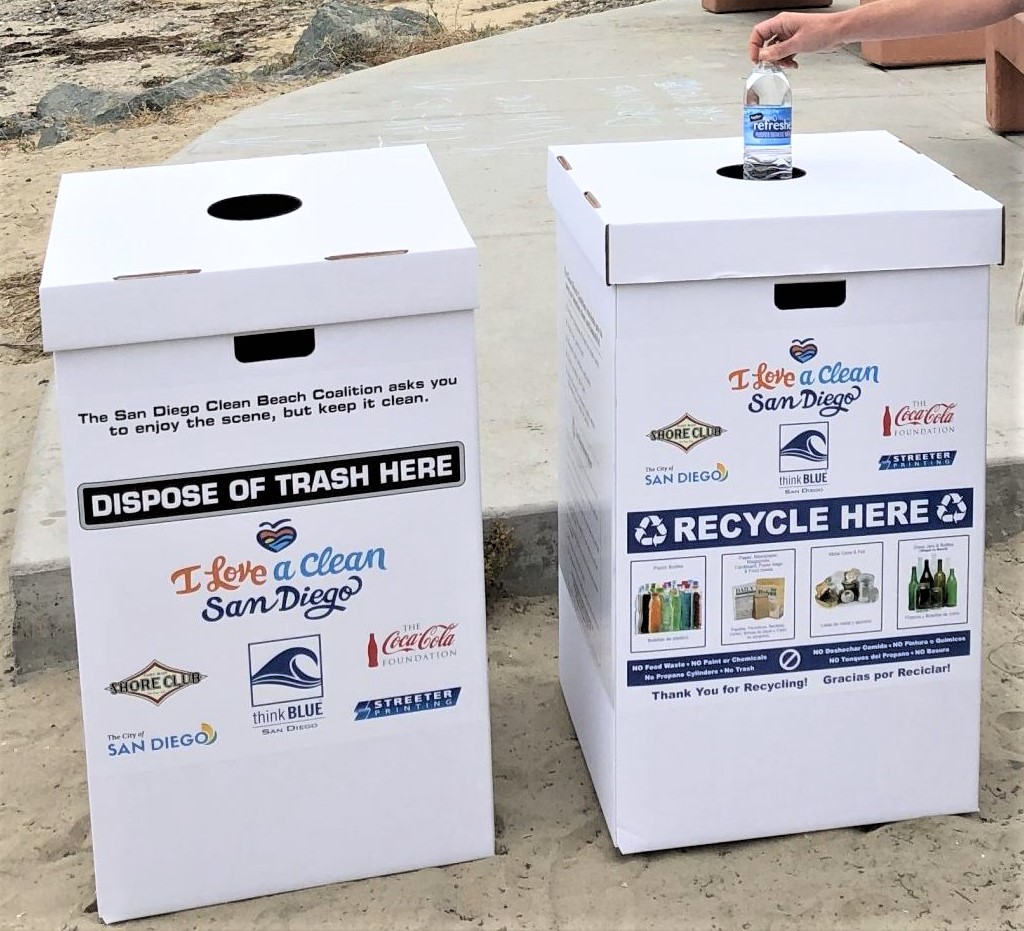
So proximity shouldn’t be a problem.

But as the day goes on, if those containers look like this:
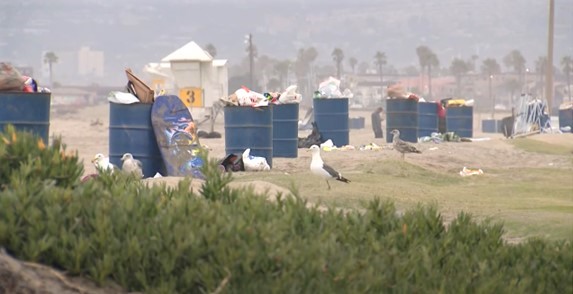
Some people decide it’s easier to leave their trash where it lays; the trash containers are all full, so why bother?

Another theory:

“People are more likely to litter when they feel no sense of ownership for parks, walkways, beaches, and other public spaces.” 

“It’s not my beach so it’s not my problem” – right?

Conversely, another theory is that “some people leave litter in the outdoors as a way of marking territory or claiming ownership – a kind of ‘litter as graffiti’ behavior.”

Then there’s the theory that some people feel a sense of entitlement:  “Someone will clean up after me.”

And who knows?  Maybe that goes all the way back to our earliest experiences of loading up our diapers, and someone else taking care of our mess.

So there are lots of theories, but here’s a fact:

Litter wasn’t always the gargantuan problem it is today.  Once upon a time, if you tossed an apple core out the car window…

Animals would eat it, or it would decompose, and no harm done.

But then came this:

And that was a relatively recent development:

“Production of plastics leaped during World War II, nearly quadrupling from 213 million pounds in 1939 to 818 million pounds in 1945.

“Come V-J Day, however, all that production potential had to go somewhere, and plastics exploded into consumer markets.” 

“Thanks to plastics, newly flush Americans had a never-ending smorgasbord of affordable goods to choose from.  The flow of new products and applications was so constant it was soon the norm.  Tupperware had surely always existed, alongside Formica counters, Naugahyde chairs, red acrylic taillights, Saran wrap, vinyl siding, squeeze bottles, push buttons, Barbie dolls, Lycra bras, Wiffle balls, sneakers, sippy cups, and countless more things.”

And consumers considered plastic disposable – it went out with the trash, along with that apple core and squeeze bottles and Wiffle balls and, and, and…

It took years to understand that…

“‘Unlike other materials, plastic doesn’t break down,’ said Alex Ferron, manager of the Surfrider San Diego chapter.  ‘Unlike paper and aluminum, where it’s breaking down and becoming inert, plastic breaks up.  So while you might not be able to see it, after some time it gets smaller and smaller, and all throughout the cycle of doing that, it’s getting eaten.  So it’s finding its way into our food chain, into fertilizers, it’s getting absorbed as rainwater.  It’s truly everywhere.’”

Even cigarette butts, said Ferron, contain “acetate plastic fiber.”

Of course we all know all of this.

And we do this anyway:
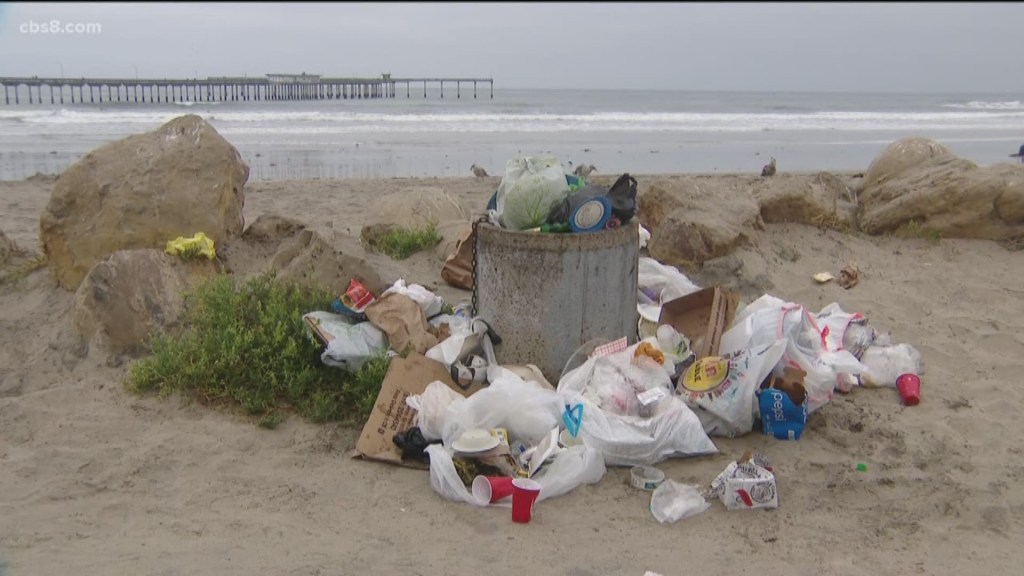
Still, there was a note of hope after the July 5 Surfrider’s Morning After Mess Cleanup:

Many of our volunteers remarked that the beaches seemed cleaner than in previous years, which is a great sign,’ said Ferron.”

Then she added, correctly:

“‘Despite that, we cannot lose sight of the fact that even one piece of trash on the beach is one piece too many.’”

Perhaps we’ll reach never reach that point of not “even one piece” of trash on our beaches.  And your beaches.  And our/your parks and sidewalks and streets and highways.

But perhaps someday – and soon, I hope – there won’t be enough trash left on San Diego beaches for Surfrider volunteers to make another one of these:

Dear Abby:  You Dogged It Big Time, This Time

I’m a faithful Dear Abby reader – I often think her advice is spot on, and now and then, it even applies to a situation I’m dealing with.

This time, however, I thought her advice was awful.  Egregiously awful.

And if the letter writer takes Abby’s advice, I believe the writer will regret it.

Here’s the letter:

Dear Abby:  My husband died recently.  I have been approached by a much younger man for a sexual relationship.  I want to, but I feel he is too young.  I’m 61, and he’s 37, the same age as my son.  We have been friends for years, and I am unsure if I should change the relationship.  I see no future in it except occasional sex.  Should I drop it or consider the possibilities?
– Thinking About It in Ohio

Here’s Abby’s response:

Dear Thinking:  Before dropping it, carefully consider the “possibilities.”  At 37, this person is not a kid, he’s an adult.  Something like this happened in my family years ago.  A close friend of a relative’s son announced he had fallen in love with her.  It took her a little while to adjust her thinking, but the result was a very happy marriage.

You dogged it, Abby.

Here are the most important words in the writer’s letter:

“for a sexual relationship.”

Abby, you somehow missed this, and instead went off the deep end about someone and so-and-so and yada yada they lived happily ever.

But the man wasn’t talking about happily ever after.

He wants a sexual relationship.

It might be for a night, a month, a year, multiple years.

But it’s a sexual relationship.

And instead of giving the guy credit for being honest, you encouraged the woman to have delusions of walking down the aisle and all that can precede it.

But…the man said “a sexual relationship,” and he meant exactly that.

Not cuddling and cozy conversation after sex.  Not waking up together in the morning.  Not sharing coffee and kisses before you start your separate days.

No romantic dinners in candle-lit restaurants where he says “I love your sense of humor,” admires her intelligence and enumerates the many things they have in common.

Not sending each other short, sweet “Thinking of you” texts with hearts and happy faces.  Not romantic getaways to a tropical beach and sunset walks. 

And definitely not this:

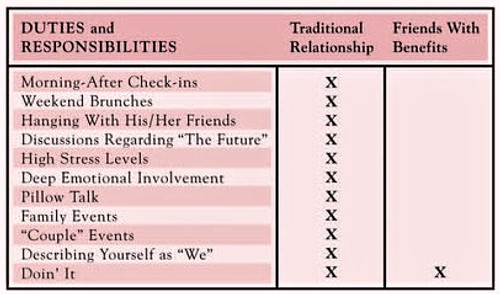
There’s a name for what the man wants, and even an acronym:  FWB.

And there are rules for FWB.

Lots of rules.

And lots of articles about the rules:

“So you’re great mates who just both happen to be single at the same time, why not add a bit of ‘no strings attached’ fun into your friendship?

“In order for a friends with benefits (FWB) relationship to blossom, experts and our readers agree that there needs to be a strict set of rules.  Here we discover the meaning of a friends with benefits relationship, how to find a pal and how to do it orgasmically well.”

A sampling of the rules:

No warm and fuzzies.  Before getting into FWB make sure you’re 100 percent fine with having sex without anything deeper.”

Stay safe.  You are not obligated to be exclusive in a FWB so it’s crucial to stay safe and STD-free.”

Keep in mind what this is.  You are not building an intimate relationship, but rather just having fun and enjoying one another physically.”

Abby, here’s the advice you should have given the woman:

Dear Thinking:  You’ve been invited to have an FWB relationship – friends with benefits.  Believe him when he says he wants a “sexual relationship.”  Don’t dress it up, put a ribbon on it and pretend it’s something else.  Don’t hope he’ll fall in love with you.  And don’t think he’ll change, or worse – that you will get him to change.  Go online and read about FWB and the rules entailed.  Then, if you truly believe you can live within those parameters – go for it.

I Could Go To Jail For Stealing A $10 Lipstick – These Folks Stole $8.4 Million Of Your Tax Dollars And Our Government Gave Them A…

Let’s say I walk into a department store in San Diego, where I live, and shoplift a $10 lipstick.

And I’m caught.

Here’s what can happen to me if I’m convicted:

For a misdemeanor act of shoplifting – which this is, because the value of what I stole is under $950 – the penalty may be six months in a county jail, a $1,000 fine, or both a fine and jail time.

That’s the law.

It doesn’t matter if I think the law is stupid.

It doesn’t matter if I tell the security guard who apprehended me that I’ll give the lipstick back.

It doesn’t matter if I tell the judge I’m really, REALLY sorry.

A fine, jail time, or both.

That’s the law.

Now instead of shoplifting a $10 lipstick…

Let’s say I steal more than $8 million taxpayer dollars in a COVID scam, like these people did, as recounted in this December 2020 article:

“The federal government has seized $8.4 million in pandemic-related loans obtained by a family running a fake ministry in Orlando who then tried to spend some of the money on a $3.71 million house in Disney World’s Golden Oak neighborhood, according to court records.”

The family was dad Evan Edwards; mom Mary Jane; daughter Joy, 36; and son Josh, 30:

The name of their fake ministry:  ASLAN International Ministry, which doesn’t appear to have a website, but was getting attention on the Ministry Watch website in December 2020.

Ministry Watch is an independent evangelical Christian organization whose purpose is to review Protestant ministries for financial accountability and transparency, and to provide independent advice to Protestants considering making donations to them:

“A so-called international ministry based in Florida who didn’t appear to do anything ministry-related allegedly obtained millions by defrauding the Paycheck Protection Program, federal authorities say.

“CNBC reports that U.S. Secret Service agents seized more than $7.5 million from accounts at Bank of America and another $868,000 from First American Trust from ASLAN International Ministry.  The information came from a civil forfeiture complaint filed in U.S District Court in Orlando, FL.”

So, this sounds like a story with a happy ending – not for the Edwards family, but for taxpayers.

The family had gotten $8.4 million in pandemic-related loans under false pretenses and now the government had taken it back.

How did the Edwards family get the $8.4 million?  According to the Orlando Sentinel article: 

“It began after Joshua Edwards, a vice president of ASLAN International Ministry, applied for $6.91 million for a federal Paycheck Protection Program loan, or PPP, according to a federal complaint signed Monday by Assistant U.S. Attorney Nicole Andrejko.”

Remember the Paycheck Protection Program? 

It became a law on April 24, 2020, and its purpose was to help businesses, self-employed workers, sole proprietors, nonprofit organizations, and tribal businesses continue paying their workers and survive the economic hardship caused by the coronavirus pandemic.

That was April 24, 2020, and I’m betting Josh Edward started filling out the fraudulent application same day. 

As this April 2022 article put it:

“The Paycheck Protection Program was supposed to be a lifeline to small businesses during some of the darkest months of the pandemic – $800 billion distributed from April 2020 to May 2021.  And as we now know, some $80 billion of those taxpayer dollars ended up in the wrong hands or misspent.”

Josh Edwards…

“…submitted documents that painted a picture of a successful Orlando-based ministry that employed 486 people on a monthly $2.76 million payroll and had revenue of more than $51 million in 2019.  He submitted IRS forms and a cover letter from an accountant that showed summaries of ASLAN’s bank accounts.”

The Edwards family waited, but not for long – in 2020, the government was in a hurry to get the money to people, and people were anxious to get it. 

The big day came:  First Home Bank notified Josh Edwards that ASLAN International was eligible to receive more money than he had asked for:  a total of $8.4 million.

Josh applied for $6.91 million and we taxpayers gave him almost $1.5 million more than requested.

But wait, you’re thinking.

This all happened back in 2020.  The story has a happy ending.  The government got our tax dollars back, and the Edwards are all rotting away in prison, right?

Wrong.

The Edwards fraud story was resurrected in this July 1, 2022 NBC article:

The article goes into great detail about the family’s fraud, up to September 17, 2020 when the Edwards family, in their Mercedes, was pulled over by three Florida Highway Patrol cars. 

Then we get to the point:

“…more than 18 months after the Florida traffic stop, authorities have yet to charge any member of the Edwards family with a crime.”

The NBC article says,

“The Edwards did not challenge the seizure of the $8 million in loans, all of which was recovered by the Justice Department.”

“The federal government has taken no action against the Edwards since then, according to a search of public court records.” 

Let’s go back to the April 2022 NPR article I cited above.  This was an interview with Justice Department Inspector General Michael Horowitz, chair of the Pandemic Response Accountability Committee, who said:

“We actually have now had over 1,200 indictments in total in our investigative work – about 900 arrests and almost 500 convictions.”

And those arrests and convictions make headlines, like this one from March 2022:

William Sadler (pictured) fraudulently got a measly $1.7 million in Paycheck Protection Program money.  He “pleaded guilty to federal fraud and money laundering charges,” and was facing “a maximum sentence of 82 years in federal prison.”

And the Edwards family…

Gets nothing?

No…

No…

No dressed in an orange jumpsuit, facing a judge in a courtroom…

No…

No.

Here’s the $8.4 million-dollar question:

Actually, I have two whys.

Why aren’t all four Edwards in prison?

And why did NBC reporters revive this story more than 18 months after it happened, when there is nothing new to report?

There is no new development making headlines anywhere else that I could find.  The few current stories I did see, like this one…

…were all just a rehash of the NBC July 1, 2022 story.

Why now?

I contacted the three NBC reporters and ask, but haven’t heard back from them.

Heaven forbid that an NBC news reporter should respond to an NBC news consumer.

I did find items of interest in a link in the NBC article that went to this 2021 article:

It sems the Edwards family had reappeared in Canada, both in person:

Evan Edwards and his daughter, Joy, pray for people at a drive-thru event in an undated video that has since been removed. 

And online – this is dated September 12, 2021:

The Roys Report article says:

“…previous contributors to ASLAN International have received an email purporting to be from ‘Edwards Family Ministries’ with little text besides the subject line:  ‘948 salvations so far!  It’s been a year of Harvest in 5781!  Happy New Head of the Year 5782 – PTL!’”

The email included links to the YouTube videos (above) depicting members of the Edwards family asking for money.  The videos were “quickly taken down,” according to NBC. 

The Roys Report goes on to say:

“Edwards Family Ministries’ address at the end of the email matches the one for Aslan International Association in Alberta, Canada.”

Here’s what that looks like:

“And while the Edwards aren’t listed anywhere for the Canadian organization, their Florida nonprofit uses the Canadian organization’s information as their own.”

Here’s where the Florida nonprofit link takes us:

And on this page is a link to an “Annual Report” dated 4/28/22:

The document is signed by “Joshua Evans.”

The Roys Report closed with this:

“News 6 in Orlando reported last year that the family was being investigated by the Edmonton (Alberta) Police Service in addition to the U.S. Secret Service.”

It appears the Edwards family – in 2020 – was being investigated by Canadian police as well as by the U.S. government.

But when NBC contacted U.S. authorities for its July 1, 2022 article, all they got was this:

“A spokesperson for the U.S. Attorney’s Office for the Middle District of Florida emailed NBC News that the office declined to comment.

“Roy Dotson, the national pandemic fraud recovery coordinator for the U.S. Secret Service, which led the investigation, said, ‘Due to the fact that this is an ongoing investigation, the Secret Service cannot provide any additional information related to this case at this time.’” 

In summary:  From September 2020 when the Edwards family was pulled over in Florida – in their Mercedes – to now is 21 months.

The Edwards family’s Aslan International Association in Alberta, Canada is still in operation, now blessing – and bilking – unsuspecting Canadians.

They’re still filing annual reports as Aslan International Ministry, Inc.

Law enforcement in the U.S., and possibly in Canada, are still investigating.

No one is still being arrested.

Evan Edwards’ book is still available on Amazon:

And we’re all still wondering…

I Knew This Was Happening But I Never Knew Its Name

I drink a lot of Gatorade so it’s always on the grocery list.

Recently my husband returned from the supermarket with another supply, and he mentioned that these bottles were different from the bottle in the fridge.

They were:

In the fridge: bottle on the left, 32 ounces; new: bottle on the right, 28 ounces.

Different packaging but similar in size.

Less content.

Higher price.

It wasn’t the first time I’d noticed I was getting less of a food item in the same or similar-size container.

Years ago, coffee came in a one-pound can (below, left), but today that almost-the-same-size can hold 11.5 ounces of coffee, plus air:

And canned tuna – that used to be six ounces, then it shrank to five, and now it’s 4.5 ounces “NET WT” or “Net Weight,” and four ounces “DR. WT” or “Drained Weight”:

The can size has not changed appreciably.

So I’d know about this for years – the practice of food companies keeping the container size the same or similar, reducing the contents, and charging us the same, and often more.

The food companies believing that we consumers were/are too stupid to notice.

I’ve known, and so have you, but I hadn’t known the name for this.

Until I read this article:

It’s called “Shrinkflation.”

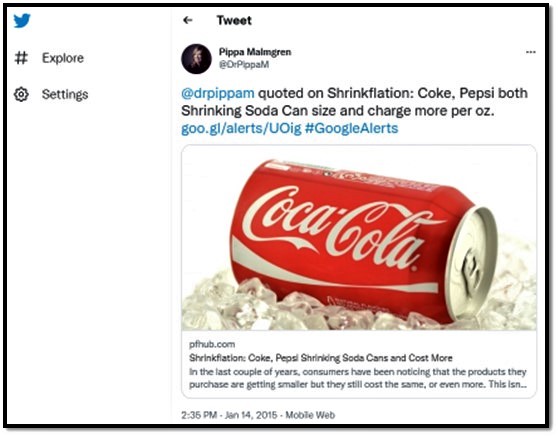
“Shrinkflation” was coined back in 2015 by British economist Pippa Malmgren in this tweet:

This article…

…defined shrinkflation as:

“…the practice by which companies reduce the size or quantity of a product while the price of the product remains the same or slightly increased.

“In some cases, the term may indicate lowering the quality of a product or its ingredients while the price remains the same.”

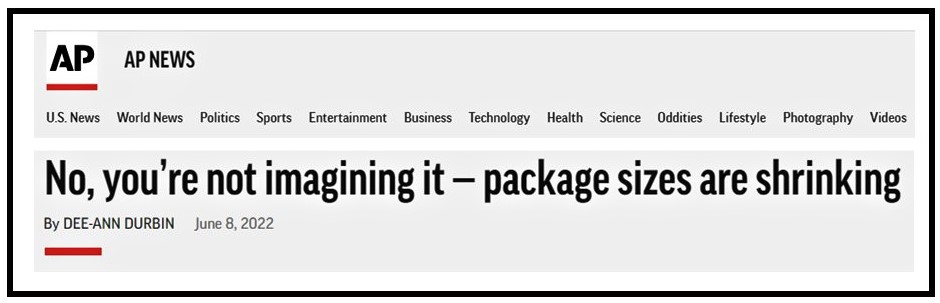
While the Associated Press article called it…

“…the inflation you’re not supposed to see.”

Shrinkflation isn’t out there in plain sight, like gasoline prices – nobody can miss those, especially here in California. Here’s what I’m paying in San Diego County:

And how about Mono County, CA:

No, shrinkflation doesn’t look like that.

Instead, shrinkflation looks like this.  The quotes and images are from Reddit:

The Associated Press article listed a number of other examples including “…Cottonelle Ultra Clean Care toilet paper, which has shrunk from 340 sheets per roll to 312…”

…and goes on to say:

“…shrinkflation appeals to manufacturers because they know customers will notice price increases but won’t keep track of net weights or small details, like the number of sheets on a roll of toilet paper.”

“Companies can also employ tricks to draw attention away from downsizing, like marking smaller packages with bright new labels that draw shoppers’ eyes.”

Like I said – these companies think we’re stupid.

Here’s something else these companies have in common:

“No comment”:

When PepsiCo was asked why the 28-ounce Gatorade was more expensive than the 32-ounce, “it didn’t respond.”

“Kimberly-Clark – which makes both Cottonelle and Kleenex – didn’t respond to requests for comment on the reduced package sizes.”

“Proctor and Gamble didn’t respond…”

“Hain Celestial Group didn’t respond…”

And what’s our response to shrinkflation, besides anger?

The internet abounds with articles like this one:

That offer suggestions like these:

  • Compare the unit price of similar products to see which is the best price.  The price per unit is usually really tiny on the item or the shelf price tag.  
  • Substitute store brands for brand names.  Store brands are usually the last to shrink.
  • Stock up if you can find the older, larger sizes.
  • Use store apps and loyalty programs for discounts.

These are all valid ideas, but consider the practical application.

Many people grocery shop on their way home from work.  They’re tired, they’re hungry, and all they want is to get their stuff, get the hell out of the store and go home…

Standing in a crowded supermarket aisle, comparing unit prices that are 2.3¢ on one brand and 3.2¢ on another brand…moneysaving, but not real practical.

We consumers are not stupid, but we’re often rushed, distracted, and exhausted.

From personal experience, I can verify that clipping coupons (or downloading them), while time-consuming, is worthwhile.  My husband always has coupons in hand for trips to the supermarket, and he always saves us money.  It might be $3 or $10 or $28, and we gladly take it.

And if companies are making more profits off us from shrinkflation – well, we’re a capitalist country and that’s how we roll.

I’m not being cavalier about it – just realistic.

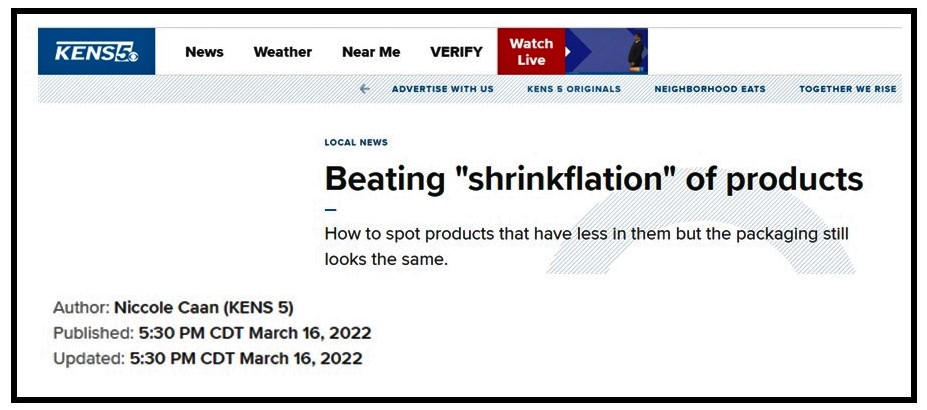
As a guy in the above KENS5 TV story put it:

“‘I’m asked very often, is this an illegal practice?’ said Edgar Dworsky of ConsumerWorld.org.  ‘It isn’t.  They comply with the law.  They put the net count or the net weight right on the package.’” 

So, shrinkflation isn’t illegal.

I guess all we can do is do what we can do to deal with shrinkflation.

Well, perhaps there is one more thing:

Go on social media and gripe about it.  Post pictures and comments like the Reddit examples above.  It may not change anything, but you might feel better for it.

I just did, with this post.

And I do feel better for it!

I Know Our Country Is Divided, But There ARE Things We Have In Common – And That’s…

It’s no news that our country is extremely divided.  We often hear, read and see evidence of that, like this June 25, 2022 article:

So on this Independence Day holiday, let’s take a break from all that.

Let’s take a journey across the U.S. to celebrate that for all our divisiveness, our 50 states still have a lot in common.

Like…officials.

I’m not referring to officials, as in politicians. 

I’m referring to something useful.  Interesting.  Straightforward.

Like…

This guy:

Meet the big-eared bat, the official state bat of Virginia – so designated in 2005.

Virginia, and all states, have a list of “officials” – the expected ones like official state flags and state seals and state mottos.  Such as:

And all states have unexpected officials, as I’ve now discovered.

Like Nebraska – it has an official state drink:

Officially designated in 1998, Kool-Aid was developed in 1927 by Edwin Perkins and his wife Kitty of Hastings, NE.  The original Kool-Aid had six flavors, but today you can slurp up dozens, including sugar-free.

And Alabama?  Check out their official state crustacean:

This became official in 2015, and it’s OK if you call brown shrimp by its other names:  brownies, green lake shrimp, redtail shrimp, golden shrimp, native shrimp, and summer shrimp.

And how about Idaho?  No surprise here:  an official state vegetable:

And a museum to go with it.  The potato became the official State Vegetable in 2002, and the museum pre-dates that – it opened in 1988, and is in Blackfoot, ID.

Now, you may have noticed I’ve used the word official a number of times.  But how does something become an official something?

State legislatures and the governor declare them so.

And it’s not just a bunch of politicians standing around one morning before the session starts, saying, “Hey – we don’t have a state pickle!  Let’s get one!”

There’s a process involved.

Sometimes the process is started by residents who could benefit from having their item designated official.  You don’t think the idea for a state vegetable in Idaho just came out of nowhere, right? 

Or, the request might come from schoolkids, perhaps as a class project to show how government works – all those committees and subcommittees and meetings and…

Or how the government doesn’t work.

Or maybe that official idea comes from you, because you think your state has a lack and you aim to fill it.  If Alabama has an official state crustacean, shouldn’t New Mexico, too?

Whoever the citizens are and whatever their motives, they must contact their state representatives to make a request for a bill.  If the representative has the time and inclination and agrees, they’ll draft a bill and introduce it.

The bill winds through the state’s legislative process and if both houses approve the bill, it’s sent to the governor for signing – and she/he can veto all or part of the request.  (“An official state pickle?  Seriously?”)

If the governor eventually signs, then the bill is enacted, and that entity is proclaimed a new state symbol.

You may be wondering – as I am – don’t state politicians have better things to do than debating their state’s official dance? 

They do, but they’d rather discuss the Square Dance vs. the Funky Chicken.

And considering our current state of politics…perhaps that’s best.

Back to what our 50 states have in common.

According to the July/August 2022 issue of Food Network magazine, people in all 50 states have a “food specialty”:

The article didn’t specify Bowl of Red What, and considering that it’s Texas, perhaps that, too, is best.

Here’s the list from the magazine of all state food specialties, in case you were wondering about your state:

Another commonality among our 50 states?

All states have weird landmarks, according to this article:

In Virginia, for example, we’ll find Foamhenge:

This landmark is a life-size, styrofoam replica of England’s Stonehenge with 14-foot-tall foam-stone pillars, built in 2004.

And, according to this article:

Every state has an obscure fact. 

Such as:  In 1986, Delaware became the home of the annual World Championship Punkin Chunkin Competition, the sport of hurling or “chucking” a pumpkin by mechanical means for distance.  The devices used include slingshots, catapults, centrifugals, trebuchets and pneumatic (air) cannons.

Alas, in 2016 injuries and lawsuits resulted in a suspension of the competition, so if you’re looking for a nice, gently used trebuchet like this one:

Just head on over to Delaware.

No what-do-our-states-have-in-common list would be comprehensive without mentioning that all 50 states have some weird laws – at the state, county and city level.  This recent article was helpful:

From this and other articles, I’ll pick three states – how about Connecticut, West Virginia and California?

Connecticut:

A pickle must be able to bounce.  Well, that’s at least one of the tests used to determine whether or not a pickle is legally fit for human consumption.  Pickles dropped one foot should bounce, according to the Connecticut Food & Drug Commission.

West Virginia:

If you see roadkill in West Virginia, it’s completely legal to take it home and cook it for supper.  The state law says that wildlife “killed or mortally wounded as a result of being accidentally or inadvertently struck by a motor vehicle” is fair game (get it?).  If you’re in need of recipes, Jeff Eberbaugh’s Gourmet Style Road Kill Cooking (pictured) was a runaway success in West Virginia when it was published in 1991.

California:

Because my home, California, is the state with the highest population, and perhaps the greatest amount of weirdness, I figured it deserved recognition for three laws, not just one:

  1. It’s illegal to walk a camel down Palm Canyon Drive in Palm Springs between the hours of 4pm and 6pm.
  2. In Los Angeles, you’re not allowed to wash your neighbor’s car without their permission.
  3. In Arcadia, peacocks have the right of way in all driveways and roadways:

Our journey is coming to an end, and I’m getting hungry after all this research.

So to complete our list, how about…

A Best Sandwich!

And the July/August 2022 issue of Reader’s Digest just happened to provide, as the magazine put it, “the 50 greatest ways to fill two slices of bread (or just one, or a bun, or a biscuit…).”

I’d barely turned to the first page and I was already salivating: 

All 50 sandwiches looked/sounded so good, I came darn close to gnawing on the magazine.

And as far as that official pickle, even with all my research, I found no state with this…yet.  

But eating pickles is something else our states have in common – Americans consume about 20 billion pickles every year.  We celebrate National Pickle Day on November 14; a number of states have Pickle Festivals; and no Pickle Festival would be complete without a… Pickle Queen!

1952, Mount Olive, NC.

This has been a fun journey, discovering that our 50 states have so much in common.

And all this called to mind the lyrics of a song from the musical Gypsy:

We have so much in common
It’s a phenomenon.
We could pool our resources
By joining forces from now on.

“…joining forces from now on.”

Now, wouldn’t that be…

To Update The Old Saying, In This Case…

(If you read this and start thinking, “This only affects San Diego,” think again.  This involves your federal tax dollars.)

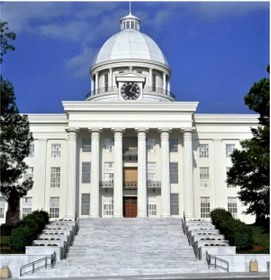
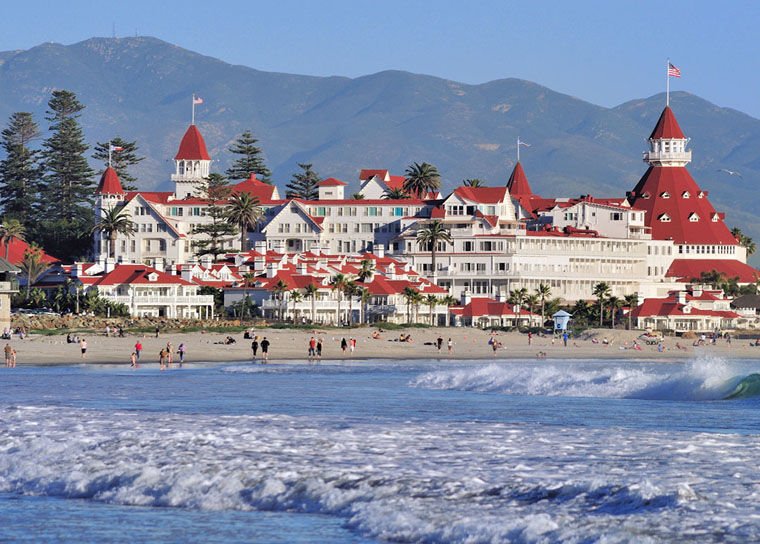
If you haven’t been to San Diego, chances are you’re still familiar with this local icon, the Hotel Del Coronado:

Located right on the beach, Hotel Del opened in 1888 and has been the setting for many movies including the wildly popular 1959 Some Like It Hot, starring (below, left to right) Tony Curtis, Jack Lemon and Marilyn Monroe:

Hotel Del is a popular place for visitors both for the hotel and the beautiful beach.  You are cordially invited to visit Hotel Del.

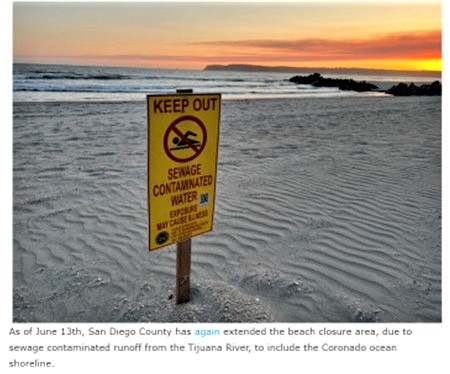
But alas, lately – not it’s beach:

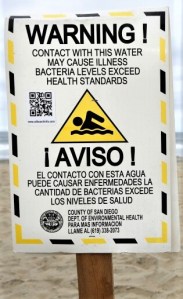
Here’s why:

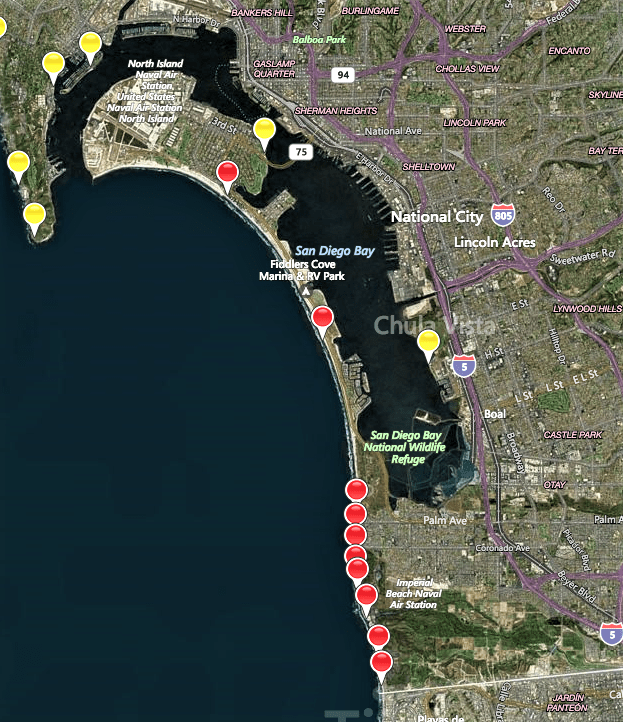
In fact, beaches from Coronado south to the Mexican border were closed due to sewage contamination– see the red dots:

And unfortunately, this is not a one-time-only event.

It’s routine.

2021:

2020:

2019:

2018:

I could go back further, but you get the idea.

Raw sewage from Tijuana moves north through the Tijuana River Valley across the U.S./Mexico border and empties into the Pacific Ocean. Currents carry the sewage north, closing beaches along the way:

This is a big problem, and not just for the San Diego area:

This is a local problem:  San Diego is a top U.S. travel destination, and visitors spend more than $11 billion here annually.  Our beaches are big part of the attraction…

…but if visitors can’t enjoy the ocean, they’ll spend their money elsewhere.  This impacts every local business, from restaurants and hotels to gas stations and surfboard rentals – both the owners and the employees.

This is a health problem:  For people and the environment:  In a 2020 60 Minutes story, an interviewee cited for Leslie Stahl some of the contaminants in Tijuana sewage: 

“…fecal coliforms, drug-resistant bacteria, benzene, cadmium, mercury, hexavalent chromium medical waste, and DDT, which has been banned for years in the United States.”

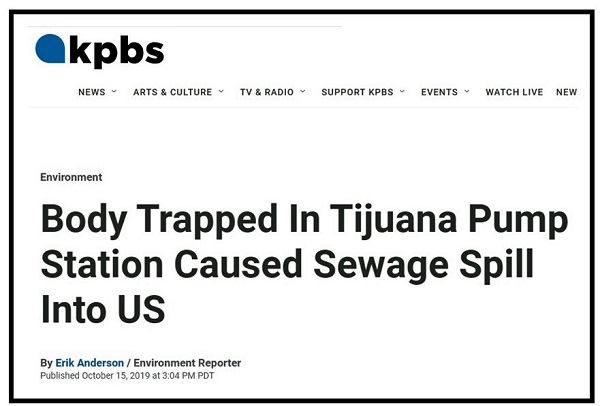
This toxic cocktail is combined with assorted trash including plastic and tires, dead animals and sometimes a dead human:

All this is pouring into the Pacific Ocean.  But it’s not just swimmers and surfers and birds and other wildlife who can be harmed. 

Let’s say you live in Ohio, and you’re treating yourself to a dinner at a nice restaurant.  You order the grilled tuna, flown in fresh this morning from the West Coast:

This is also a national problem:  Millions of your federal tax dollars have been spent trying to fix the Tijuana sewage problem, much of it coming from the Environmental Protection Agency.

It’s not fixed, and this is still happening:

What, exactly is the cause of this problem?

What I learned from my research is that there’s no “exactly,” because it’s a combination of factors: 

Too many people in Tijuana overloading an inadequate sewage system. 

Promises made, like this one from 2018:

And promises broken.

As for the money spent – there’s been a lot of that, but obviously to little effect.

Like this state funding in 2017:

And upcoming federal tax dollars:

Here are just a few more examples of federal tax dollars spent on the Tijuana sewage problem:

1995:  $157 million from IBWC (International Boundary and Water Commission)
1997:  $239 million from EPA
1998:  $42 million from EPA
2011:  $93 million from EPA

The money keeps flowing.

And so does the sewage and the contamination.

In mid-June, just as the tourist season had gotten underway, that contamination closed beaches from Coronado, location of Hotel Del, south to the Silver Strand and down to Imperial Beach:

And it looks like the problem is worse than anyone realized, according to this “new testing”:

“Beach closures that were once thought of as largely a wintertime occurrence now appear poised to become a year-round phenomena in San Diego’s South Bay.”

“It’s because the ocean is more polluted than previously thought.  A spate of recently shuttered shorelines followed a May 5 rollout of a new DNA-based water-quality testing system nearly a decade in the making.”

So, better testing = more beach closures.

The article continues:

“For years, environmental regulators thought sewage pouring over the border from Mexico was largely the result of heavy winter rains that flushed polluted runoff and wastewater through the Tijuana River channel into the estuary in Imperial Beach.”

“However, recent studies out of UCSD’s Scripps Institution of Oceanography and Stanford University have identified a defunct wastewater facility in Tijuana as a major source of the pollution.  San Antonio de los Buenos sewage treatment plant at Punta Bandera is estimated to be dumping as much as 35 million gallons of raw sewage a day into the Pacific Ocean.”

Here’s another map, this one indicating the San Antonio de los Buenos sewage treatment plant:

Let’s stop and think about this:

“As much as 35 million gallons of raw sewage a day into the Pacific Ocean.”

How much raw sewage is that, per day?

Picture an Olympic-size swimming pool:

The pool is 164 feet long, 82 feet wide, and 6 feet deep. 

It holds about 660,000 gallons.

Now think about 53 Olympic-size pools full of shit and trash and the occasional dead body being poured into the Pacific Ocean…

Every day.

Sickening, isn’t it?

And it makes people sick – again, from the June 14, 2022 Union-Tribune:

“The [beach] closures are necessary to protect beachgoers from dangerously high levels of bacteria and viruses, according to county public health officials.  Swimmers who ignore the restrictions could be at risk of diarrhea, fever, respiratory disease, meningitis and even paralysis.”

Going back to the map, above –

“When ocean currents move northward, referred to as a ‘south swell,’ they can carry plumes of feces and other pollution as far north as Coronado.  Such conditions are prevalent in the spring and summer, according to health officials.”

So why doesn’t Mexico get their shit – literally – together and fix the problem?

Because they don’t have to.

Sewage from Tijuana is flowing out of the city so their problem is solved.  If their system causes problems in another country – the U.S. – that’s not Mexico’s problem.

And what’s the U.S. going to do? 

Declare war on Mexico? 

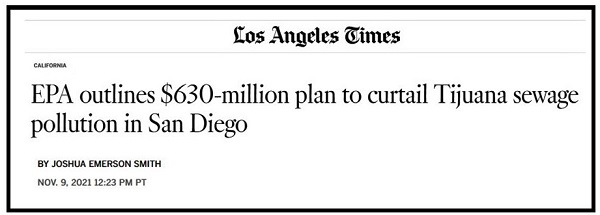
So:  Will this $630 million from the EPA fix the problem?

If so, it won’t be anytime soon:

I’d say “moves forward” is way overstating the progress, when all the EPA is doing at this point is asking for public comments.

As though the public hasn’t been commenting about Tijuana sewage problems since the 1930s, according to this article:

“Water pollution has been an ongoing concern on this side of the border since at least 1934 [almost 90 years ago], when the International Boundary Commission was instructed by the U.S. and Mexico governments to cooperate in sewage mitigation.”

The public comment period is “now open and will end on August 1, 2022” according to the EPA website:

And then, says the June 17 KPBS article:

“Once public input has been incorporated, officials will select an option with an eye toward starting the design process in the fall.”

Here are the three options the EPA is considering, with my public comments:

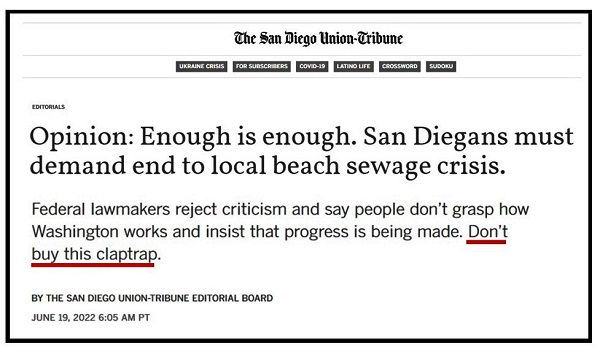
In addition, I’ll offer some great comments from the June 19 San Diego Union-Tribune:

I love the word claptrap:  “absurd or nonsensical talk or ideas.”

“Bummer Summer” indeed.

Now, that’s an idea I can get behind.

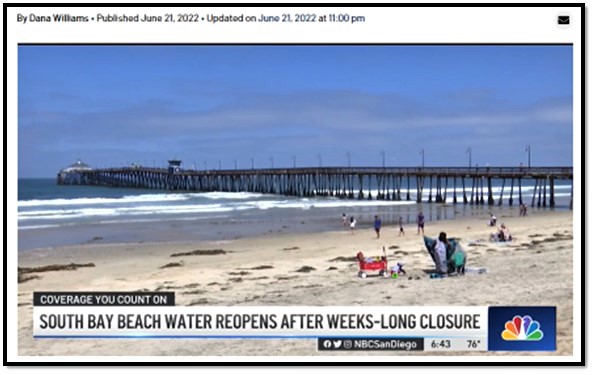
Update:  The beaches from Coronado south to Imperial Beach finally reopened on June 21:

That’s the good news.

The bad news?

Officials “hope” this EPA $630 million plan “can be completed by 2030.”

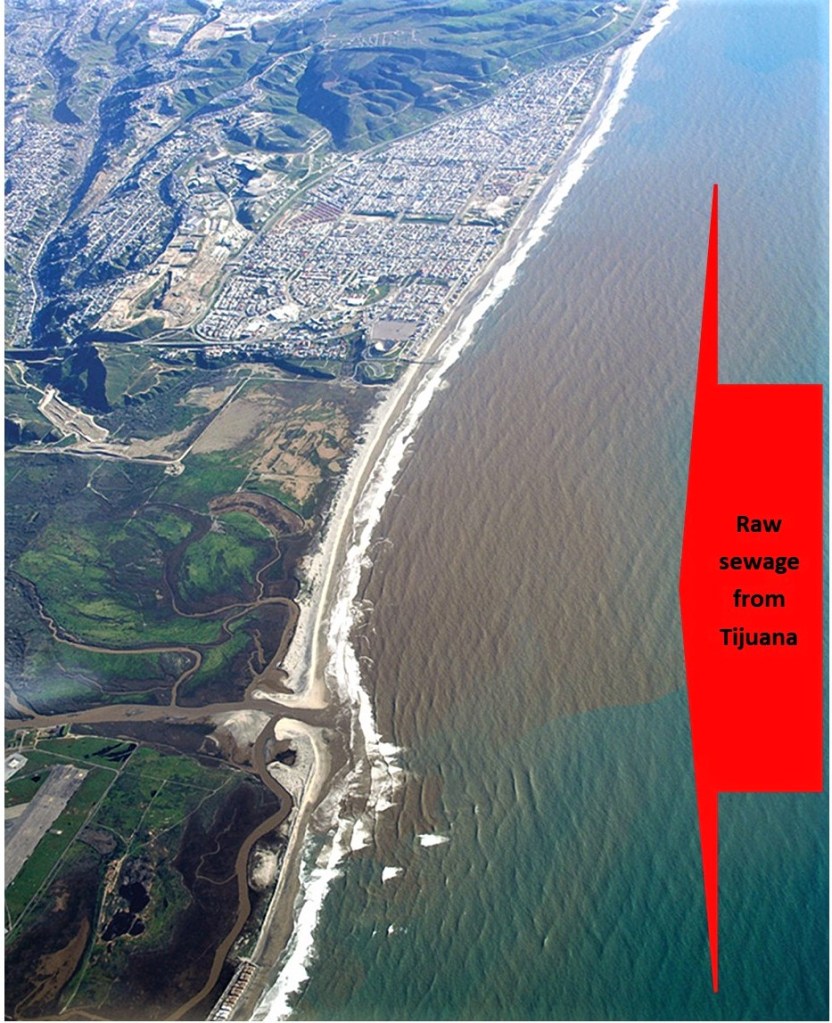
Until then, this will keep happening:

A plume of sewage empties into the Pacific Ocean and flows north from the city of Tijuana, upper left.

And so will this:

Update: Well, the beaches were reopened.

Until this, from the June 30 San Diego Union-Tribune:

I’m Concerned This Might Put Political Satirists…

The phrase “political satire” has been around for a long time.

What is political satire?  Here’s a good description:

“Political satire is a humorous, ironic, or sarcastic examination of the political arena in an attempt to expose absurdity and hypocrisy.  A combination of humor and political analysis, political satire can skew more toward bringing laughs or toward activism, depending on the content and the intent of the satirist.

“There are many different forms of political satire, including prose, editorial cartoons, and fake news.  A controversial issue, satire with a political bent may be viewed as anything from mere folly to unpatriotic or even rebellious behavior in some parts of the world.”

And as for my saying political satire has been around for a long time, some sources point back to the days of Aristophanes (c. 466 BC- c. 386 BC) in ancient Athens:

Aristophanes is also known as the “Father of Comedy,” as the inscription on the above image’s pedestal clearly states.

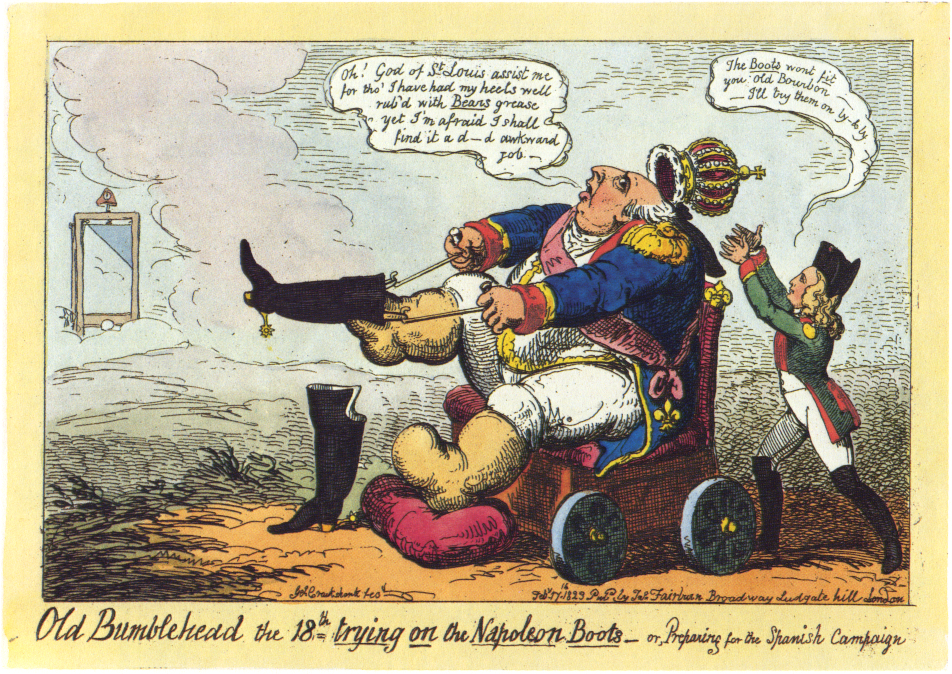
Since then, wherever politicians have existed, people have been satirizing them.  First with prose, then cartoons were added, like this example from 19th-century France, poking fun at King Louis XVIII, nicknamed here as “Old Bumblehead”:

These days we can also watch political satire, like Saturday Night Live’s “Weekend Update”:

While closer to (my) home, San Diego Union-Tribune political cartoonist Steve Breen hits them out of the park on a regular basis:

But now, I’m concerned that our current political satirists could be put out of work.

Because these days, I’m seeing politicians actively satirizing themselves

And doing it so well…

That our political satirists may have to consider a different career direction.

Take this recent headline:

Representative Mary Miller, R-IL…

…was at a Trump rally and, referring to the Roe vs. Wade decision said,

“President Trump, on behalf of all the MAGA patriots in America, I want to thank you for the historic victory for white life in the Supreme Court yesterday.”

Don’t hold back, Mary.  Tell us how you really feel.

No political satirist could have would have imagined this.

Next recent example:

Rhode Island Democratic state senate candidate Jennifer Rourke…

…was at an abortion rights rally at the State House in Providence “when my Republican opponent Jeann Lugo punched me multiple times in the face.”

Don’t hold back, Jeann.  Show us how you really feel.

No political satirist would dare to even hint at such a thing.

And why would they, when the politicians are doing the satirizing of themselves – for themselves?

But here’s the best of the recent self-satirizing stories, and no surprise, it’s…

The short clip was shared by filmmaker Alex Holder, whose documentary Unprecedented

…a three-part film about the final months of the Trump presidency, is slated to be released this summer and has been bought by Discovery Plus.

In the “bizarre clip” – filmed at “The White House, December 5, 2020” – Trump enters the set, seats himself, and looks up, fixated on the image of himself on a monitor.

At :13 seconds into the video Trump – known for his modesty – exclaims, “Beautiful!”

Trump remains mostly fixated on the monitor, and here’s what follows:

:19 I don’t think you want to have the water in the picture, right?

:21 You can take it (gestures).
:24 Yeah, put it over there, Nick.
:29 Yeah, might as well take the table (referring to the table that had held the water glass; someone briefly on camera removes both).

:32 Good, very good, thank you.

(And then, one second later:)

:33 You know what you can do, Nick?  Put the table back cause it’s missing something.  Put the table back and put the water on the table without the thing on top of it.

(Table returned, napkin returned, water glass returned “without the thing on top of it.”)

:50 OK… (Trump adjusting table and water glass) How does that look?  (Lifts glass off napkin).
:58 Go ahead, take it out (Trump pushes away napkin).

1:01 Yeah.  All right. (Trump makes more adjustments to water glass position.)

1:05 Right?  Let’s go.

At 1:11 the video clip ends.

No wonder Holder’s documentary has three parts – it took most of Part 1 to get rid of the water glass, and table, then return the water glass, and table, and…etc.

NO political satirist could EVER have made up Trump’s behavior in this video.

Because no political satirist – no sane person, period – could be so obsessive, so narcissistic, and so stupid.

So Trump, Trump Jr, Ivanka and Eric all agreed to participate in a lengthy documentary about themselves – no surprise there.

But apparently this came as a surprise:

“The Jan. 6 committee has subpoenaed documentary filmmaker Alex Holder in regard to footage and interviews Holder and his team shot while following former President Donald Trump and his inner circle throughout the 2020 presidential campaign.

“Holder’s company, AJH Films, confirmed to Rolling Stone on Tuesday that he has been subpoenaed, will sit for an interview with the panel on Thursday, and has ‘fully complied with all of the committee’s requests.’”

And I think that is…

Important Conversation Starter – Or Cheap Publicity Stunt?  What Do You Think?

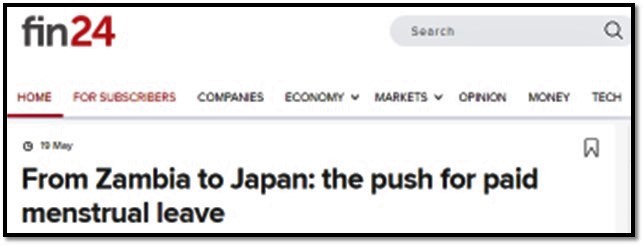
Back in May I did a post where I started out by talking about Spain’s government considering a bill allowing women to take days off work if they are diagnosed by a doctor with severe menstrual pain, with the government footing the bill.

If this happens, Spain would be the first Western European country to support what’s called “menstrual leave.”  But Spain wouldn’t be the first country – a half-dozen other countries have menstrual leave.

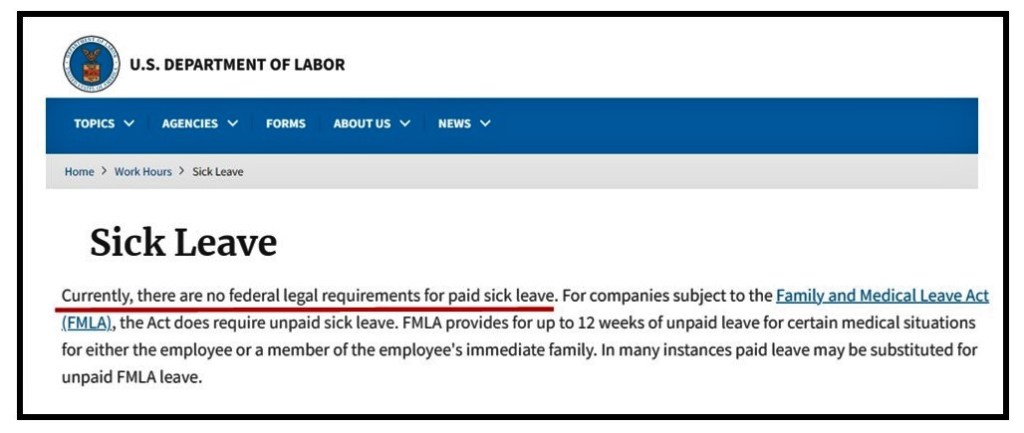
None of which, of course, is the U.S.

There are pros and cons around menstrual leave, but as I was researching and writing that post, my attitude was in favor of anything that destigmatized menstruation.

Destigmatize:  To remove associations of shame or disgrace from.

In favor anything that would lessen, and someday eliminate, period shaming.

Period shaming:  A consequence of the social construction of menstruation as an undesirable bodily event 

Shaming by men, shaming by other women, shaming by ourselves.

Anything, I thought.

And I meant it

Until I saw this:

And this:

It’s a breakfast cereal.

The cereal creator is INTIMINA:

And INTIMINA’s website says the company is:

“…a Swedish brand that offers the first and only range of products dedicated exclusively to all aspects of women’s intimate health.  Our mission is to provide a comprehensive collection of products and information for women at every stage of life, from the first menstruation to beyond menopause.”

Here’s their Period Crunch announcement:

So, “INTIMINA Brings Period On The Kitchen Table…”

But INTIMINA does not bring Period Crunch to the kitchen table.

As I learned from reading various articles including this Australian publication:

Period Crunch is not available to buy at your grocery store.

Or online.

Or on the black market.

Or anywhere.

You can, however, send an email “to register your interest in receiving a box of Period Crunch.”

Which I did – more to come on that.

Period Crunch – as I learned from assorted websites – is wheat-based, and “colored with freeze-dried raspberry powder which gives it a fruity flavor.”

And dyes the milk “a distinctive red.”

The box includes conversation starters, and a diagram of the female reproductive system for people to identify where the uterus is located because, says the INTIMINA announcement:

“This follows research from INTIMINA that reveals 82% of people cannot correctly identify where the uterus is.”

I find that 82% hard to believe, unless the only people surveyed were men.

Anyone with a uterus who’s experienced menstrual pain – sometime excruciating, debilitating pain – knows exactly where in the body that pain is coming from…

Month after month, year in and year out.

And to emphasize INTIMINA’s point – in case you haven’t picked up on this:

“Every piece of the statement-making cereal resembles a uterus and has been released by INTIMINA as part of our campaign to encourage more dialogue about menstrual health.”

Here’s a close-up of pieces of Period Crunch side-by-side with an illustration of a human uterus:

It appears that the Period Crunch cereal pieces include some other organs besides the uterus, but I won’t quibble.

What there are no images of – from INTIMINA or elsewhere – is the cereal in a bowl with milk dyed “a distinctive red.”

I won’t quibble with that, either.

Here’s my quibble:

I know I said I was in favor of anything

But this is not it.

Because – predictably – there’s been a negative response.

Here’s a sampling from Facebook:

Here’s a sampling from Instagram:

Here’s a sampling from YouTube:

All these YouTube videos were recorded by men.

Every video is negative, with comments including “disgusting,” “make womb for breakfast” and “Rather have some Painful Rectal Itch cereal.”

These videos have gotten thousands of views.

These social media platforms do nothing to – as the INTIMINA announcement suggests:

“… increase the visibility of menstrual wellbeing across the world, normalize conversations about menstrual health, tackle stigma and bias, and raise awareness of intimate health conditions.”

Instead, these videos and posts and a number of the online articles I read contribute to the negativity around periods, and having conversations about them.

So – will I be receiving a box of that uterus-shaped, wheat-based, colored-with-freeze-dried-raspberry-powder-which-gives-it-a-fruity-flavor-and-turns-the-milk-red cereal?

INTIMINA’s emailed response said, in part:

“Thank you so much for your interest in receiving a box of Period Crunch!  A limited number of boxes have been created and due to such a high demand, we no longer have any boxes left.  However, if any become available, we will be sure to let you know. 

“We have been overwhelmed with such a positive response with requests coming in from all over the world and are thrilled with the excitement that has been created around Period Crunch.” 

First:  I’m sure INTIMINA “no longer has any boxes left.”

And that’s because there were no boxes to start with.  The cereal box and bits could be easily created with graphic design software. 

And – though I said I wouldn’t quibble about this – why, pray tell, isn’t the milk turning red in this image?

Second:  I’m sure INTIMINA will let me know “if any become available.” 

In the meantime, where all those fortunate people who created that “high demand” and did indeed receive a box of Period Crunch?  Where are their online comments?  Where are the pictures of them slurping up cereal and smiling with delight?

Third:  I’m sure INTIMINA is “thrilled.”

Thrilled – because INTIMINA got national and international attention, which no doubt led more visitors to their website, and no doubt led to more sales of their “range of products dedicated exclusively to all aspects of women’s intimate health.”

Products, which appear to be priced from around $11 to well over $100.

Thrilled – because their cheap publicity stunt worked.

And that’s what get my vote:

Is This Crazy?  Is It Absurd?  Is It – Perhaps – Machiavellian?

There’s nothing funny about an STD – sexually transmitted disease.

And there’s nothing funny about HPV – human papillomavirus, which is an STD.

So this recent news story isn’t funny.

What I’m grappling with is…is this crazy?

Absurd?

Or perhaps…

Machiavellian?

Here’s the story:

I’ve read many articles about this, and discovered that each contained pieces of information that the others didn’t.  Here’s what I’ve put together:

Missouri, 2017.

A woman and man have unprotected sex in his car.

In court documents she’ll be identified as “M.O.” and he as “M.B.”

M.B. is variously described as M.O.’s “then-romantic partner,” “then-significant other” and “then-beau.”

At some point, it appears the relationship ended.

In 2018 M.O. learned she had HPV – human papillomavirus.

Apparently M.O. believed that she’d contracted HPV from that encounter with that man – M.B. – in his car in 2017.

The man’s auto insurance carrier was GEICO.

You probably know GEICO from all their ads starring the GEICO gecko:

According to this article:

I learned that:

“She says the man was negligent and didn’t tell her about his health diagnosis, despite having a throat cancer tumor that was confirmed to be positive for HPV.”

She contacted GEICO.

According to the CNN article:

“In February 2021, the woman – anonymously identified in documents as M.O. – submitted a petition to GEICO directly.  She alleged that her sexual partner negligently caused or ‘contributed to cause to be infected with HPV by not taking proper precautions and neglecting to inform and/or disclose his diagnosis,’ according to court documents, and that his ‘insurance policy provided coverage for her injuries and losses.’

“She made a final settlement offer of $1 million to resolve her claims, the documents say.”

I find it curious – one of many things about this story I’ll find curious – that the woman apparently wasn’t directly suing the man she believes gave her HPV, but rather his auto insurance company.

Curious, because there’s a plethora of law firms out there who are ready, willing and eager to take on your case against the person who infected you an STD, like this law firm:

Is it possible that M.O. decide to sue GEICO because of their deep pockets, which, according to a May 2022 article I found:

“GEICO revenue in Q1 was $9.554 billion, up from $8.923 billion in 2021 Q1, according to Berkshire’s 10-Q.”

Are deep pockets, indeed.

That “Berkshire’s”?

Think Berkshire Hathaway.

Think Warren Buffet.

According to this article:

“Warren Buffett has owned shares of Geico stock since 1951, and Geico became a wholly-owned subsidiary of Berkshire Hathaway in 1996.”

Deeper than deep pockets.

Another curiosity for me:  None of the articles mention the fact that even as the man was having unprotected sex with her, she was having unprotected sex with him.

Where is her responsibility here?

None of the articles explained why, after the HPV diagnosis in 2018, M.O. waited until February 2021 to contact GEICO.

Yes, one article said:

“At a gynecology exam about a year after the relationship began, the woman was diagnosed with HPV, according to court records.”

So that brings us to 2018 – why the lag time between 2018 and February 2021?

And…was the car the only place M.O. and M.B. had sex?  No bedroom sex, no balcony sex, no sex anywhere else where she could have been infected?

Was M.B. the only sexual partner she had after that encounter in the car – no other sexual partners between 2017 and contacting GEICO in 2021?

None of the articles say.

So M.O. contacts GEICO and, according to this article:

“The insurance company refused the settlement offer, saying the woman’s claim did not occur because of normal use of the vehicle, according to court documents.”

Actually, people have been having sex in cars since cars were invented.  Perhaps GEICO should have said “because of intended use of the vehicle”?

Either way, her request for $1 million was denied by GEICO.

After that, all the articles agree, M.O. and M.B. went into arbitration.

But none of the articles I read detailed what was being arbitrated here.  Was the guy – M.B. – disputing that he and M.O. had sex?  Had sex in his car?  That he gave M.O. the infection?  That his auto insurance carrier should pay her?

Don’t know.

But we know what the arbitrator decided.

The Associated Press article says:

“An arbitrator eventually determined she should be awarded $5.2 million for damages and her injuries.  She then filed a motion in Jackson County Court seeking to confirm the award.”

“GEICO claimed it did not know the man and woman had entered into arbitration and, when it found out, it sought to intervene in the court case.  The company argued the arbitration award was reached through collusion and fraud, violated its rights to due process and was unenforceable.”

Is it possible…just possible…that there was collusion between M.O. and M.B., figuring they’d get a cool $1 million from GEICO and share the spoils?

Don’t know.

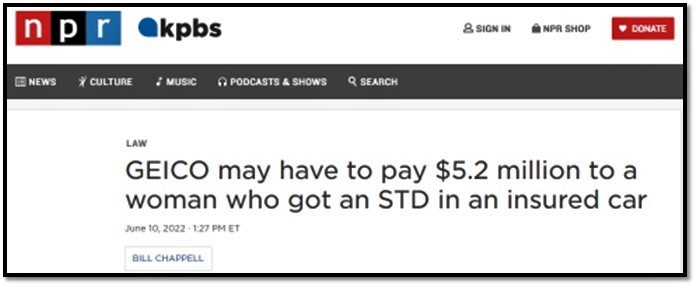
This, from the NPR article:

“…in April of 2021, GEICO sued both M.O. and M.B. in federal court, asking the court to rule that the insurance company isn’t liable for the woman being infected with HPV, and that it doesn’t have a duty to defend the man from her claims against him.

“GEICO says the car owner’s claims for coverage should be dismissed because they’re barred by a number of legal doctrines, including ‘fraud, collusion, illegality, laches, and unclean hands.’”

What the heck are “laches”?

“A doctrine in equity that those who delay too long in asserting an equitable right will not be entitled to bring an action.”

And “unclean hands”?

“A legal doctrine which is a defense to a complaint, which states that a party who is asking for a judgment cannot have the help of the court if he/she has done anything unethical in relation to the subject of the lawsuit.  Thus, if a defendant can show the plaintiff had ‘unclean hands,’ the plaintiff’s complaint will be dismissed or the plaintiff will be denied judgment.”

Looks like GEICO was pulling out all the stops.

Which brings us up to June 7:

“The Missouri Court of Appeals upheld a $5.2 million judgment on Tuesday involving a Jackson County, MO woman who said she unknowingly caught HPV, the human papillomavirus, during unprotected sex in the luxury sedan of a former male romantic partner in 2017.”

I have to pause here and wonder – what the hell does the car being a “luxury sedan” have to do with anything? 

Is M.O. supposed to be mollified because she was allegedly infected with HPV in, as the Washington Post went on to put it:

“…2014 Hyundai Genesis – a luxury sedan that Kelley Blue Book raved ‘leaves very little to criticize.’”

And the NPR story was just as bad – their headline included an image that was similar to the car allegedly used, as though the make and model of the car have anything to do with anything:

Early on I was speculating about this story being absurd, and this part of the reporting certainly is.

So the Missouri Court of Appeals upheld the judgment against GEICO.

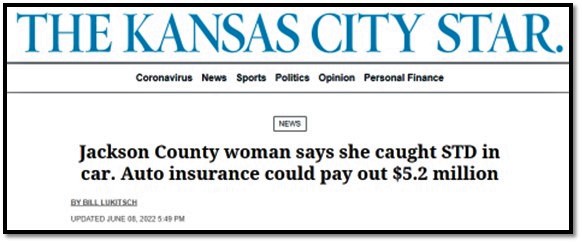
Now this, from the Kansas City Star:

“In a related federal court case, GEICO is contesting the idea that the claim is covered under its insurance policy.  The outcome of that case would determine whether the company has to actually pay the settlement.

“Correction:  An earlier version of this story erroneously stated that the decision by the Missouri Court of Appeals meant insurance company GEICO must pay the judgment claim.  The insurance company is still contesting the decision in federal court, arguing that the claim is not covered under the policy.”

The NPR article noted:

“The federal case is set for a jury trial, which is currently slated to begin in a Kansas City courtroom in October.  Since GEICO filed its federal suit more than a year ago, well over 100 docket entries have been made.”

So:  

M.O. is unhappy.  She has HPV and no money yet from GEICO.

M.B. is unhappy.  He has HPV and HPV-caused cancer.

GEICO is unhappy.  This pesky thing isn’t going to be resolved for months.

Guess who is happy about all this?

The lawyers.

Crazy?

Absurd?

Machiavellian?

I’m going back to my noting that M.O. apparently isn’t suing the guy she claims infected her with HPV – but rather his auto insurance company.  If the federal court finds in favor of M.O., then…

If person A goes to the home of person B, and they have sex, and A is infected with an STD, does A sue B’s homeowner’s insurance company?

If persons C and D have bathroom sex on an airplane and one of them is infected with an STD, does that person sue the airline?

If persons E and F have sex under the stars in Yosemite National Park and one of them is infected with an STD, does that person sue the National Park Service?

I know that my questioning of M.O.’s story and motives will anger some people.  That questioning any woman’s story and motives is deemed unsupportive of women, and worse – can have a negative impact on all women, as suggested by many following the Amber Heard/Johnny Depp recent court case:

But…there’s just something troubling me about M.O. suing a deep-pocketed insurance company rather than suing M.B., the alleged source of her HPV.

And waiting so long to do it.

I’m closing this with more questions than I had when I started.

Trump Wants “Equal Time” And I Want Him To Have It:

For the first time EVER, I agree with Donald Trump.

I want him to have “equal time.”

Equal time with Al Capone:

In October 1931, gangster Al Capone was sentenced to 11 years in prison for tax evasion.  

Equal time with Harvey Weinstein:

In March 2020, movie producer Harvey Weinstein was sentenced to 23 years in prison for sex crimes against women.

Equal time with Sheikh Omar Abdel-Rahman (“the blind sheikh”):

In October 1995, Abdel-Rahman was convicted of seditious conspiracy and sentenced to life in solitary confinement.  He died in federal prison in 2017.

Yes, I want Trump to have equal time:

11 years in prison.
23 years in prison.
Life in prison.

Served consecutively.

Father’s Day:  A Brief But Heartfelt Tribute

Father’s Day is Sunday, June 19, and I use this opportunity to take special note of a family member who’s the father of two, and a man who’s clearly interested in being a good role model for his children:

Doesn’t this image just warm your heart?

Father and sons together, bonding, sharing the fun of killing.

With a gun.

Or perhaps it was “guns” – I expect by this age, Dad has bought his boys their own guns.

That’s what a loving father does, right?

I can envision the three of them together, moving quietly and carefully through the woods on a crisp fall day – and then…

Spotting their prey!

Dad shouts, “Kill it!  Hurry up!  Kill it!”

And one son, or the other, or maybe both, take aim and shoot and kill.

Dad is proud.

The boys are proud.

And America’s love affair with guns
Is passed from a father to his sons.

Welcome To The Emperor’s New Clothes, 21st-Century Style

(I’m using the words “con man” as an all-purpose term instead of specifying “con woman” or “con person” or “con whatever.”)

The Emperor’s New Clothes, an 1837 folktale by Hans Christian Anderson, is in part a story that’s been around as long as humans have:

The con man.

And the phrase “Emperor’s New Clothes” has, according to scholars, become “a standard metaphor for anything that smacks of pretentiousness, pomposity, social hypocrisy, collective denial, or hollow ostentatiousness.”

Read on to see why I’ve referenced it.

*****

If you were among the nearly 40,000 victims of con man Bernie Madoff who were swindled out of billions of dollars, you were feeling some sense of relief back in 2009 when he was convicted and sentenced to 150 years in prison:

If you’re someone who’s been conned in this scam:

You’re hurt and angry, and you’ve got plenty of company:

“A shocking number of Americans will spend Valentine’s Day not only broken-hearted – but dead broke – after being swindled by digital-dating deceivers.

“The lovelorn were grifted out of $547 million by dating-app scammers last year, a shocking 78% increase over the previous record $307 million in losses in 2020, according to the Federal Trade Commission.

“The number of reported cases climbed from 33,000 to 56,000, or 70%, over the same year.”

Oh, sure – there are lovable con men, like these guys…

But that was a movie, and nobody actually got stung.

Here – in my opinion – is another real-life, contemporary con man.  He’s been conning people, and some are falling for his bullshit.  Some have even bought his bullshit “art.”

He was making plenty of headlines a year ago, though I learned about him only recently:

Meet Salvatore Garau, born in 1953, from the Mediterranean island of Sardinia.  According to this website:

“Salvatore Garau’s work has been offered at auction multiple times, with realized prices ranging from $34 to $26,636, depending on the size and medium of the artwork.”

Here’s a sampling of what I assume is Garau’s work, from his Facebook page:

Or…maybe they go this way?

Or…maybe it doesn’t matter?

Garau’s been around for awhile, creating his works and occasionally selling them.

And – again, from his Facebook page – he occasionally makes headlines:

The headline translates to, “Today’s altarpieces Garau’s gaze towards the sky.”

It maybe lost something in the translation.

So Garau is selling some artwork, and making some headlines.  Seems like an OK life for an artist, sì?

Maybe, but in 2021 it will…

Diventare molto meglio!

Become much better!

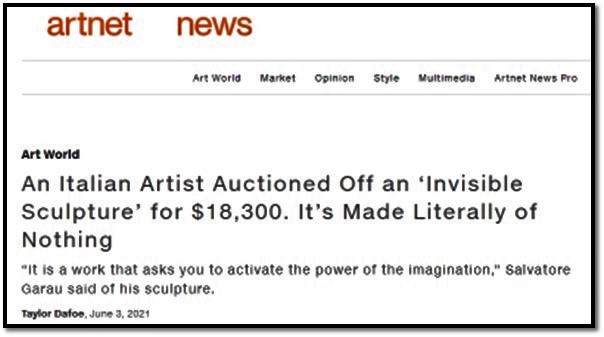
Let’s go back to those headlines from a year ago.  There were plenty of them, national and international, like this one:

I’m quoting directly from the article because it’ so absurd that even I – who loves the absurd – could not make this up:

“…artist Salvatore Garau sold an ‘immaterial sculpture’ – which is to say that it doesn’t exist.

“To be fair, the artist might disagree on conceptual grounds.  For Garau, the artwork, titled Lo Sono (which translates to ‘I am’), finds form in its own nothingness.  ‘The vacuum is nothing more than a space full of energy, and even if we empty it and there is nothing left, according to the Heisenberg uncertainty principle, that nothing has a weight,’ he told the Spanish news outlet Diario AS.  ‘Therefore, it has energy that is condensed and transformed into particles, that is, into us.’

“Lo Sono went up for sale in May at the Italian auction house Art-Rite.  The pre-sale estimate valued the piece between €6,000-9,000, according to AS, but competing bidders pushed the price tag to €15,000.”

“Competing bidders.”

It wasn’t just one idiot – multiple idiots were competing to buy nothing.

And one of those idiots paid €15,000 – $18,300 – for it.

“The lucky buyer went home with a certificate of authenticity and a set of instructions:  the work, per Garau, must be exhibited in a private house in a roughly five-by-five-foot space free of obstruction.”

I can’t show you a picture of Lo Sono – nor can anyone else – but I can show you an image from the “Italian auction house Art-Rite” showing the sale of another of Garau’s…um…whatevers:

The name of this…um…whatever is Davanti a te, or In Front of You.  The website notes:

Intangible sculpture to be placed in a place free of encumbrances
Variable dimensions, 200 x 200 cm circa
Work accompanied by a certificate of authenticity issued by the artist

Selling price:  $28,887.

Another idiot!

Has Garau got a con going?

Can you doubt it?

He created nothing – twice – and was paid more than $47,000 for it.

Incurring practically no costs to himself at all:  for art supplies, for crating and shipping and insuring artwork, for publicity. 

Would you like to not see more of his…um…whatevers?

Here’s Buddha in Contemplazione, meaning Buddha in Contemplation, installed in February 2021 at the Piazza Della Scala in Milan:

Cost to artist:  One roll of white tape from Lowe’s, $4.78.

Of Buddha, Garau said,

“Now it exists and will remain in this space forever.  You do not see it but it exists.  It is made of air and spirit.”

Uh-huh.

And again from 2021, here’s Afrodite Piange or Aphrodite Crying in New York, a few steps from Wall Street:

Cost to artist:  One hula hoop from Target, $6

Of Aphrodite Garau said,

“You don’t see me but I exist, right above this white round shape.
“I am Aphrodite, an intangible sculpture made of air and spirit.
“Still don’t see me?  And yet I am here, in front of you.
“And I cry because I am beauty and love which is disappearing.”

Stronzo!

And not only are idiots throwing money at Garau, the Italian Cultural Institute in New York…

…bought into this nonsense!  Their website says (I’m assuming from 2021):

“From Saturday, May 29, therefore, the digital platform ‘Stanze italiane’ of the Italian Cultural Institute of New York – which represents a new way to show Italy as a country going beyond traditional styles and open to the new, the unprecedented, the unexpected – will offer a preview of the video documenting the positioning in New York of the new immaterial sculpture by Salvatore Garau Afrodite Piange:  a white circle with a red dot at its center, on the notes of an intense soundtrack that is almost endowed with a co-protagonist role, featuring Anna Tifu’s violin, Andrea Cutri’s guitar and the drums played by Garau himself, a member of Stormy Six in the 1970s and 1980s.”

Gosh, I overlooked the cost to the artist of that “red dot”:  ½¢ also from Target.

An article dated May 2021 said that Aphrodite Crying is “the third in a cycle of seven ‘immaterial’ works that will be installed in as many cities around the world.”

I’ve been unable to find any information that indicates Garau has graced our lives with any further installations.

In fact, I’ve been unable to find anything online about Garau beyond that flurry of interest in spring/summer 2021.

Perhaps Garau – like his “art” – has become invisible.

Or “intangible,” as in his Aphrodite Crying:  “an intangible…made of air and spirit.”

And perhaps that’s just as well, because Garau is being sued:

“A Gainesville artist who created an invisible sculpture is suing an Italian artist for profiting off his idea.”

“Tom Miller, a multidisciplinary performance artist, installed his sculpture called Nothing at Bo Diddley Plaza in 2016.”

Tom Miller at Bo Diddley Plaza, with his invisible sculpture. Or, maybe not.

“Now, he said an Italian artist is trying to sell a different ‘nothing’ for $18,000.

“‘The space in our world is legitimate to work with as an artistic product.  So the idea is fashioning nothing into a sculpture, and that’s what the lawsuit is all about,’ said Miller.”

If Miller wins his lawsuit, I wonder if Garau will pay him with…

Invisible money?

My takeaway?

I am sincerely sorry for many of the nearly 40,000 victims who were conned by Bernie Madoff.  Sure, some of them were just plain greedy, but many more of them were hardworking people who trusted Madoff with their life savings, and lost it.

I am sincerely sorry for the thousands of people who went looking for love in all the wrong online places, and were conned out of $547 million last year, and those who are being conned as we speak.

But I am not, and never will be, sorry for the idiots have been – and may well continue to be – taken in by Garau’s con game.

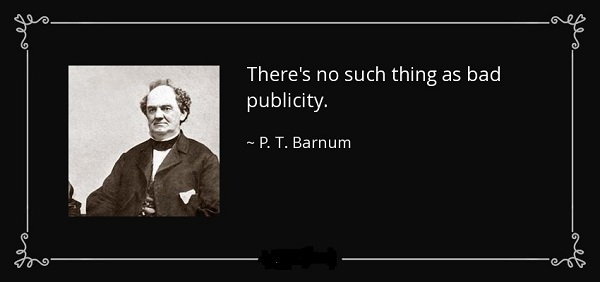
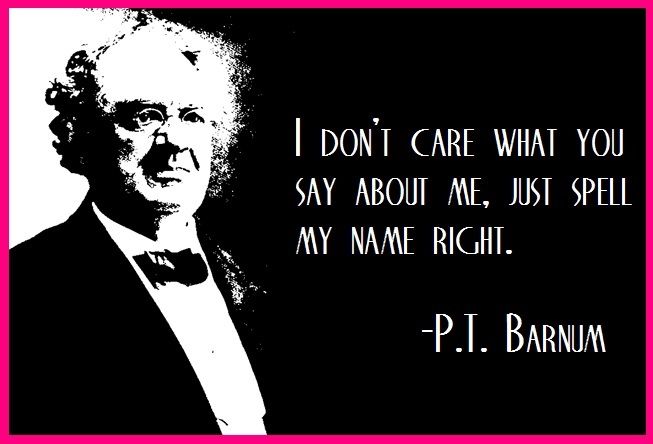
Garau personifies not only the Emperor’s New Clothes, but also an old saying from arguably the world’s greatest con man, P.T. Barnum:

Let’s Look At Some “Let’s” Headlines:

My Sunday newspaper devotes a full page entitled The (almost) Back Page to stories that may not make big headlines but nonetheless may be interesting. 

Now and then some of the stories make me curious enough to learn more, like a recent Sunday’s collection.

And sometimes, when I learn more, I like to share.

So…

Let’s Hand An Eight-Year-Old The Car Keys

Gastonia, NC – population around 77,000 people – is located about a half-hour east of Charlotte, NC:

TripAdvisor’s Things To Do In Gastonia, NC list includes Carothers Funeral Home at #10 out of 38, which may tell us something about Gastonia, though I’m not sure what.

Fortunately, the funeral home’s services were not required for consequences of this event:

A mother and her eight-year-old son were visiting relatives in Gastonia one evening in late May.  For reasons unexplained, Mom handed the kid her car keys and told him to go start the car.

Now, based on my observations, most parents are reluctant to hand over their car keys to kids twice that age – 16-year-olds – even when they’ve completed driver training and gotten their driver license. 

But here’s Mom, willingly handing her keys to and eight-year-old and telling him to start the car?

So he did.

And he drove away.

With his one-year-old sibling in the back seat, whom Mom had left in the car while she was visiting the relatives.

The eight-year-old drove the car two miles home, and apparently decided, “Nah, let’s keep going.”

And he did. 

In the meantime, Mom (who didn’t want to be identified) discovered the missing car and children and had called 911.  Deputies spotted the car and got the eight-year-old to stop.  They gave him a roadside sobriety test, cuffed him and read him his rights.

OK, I’m kidding about the last part. 

It should have been Mom who was cuffed and charged, and according to the WSOC-TV story, perhaps she will be:

“Police said the 8-year-old isn’t facing charges, but that his mother could be investigated by the Department of Social Services for possible neglect.”

Gosh, tell an eight-year-old to start the car?  Leave the one-year-old in the car while you’re in the relatives’ house?  What did she do with her five-year-old?

Drop her off at Cavendish Brewing Company, which is #16 on the TripAdvisor List? 

“Here’s $10, sweetie, you have a couple of brewskies while Mommy visits with Aunt Erna.”

Let’s Get Within 10 Feet Of A Bison

Ahhh…Yellowstone National Park:

So beautiful, and so many great things to do:  Hiking, biking, riding horses…

…photography, camping, picnicking, touring…

And some things not to do – including this:

Let’s talk logistics here.

Like the woman in the first story, this event also happened at the end of May and this woman is also unidentified, except as age 25 and from Ohio.

This woman was within 10 feet of the bison when she was gored and then tossed 10 feet.  She sustained a puncture would and other injuries, and park emergency medical providers responded and transported her via ambulance to a hospital in Idaho.

As of May 31, “The incident remains under investigation, and there is no additional information to share.”

Well, there is this one piece of information:

I’m sure the woman was relieved to hear this.

Let’s talk more logistics.

First, it’s not like staying away from Yellowstone’s wild animals is a big secret – signs abound throughout the park.  This one includes a picture of the very same animal the gored woman should have avoided:

Second, park regulations require visitors to “Stay more than 25 yards (23 m) away from all large animals – bison, elk, bighorn sheep, deer, moose, and coyotes, and at least 100 yards (91 m) away from bears and wolves.” 

Third, why would anyone with any sense approach a bison?

For an opportunity like this?

This incident happened a few years ago. The woman taking the selfie had a child with her and, according to the National Park Service,

“They heard the bison’s footsteps moving toward them and started to run, but the bison caught the mother on the right side, lifted her up and tossed her with its head.” 

“The family said they read the warnings in both the park literature and the signage, but saw other people close to the bison, so they thought it would be OK.” 

“OK” – like handing your car keys to an eight-year-old.

Well, here’s hoping the Ohio woman will put her photo op to good use:

Let’s See If These Robots Work Better
Than Elon Musk’s Self-Driving Cars

Again, from late May.

This story isn’t about dumb people, but about what may be a dumb idea:

I read “robots” and I think this:

C-P3O from Star Wars, right?

Heck, I don’t want to wait until I’m “elderly” – I want a C-P3O right now!

But…no.

Instead, the robots look like this:

I’m pretty sure this thing isn’t going to bring me wine.

According to The Verge:

“The state of New York will distribute robot companions to the homes of more than 800 older adults.”

“The scheme is being organized by the New York State Office for the Aging (NYSOFA), and is intended to help address the growing problem of social isolation among the elderly.”

The article goes on to clarify that “growing problem”:

“An estimated 14 million Americans over the age of 65 currently live alone, and this figure is projected to increase over the next decade as the boomer generation ages.  Studies have suggested that long-term loneliness is as damaging to an individual’s health as smoking.” 

The robot, called ElliQ, was built by Israeli firm Intuition Robotics and, says this article:

“…will remind [seniors] to take their medication, help contact loved ones, book an Uber ride and even engage in small talk and crack jokes.”

That all sounds great, though I can see it possibly going south in some situations:

ElliQ:  Good morning, Sam.  How are you today?
Sam:  Oh, I’m fine.  Hey, ElliQ – knock, knock.
ElliQ:  Did you say…“Knock, knock”?
Sam:  Yeah!  It’s a joke.  I say, “Knock, knock” and you say, “Who’s there?”  OK?  So, knock, knock.

(Silence)

Sam:  ElliQ?  Knock, knock?
ElliQ:  Who’s there?
Sam:  Nobel.

(Silence)

ElliQ:  The Nobel Prize was awarded in 2015 to two researchers for the drug ivermectin.  Sam, have you taken your drugs this morning?

I’m not saying companion robots for the elderly aren’t a good idea – perhaps they are.

What I’m questioning is the New York State Office for the Aging distributing more than 800 of the robots, an investment of “$700,000 in the pilot program,” according to the New York Post

“Pilot program.”

By definition, a pilot program is “a small-scale preliminary study conducted to evaluate feasibility, duration, cost, adverse events, and improve upon the study design prior to performance of a full-scale research project.”

Distributing more than 800 ElliQ doesn’t sound “small-scale” to me.

Nor does $700,000.

For what is, after all, an experiment.

Maybe before New York spent $700,000 taxpayer dollars – state and possibly federal tax dollars – couldn’t they have experimented with giving just one or two or a half-dozen ElliQ to the elderly, to ascertain that these things actually work?

Work better than, say…Elon Musk’s self-driving Teslas?

Book Review:  I Liked Another Book!  I Really Liked It!

(I posted a book review last Friday, and normally wouldn’t do another so soon.  I guess I lost my head after reading two books so close together that I liked so much.  Unheard of!)

Publication date:  May 2022

Category:  Contemporary women’s fiction, romantic comedy.

Review, short version:  Four roses out of four.

Review, long version:

I’ve read many book-related books:  books about book clubs, books about bookstore owners, books about book writers, books about book editors.

The lead character in Emily Henry’s Book Lovers was a first for me:  a book agent.

More correctly, a literary agent.

According to this article:

“What is a literary agent?  In short, they’re the person whose job it is to sell your book to a publisher.  Literary agents work to present great manuscripts to potential publishers, and while the agent’s primary role is to sell books and negotiate contracts, your agent can also be your motivation, your first editor, and your biggest supporter.”

Henry’s lead character, Nora Stephens, is described on the Book Lovers dust jacket as…

“…a heroine for her clients, for whom she lands enormous deals as a cutthroat literary agent…” 

Nora, single and 32, has a sister, Libby, 28, who’s married and a mother of two with a third on the way.  Both live in New York City, and even more important – both are New Yorkers.

The sisters’ relationship is complicated, and so are they.  Their father abandoned them when Libby was still in the womb, and since then Nora has seen her role as her sister’s protector – from their loving but flaky mother, from things that go bump in the night, from the world in general.

But does Libby need Nora’s protecting?

Libby does need some time away from her overly busy life and two small daughters before the third arrives, and she convinces Nora to join her for a three-week vacation in Sunshine Falls, a small North Carolina town.  Libby chose Sunshine Falls because it was the setting for a novel she’d read and loved.

But does Libby have ulterior motives?

Nora needs a vacation, but Nora doesn’t take vacations.  Her work, and protecting Libby, are her life.  When she dates, the relationship is brief and ends badly.  When she cries – well, she doesn’t cry.  Period.

Nora hasn’t cried in 10 years.

Now let’s meet Charlie Lastra, “a bookish, brooding editor,” also from New York.  Nora considers Charlie her “professional nemesis,” and you know they’re going to mix like oil and water.  Their exchanges are snarky and entertaining.  Their attraction is growing.  But Charlie…

Is also complicated.

And Charlie – another diehard New Yorker – is, inexplicably, also in Sunshine Falls.

Will Nora and Charlie stop snarking and start kissing?  Will Libby liberate herself from Nora’s well-intentioned but overdone helicoptering? 

Will Nora cry?

And if so, why?

I didn’t like Henry’s last book, People We Meet on Vacation, and I was iffy about Book Lovers.  I’m glad I took a chance and read the book, because this time around I enjoyed the story, the writing, the characters and changes they went through.  And I enjoyed the surprises.

I liked another book.

I really liked it!

When It Comes To The Kardashians I’m…

The above image, known as Three Wise Monkeys, has long represented an old proverb:

Hear no evil, see no evil, speak no evil.

I’m using the image to describe how I feel about anything Kardashian-related:

Don’t make me hear it, don’t make me see it, or it will make me vomit.

The Kardashians, about whom I know enough to know that they’re famous for being famous…

…and that’s more than I want to know.

For years I have studiously avoided everything Kardashian-related.

Until a recent article caught my eye in – of all things – the Health section of my newspaper.

Something Kardashian-related – in a newspaper’s Health section?

Dared I hope that all the Kardashians decided to be cryogenically frozen – kind of like popsicles – and be thawed out maybe…a thousand years from now?

This required investigating.

The article I read in the San Diego Union-Tribune originally appeared in the Washington Post, on May 10:

The story says that on May 2, Kim Kardashian attended the Met Gala, which goes by several names:

“The Met Gala, or Met Ball, formally called the Costume Institute Gala or the Costume Institute Benefit…”

And its purpose:

“…is an annual fundraising gala held for the benefit of the Metropolitan Museum of Art’s Costume Institute in New York City.”

Kardashian, who clearly hates having her picture taken…

…garnered plenty of attention, though much of it was not favorable, for several reasons.

Reason #1:  Kardashian was wearing a very famous – even iconic – 60-year-old gown, originally worn by Marilyn Monroe in 1962, when she attended a birthday celebration at Madison Square Garden for President John Kennedy and sang Happy Birthday to him:

The dress was designed for Monroe, and no one has worn the dress since Monroe’s 1962 appearance.  According to this article:

“Kardashian borrowed the dress from Ripley’s Believe It or Not! Orlando, not an accredited museum.  The novelty museum bought the work at auction in 2016 for $4.8 million.”

I love how the writer snarkily noted that Ripley’s is “not an accredited museum.”

Here’s the dress in Ripley’s Believe It or Not:

The artnet article continues,

“Textile conservators, including the former head of the Met’s fashion conservation department, Sarah Scarturro, blasted the socialite.”

The article linked to Scarturro’s Instagram account, where she went on at length, including this:

“‘When I was the head of the Costume Institute’s conservation lab, I had to swat off requests by people…to have irreplaceable objects in the collection be worn by models and celebrities.’”

So, huge pushback from people knowledgeable about the fragility of old textiles.

Though I can’t help but wonder how Monroe’s dress – a one-of-a-kind, worn-once, “irreplaceable object” – ended up in a tacky roadside attraction like this:

Side-by-side with stuff like Ripley’s Lizard Man?

Why weren’t Scarturro and the Metropolitan Museum of Art’s Costume Institute front and center in 2016 when they could have been the high bidders for Monroe’s gown, instead of Ripley’s?

Here’s the second reason the Kardashian-in-Monroe-dress story garnered so much bad press:

Reason #2:  Scarturro was also among the many who bemoaned Kardashian’s besmirching both Marilyn’s dress and her legend, saying:

“…in the end Kim Kardashian is no Marilyn Monroe.”

Other social media storm comments included:

“Marilyn’s image being bastardized and boiled down to ‘sex symbol’ like she wasn’t a woman who was unfortunately exploited her entire life by all the men that have come and gone and even after death she couldn’t even rest in peace.”

“A wealthy woman lifting her own celebrity off of a woman who was once poor and continued to be exploited her whole life just isn’t sitting right.”

And a quote from this article:

Was especially interesting:

“Another person who didn’t love Kardashian’s choices?  Fashion designer Bob Mackie, who drew the sketch for the original gown in his early career working as an assistant to Jean Louis.  ‘I thought it was a big mistake.  [Marilyn] was a goddess.  A crazy goddess, but a goddess.  She was just fabulous.  Nobody photographs like that.  And it was done for her.  It was designed for her.  Nobody else should be seen in that dress.’”

Let’s move on to the third reason Kardashian came in for criticism…

Reason #3 – and for that, we’ll revisit the Washington Post story:

Ahh.  That’s why the Kardashian story was in the Health section of my newspaper.

But “potentially harmful”?  What’s that all about?

It seems that in an interview, Kardashian shared “the extreme three-week 16-pound weight-loss regimen she undertook to squeeze into” Marilyn’s dress.

“The reality TV star was excoriated on social media not only for publicizing her potentially harmful crash diet…”

“Potentially harmful”?

Many online articles I checked (from sources I felt were credible) say a weight loss of one to two pounds per week is considered healthy.

Kardashian claims she lost 16 pounds in three weeks.

The articles suggested consequences of losing weight too quickly, including losing muscle instead of fat; becoming malnourished and/or dehydrated; digestive problems; tiredness; a slowed metabolism; and a painful condition known as gallstones.

Actress Lili Reinhart weighed in on Kardashian’s crash diet on Instagram, as quoted in this article:

“To walk on a red carpet and do an interview where you say how starving you are…because you haven’t eaten carbs in the last month…all to fit in a fucking dress?”

“So wrong.  So fucked on 100s of levels.  To openly admit to starving yourself for the sake of the Met Gala.  When you know very well that millions of young men and women are looking up to you and listening to your every word.  The ignorance is other-worldly and disgusting.  Please stop supporting these stupid, harmful celebrities whose entire image revolves around their bodies.”

Whoa, Lili! Don’t mince words!

But it wasn’t just Kardashian’s crash diet – she was also “excoriated” for…

“…advocating unhealthy slimming strategies in the past – including endorsing and selling a popular shapewear product that persists against the best medical advice:  the waist trainer.”

Now we come to the “waist trainer” in the Washington Post headline.

What the hell is a “waist trainer”?

The Washington Post enlightened me:

“Waist trainers, for those not in the know, are undergarments that create an hourglass figure by tightly compressing the waist.  They gained popularity during the 2010s thanks to praise from celebrities and Instagram influencers including the Kardashian family, and remain so despite being roundly panned by health experts.”

“If the concept sounds familiar, that’s because it is.  ‘They’re basically glorified corsets,’ said Stephanie Faubion, the director of Mayo Clinic Women’s Health in Jacksonville, FL.  ‘I’m sorry to see that we’ve reverted to the 1800s.’”

“Glorified corsets”?

Let’s have a look.

The image on the left is from 1899; the image on the right is online:

I’d agree with the corset comparison.  And I’d agree with Stephanie Faubion’s “reverted to the 1800s.” 

But “glorified”?  I think not:

“Those who endorse waist trainers on social media claim that wearing them regularly, for a period of months, trains their waist into an hourglass shape…”

“But health experts say the alleged benefits are all hype.  In fact, ‘the name waist trainer is a misnomer,’ said Faubion.  ‘It’s not training your waist to do anything different.  It’s not going to change your shape.  It’s your waist – it’s not a dog.’”

The article goes on to detail possible waist trainer side effects, including:

  • Restricting your breathing.  “Kardashian wore a waist trainer to the 2019 Met Gala and revealed that she had to take corset-breathing lessons.”
  • Affecting your internal organs:  “Long-term use can shift your organs – like your kidneys – into unnatural positions, and even cut off the blood flow that allows them to function properly.”
  • Causing digestive issues:  “Waist trainers squish your digestive system, which could lead to constipation by ‘blocking the normal motility and flow of materials through the intestines.’”
  • Weakening your musculoskeletal system.  “Sleeping in one or wearing one all day, week after week, will dissipate core strength.”

Kardashian is encouraging females to wear body-distorting undergarments like 19th-century women did – We’ve come a long way, baby!  NOT! 

And to the probable detriment of females’ health.

Good ole Kimmy is not only endorsing waist trainers – she’s selling them at her shapewear company, SKIMS.

Here’s Kardashian, from the Washington Post article :

In the Washington Post article, Kardashian was described as “at the Metropolitan Museum of Art’s Costume Institute benefit gala in 2019, wearing a waist trainer that required breathing lessons.” 

I’m guessing Kardashian wasn’t wearing one of her body-distorting undergarments under the Marilyn Monroe dress at the 2022 Met Gala since, according to this article:

The article states that resolution was reached:

“After some serious teamwork, the group managed to get the dress over her butt, but were unable to actually fasten the zip, instead securing the opening with a piece of string.”

Hence, I guess, the strategically placed fur thing:

According to the various stories, after her appearance on the red carpet in the Monroe dress, Kardashian changed into a different dress.

Presumably this dress that did not require the string solution.

So…

I’ve now gone from this about anything Kardashian-related…

Don’t make me hear it, don’t make me see it, or it will make me vomit.

To spending an inordinate amount of time hearing, seeing – and talking – about something Kardashian-related.

So, if you’ll excuse me, I need to go wash out my ears, eyes and mouth with soap…

Book Review: I Liked It! I Really Liked It!

Publication date:  March 2022

Category:  Family saga fiction, mother’s and children fiction

Review, short version:  Four roses out of four

Review, long version:

After I finished Jennifer Smith’s The Unsinkable Greta James, I didn’t immediately start another book, as I usually would.

I didn’t want to change my focus just yet.

I wanted to linger for awhile in what I’ll call Greta Glow.

The glow that I get when I thoroughly enjoy a book.

Unsinkable held my attention throughout, and ended in a way I found satisfying.  I liked Smith’s writing and storytelling, and I enjoyed being part of her characters’ challenges and changes.

Greta is a single, 36-year-old Indie music writer/singer/guitarist.  Over the past 10 years her career has grown:  She now plays to large crowds, her songs are on the radio, her second album will soon be released, and she’s recognized and asked for autographs on the street. 

Greta seemed to be living exactly the life she’d dreamed of.

“Seemed,” as in – past tense.

One night while on stage, soon after the sudden death of her mother, Greta has a meltdown.  The video goes viral, and Greta goes into hiding.

A year earlier, Greta’s mother had started planning an Alaskan cruise that she and Greta’s father would take to celebrate their 40th anniversary.  Two couples that Greta’s parents are close to would join them on the cruise.

Then Greta’s mother dies, and Greta’s brother suggests that – since Greta isn’t doing anything, anyway – she should take her mother’s place on the cruise.

It’s a situation that’s full of potential – including potential landmines.  Greta and her father have been at war for years, and now a week, trapped on a cruise ship with him? 

And since her meltdown, Greta is also questioning her own life choices:

“Greta finds it almost painful sometimes to think about all the different lives she could be leading, to know that every choice she’s made has meant the loss of so many other possibilities.  Every day, more doors close.  Without even trying, simply by moving forward, you end up doubling down on the life you’ve chosen.  And the only way to survive is to commit to it fully, to tell yourself it’s the right one.  But what if that’s not true?”

If you enjoy characters’ challenges and changes, I recommend Unsinkable.

I very often find myself at odds with Amazon reviewers.  For example, I did a post back in March about The Midnight Library, which I strongly disliked.  At the time, the book had more than 140,000 Amazon reviewers, 4.3 stars, and had been on the New York Times best sellers list for 64 weeks.

As I write this, Midnight Library just chalked up its 77th week on the New York Times list, showing how out-of-step with the majority I was and continue to be.

But not this time.

This time I found myself in accord with 83 percent of Smith’s 1200+ reviewers and Unsinkable’s 4.2 stars rating.

They liked it, I liked it, and I hope Jennifer Smith is working on another novel.

See Trump.  See Trump Headlines.  See Trump Sweat.

Truly – I am not one to wish a person ill.

But – I make one exception.

Trump.

May was an exceptionally good month for bad headlines for Trump.

I was not unhappy to see them:

May 3:

“The Trump Organization and the Presidential Inaugural Committee will pay a total of $750,000 to settle with the Washington, DC attorney general’s office over allegations they misspent money raised for former President Donald Trump’s inauguration.

“The Trump Organization will pay $400,000 and the PIC will pay $350,000, according to a person familiar with the settlement.  As part of the deal, the money will be directed to two DC nonprofits, DC Action and Mikva Challenge DC, the DC attorney general’s office said.”

May 11:

“Former U.S. President Donald Trump must pay a $110,000 fine and meet other conditions to purge a contempt of court order over his failure to comply with a subpoena in a civil probe into his business practices by New York state’s attorney general, a judge said on Wednesday.”

May 12:

“The Department of Justice has opened a grand jury investigation related to former President Donald Trump’s alleged mishandling of classified documents, following the revelation in February that he had brought boxes of documents home to his Mar-a-Lago estate when he left the White House.

“At least one subpoena has been issued to the National Archives, and interview requests have been made to some former aides who were with Trump during his last days in office, sources familiar with the matter told ABC News.”

May 25:

“Former President Donald Trump’s crusade for vengeance suffered two devastating blows after Georgia Gov. Brian Kemp and Secretary of State Brad Raffensperger won their primaries Tuesday despite rejecting Trump’s entreaties to reverse his 2020 election loss.

“It’s a huge warning sign for the way Republican voters view the former president’s crusade to punish those who were not willing to overturn the will of the voters in 2020.”

May 26:

“They’re weary of the incessant conflicts.  The inability to get past the 2020 election results. An endorsement strategy seemingly driven by a bruised and restless ego, rather than the party’s best interests.

“Channeling growing fatigue among rank-and-file Republicans, some of the GOP’s best-known heavyweights are increasingly defying former President Donald Trump in the wake of internecine conflicts from Georgia to Pennsylvania.

“Bold-face Republican names have never been so comfortable crossing Trump as in recent weeks.  Former President George W. Bush, former Vice President Mike Pence, and former New Jersey Gov. Chris Christie were among those lending aid and comfort to one of Trump’s top enemies, Gov. Brian Kemp, in Georgia’s Tuesday primary.”

May 26:

“A court has ruled that former President Trump and his children, Ivanka Trump and Donald Trump Jr., are obligated to testify under oath in New York state’s investigation into the Trump Organization’s financial dealings, state Attorney General Letitia James announced Thursday.”

“Trump’s potential testimony could be used against him in the criminal probe conducted by the Manhattan district attorney, AP reports.”

May 27:

“In the latest legal blow to Donald J. Trump, a federal judge on Friday dismissed a lawsuit the former president filed that sought to halt the New York attorney general’s civil investigation into his business practices.

“The ruling, in federal court in Albany, was Mr. Trump’s second defeat related to the investigation in two days.”

“The ruling clears the way for Letitia James, the New York attorney general, to complete her civil investigation into Donald J. Trump in the coming weeks or months.”

May 27:

“Raffensperger, top aides among those who will answer questions behind closed doors”

“The Fulton County District Attorney’s wide-ranging criminal investigation into efforts to overturn Georgia’s 2020 presidential election is heating up, weeks after the seating of a special purpose grand jury with subpoena power.”

Ahhhhhh…

I would be remiss if I didn’t include some of the information from this article, updated on May 12:

“On both the criminal and civil litigation fronts, former President Donald Trump faces a bevy of lawsuits and investigations, with more cases likely to follow.”

E. Jean Carroll Defamation and Federal Tort Claims Act Litigation:
Carroll is suing Trump for defamation after he publicly accused her of fabricating a rape allegation against him.  The parties are currently involved in an appeal before the Second Circuit, where Trump (and so far, the Justice Department as well) is arguing that he had official immunity from Carroll’s defamation claim under the Federal Tort Claims Act (FTCA).

Mary Trump Fraud Litigation:
Mary Trump is suing Donald Trump for defrauding her out of millions of dollars in an inheritance dispute.  The suit is pending in New York state court, where the parties are currently battling over former President Trump’s move to dismiss the case.
Update:  On September 21, 2021 Donald Trump filed a related lawsuit against Mary Trump, the New York Times, and several of its reporters.

Doe v. The Trump Corporation Class Action:
A group of anonymous plaintiffs have filed a class action against the Trump family and their business, alleging that the Trumps used their brand to scam investors into paying for worthless business opportunities.  The district court denied the Trumps’ bid to force the case into arbitration, and the Trumps are now appealing.

Reps. Karen Bass, et al. Incitement Suit for January 6 Capitol Attack:
Ten members of the House of Representatives, represented by the NAACP, are suing Trump, Rudy Giuliani, and two rightwing militia groups for conspiring to forcibly prevent Congress from counting the Electoral College votes on January 6.
Update:  On February 18, 2022 the district court denied Trump’s motion to dismiss the § 1985 claim against him.

Eric Swalwell Incitement Suite for January 6 Riots:
On March 5, 2021 Representative Eric Swalwell sued Donald Trump, Rudy Giuliani, Donald Trump Jr., and Congressman Mo Brooks in federal court over the January 6 riots.  Swalwell alleges that the defendants violated federal civil rights laws – including the Ku Klux Klan Act – when they conspired to interfere with the Electoral College Count on January 6.  Beyond that, Swalwell also says the defendants should be held liable for negligently violating DC criminal codes on incitement, encouraging the rioters’ violent conduct, and intentionally inflicting emotional distress on members of Congress.
Update:  On February 18, 2022 the district court denied Trump’s motion to dismiss the claims under § 1985, negligence per se, DC anti-bias law, and aiding and abetting assault.  The court granted Trump’s request to dismiss the § 1986, emotional distress, and negligence claims.

Capitol Police Suit for January 6 Riots:
Two Capitol Police officers – both on duty during the January 6 insurrection – sued Donald Trump for injuries they sustained while protecting the Capitol.  Both allege that the rioters physically attacked them with fists, chemical spray, and other weapons.  They allege that the former president, by his incendiary words and conduct, directed the physical attack and emotional distress.
Update:  On February 18, 2022 the district court denied Trump’s motion to dismiss the claims under § 1985, directing and aiding and abetting assault, and negligence per se.  The court granted Trump’s motion to dismiss the emotional distress, punitive damages, and civil conspiracy claims.

Second Capitol Police Suit for January 6 Riots:
A second group of Capitol Police officers filed suit against Trump, the Proud Boys, the Oath Keepers, and other affiliates involved in allegedly planning and executing the January 6 riots.  The seven officers claim that they were physically and emotionally injured by attackers that Trump instigated, and that Trump and his co-defendants conspired to disrupt congressional business in the certification of electoral votes.

Third Capitol Police Suit over the January 6 Riots:
A third suit was filed by a Capitol Police officer alleging that physical and emotional injuries he suffered were caused by Trump’s inciting the January 6 riot.  The complaint alleges that Trump directed, aided and abetted, and conspired to incite the riot.

Metropolitan Police Suit over the January 6 Riots:
Two Metropolitan Police Officers filed suit alleging that physical and emotional injuries they suffered were caused by Trump’s inciting the January 6 riot.  The complaint alleges that Trump directed, aided and abetted, and conspired to incite the riot.  The officers seek compensatory and punitive damages.

NAACP’s Legal Defense Fund Voting Rights Case for Post-Election Actions:
The LDF is suing Trump, the Trump Campaign, and the RNC for their efforts to overturn the 2020 election in violation of the Voting Rights Act and the Ku Klux Klan Act.  While the litigation is still at its early stages, Trump faces damages and a declaratory judgment that he did indeed violate these provisions of the law.

Scotland Unexplained Wealth Orders:
In February 2021, the Scottish Parliament voted to reject an investigation into unexplained cash transactions executed by the Trump Organization’s Scottish golf courses.  A non-profit group is now challenging that decision in Scottish court.

Trump Tower Assault Suit:
A group of six protesters are suing Trump over allegations that Trump’s security guards assaulted them outside Trump Tower in 2015.  The case is pending in New York state court.
Update:  On October 18, 2021 former President Trump sat for a four-hour deposition to answer questions about the incident.

Michael Cohen Retaliatory Imprisonment Suite:
Michael Cohen – Donald Trump’s former attorney who served a three-year sentence for Trump-related crimes – is suing Trump, the U.S. government, and other officials for allegedly retaliating against Cohen after he announced a tell-all book detailing his years of legal work for Trump.  Cohen alleges that, after the announcement, Trump and his co-defendants retaliated by trying to bar Cohen from using social media and by sending Cohen back to prison from home confinement.

Westchester, New York Criminal Investigation of Trump Organization Golf Course:
The Westchester District Attorney’s Office reportedly launched an investigation which probes, at least in part, whether the Trump Organization misled local officials on the property values of its golf course in order to reduce its taxes.

Trump is not invulnerable.

Even Superman has his kryptonite…

Happy Anniversary To…Me!

During the month of May I’ve been celebrating an anniversary:

My fifth anniversary of blogging.

When I started in May 2017, if someone had told me I’d still be at it five years later, I wouldn’t have believed them.

Yet…here I am…

…In my 690th blog post.

Prior to May 2017, I’d never considered blogging.  I’d spent no time reading blog posts.  I knew millions of people had blogs, and I couldn’t think of one good reason to become another one.

Then a work colleague mentioned she had a blog, and gave me the address.

I went…I saw…I got it.

That one good reason:

Blogging could be fun.

And it has been.

I get to write, a lot.  I get to choose to make the post long or short (rarely the latter); I get to choose or create images, do the layout, change the layout, change some text, and when I’m satisfied with what I’ve done…

And if nobody reads it, or if somebody reads it and likes it, or somebody reads it and doesn’t like it…

I’m OK with all of the above.

Because I’m having fun.

And at the same time, I’m researching and learning – about people and politics and geography and history and medical news and so much more.  My blog doesn’t have a theme, like books or recipes or relationships, so I write about anything I want to.

I like researching and writing about serious subjects, but sometimes I’ll realize that the topic is way too big and complicated for me to try and tackle – like the war in Ukraine.  So I leave that subject to wiser heads than mine.

I often write about the absurd behavior of some humans.

I love the absurd.

Like the post I did about Florida woman who hid an alligator in her pants; she’d captured it illegally, and was trying to conceal it from the police.

And the TV show Dr. Pimple Popper.  Yes, it’s even worse than it sounds.

And this bunch – they provided endless grist for my absurdity mill:

May those horrible days never come again.

So – I’ve been blogging five years this month.

How much longer?

I figure blogging is like shopping:

I figure I’ll blog…

Till it’s a…

I Never Thought I’d See These Two Words Together:

I have never heard the words “menstrual” and “leave” together, and never thought I would.

Then a small article with big news led me to this story…

*****

If you’ve never seen South Park, consider yourself fortunate.

It’s an American animated sitcom that debuted in 1997 and is still on the air.

So popular was the series from the get-go that just two years later the world was treated to an 81-minute movie, South Park:  Bigger, Longer & Uncut.

In that movie a male character, referring to a group of women, says,

“I just don’t trust anything that bleeds for five days and doesn’t die.”

“Bleeds for five days.”

Humor from the two male creators of South Park.

Not so humorous for the countless females who since time immemorial have suffered from their monthly menstruation.

Also known as:

There are many nicknames for menstruation – this article listed 100 of them, and all of them “adorable”:

Written by a man.

A man who apparently thinks periods are funny.

Something that no woman has thought…

Ever.

There is nothing funny about an event designated with a medical term that sounds as bad as it feels:

“Dysmenorrhea causes severe and frequent cramps and pain during your period.  It may be either primary or secondary.”

And there is nothing funny about an event that, even before menstruation begins, can start with premenstrual symptoms, or PMS:

And then, when the blood starts to flow, let’s thrown in some/all of these:

Note the word “normal” in the image above.

It’s considered “normal” for a female to feel this way…

Every month…

Every year…

For forty years.

And that list of symptoms is mostly lacking in adjectives, so I’ll offer the following:

Over-the-counter medications don’t help.

Excruciating headaches.  Killer abdominal cramps.  Excessive bloating.

There are women who experience only a few of the above symptoms, and in a minor way, and their periods aren’t much more than a monthly inconvenience.

But why am I telling you all tlhis?  If you’re a female, you know it.  If you’re a male, you cannot, and never will, be able to imagine it.

For so many women – I’ve read estimates as high as 50-90% – symptoms can be bad, sometimes to the point of incapacitating.

And all that suffering has come with certain societal behaviors and attitudes toward menstruation, stretching back for centuries and handed down through generations:

  • Suffer in silence.
  • It’s a secret.
  • It’s shameful, dirty, nasty.
  • It’s something females must endure.
  • Those symptoms are all in your mind.
  • Do not ever, under any circumstances, ask your significant other to buy you feminine hygiene products.

There’s even a name for it:

“Period shaming.”

Something imposed on us by others, and imposed by us on ourselves.

The article cited some examples from a survey:

  • Fifty-eight percent of women have felt a sense of embarrassment simply because they were having their period.
  • Forty-two percent of women have experienced period-shaming, with one in five having these feelings because of comments made by a male friend.
  • Twelve percent of women have been shamed by a family member and one in ten by a classmate.
  • Forty-four percent of men admit to having made a joke about or comment on a partner’s mood when she was having her period.
Heating pads don’t help.

“Period-shame is something a lot of women feel, starting with their very first cycle, which can occur as young as eight years old.  Those feelings of embarrassment and self-hate are then reinforced by society, which tells women that their bodies should be clean and tidy, and if they aren’t, that’s not something to be openly and honestly discussed.  By anyone.”

Well, thanks to some legislators in Spain, plenty of people are discussing it now:

“Spain’s left-wing coalition government this week approved a draft proposal with a broad range of reproductive rights provisions, including one that would make Spain the first European country to grant workers paid ‘menstrual leave.’

“Under the plan, the government would foot the bill for women to take days off work if they are diagnosed by a doctor with severe menstrual pain.  More than half of women who menstruate experience some pain for one to two days each month, with some feeling pain so acute that it keeps them from doing normal tasks, according to the American College of Obstetricians and Gynecologists.”

The article says that “Spain’s parliament will have to debate the draft bill, in an approval process that could take months.”

Perhaps those Spanish legislators could shorten that timeline by conferring with people in other countries that already have menstrual leave in place, including some for years.  Here’s an article from 2016:

  • Since 1947, women in Japan have been granted menstrual leave, and in South Korea, female workers have been entitled to a day off each month since 2001.
  • In 2014, Taiwan amended its legislation to grant female workers up to one day of menstrual leave a month and three of these qualify for half pay.
  • Women in Indonesia are given a monthly two-day menstruation leave by law.  

This last regarding Indonesia did come with this caveat:

“However, workers rarely take up this right because companies perform physical examinations on women before granting the leave.”

Not exactly an inducement to take care of yourself.

This May 19 article added to the list of countries:

“Zambia became the envy of other African countries when it passed a law in 2015 allowing women to take a day off work during their period, without giving notice or supplying a doctor’s note.”

And also noted:

“Some companies have not waited to be compelled by law to offer women menstrual leave.

“They include the Victorian Women’s Trust, an Australian gender equality agency, which offers employees 12 days of menstrual and menopause leave; Indian food delivery startup Zomato, which offers 10 days of period leave; and French cooperative La Collective, which gives staff up to one day of period leave per month.”

So menstrual leave being discussed by Spain’s Cabinet isn’t a first-of-its kind.

But I found it amazing, especially when I consider how much the topic is being discussed in our own federal and state legislatures, which is…

Unsurprising, when you remember that, according to the Department of Labor:

“Currently, there are no federal legal requirements for paid sick leave.”

And paid sick leave at the state level – Axios used the word “spotty,” which is generous:

The Axios article noted,

“The U.S. is the only advanced economy in the world that doesn’t guarantee paid sick leave to workers.”

“Advanced economy”?

Yes.

Advanced thinking with regards to women’s health?

No.

Because even if menstrual leave was considered in this country, if a woman must take it as unpaid time off…

How many women can afford that?

In my research I came across this May 17 article, written by a woman, who was not enthusiastic about menstrual leave.  (When you see slightly different spellings of some words, it’s because this is the United Kingdom publication):

I’m quoting her at length because she gave me a lot to think about:

“…but I find the policy horrifying.  I can’t imagine anything worse for the advancement of women in the workplace than legislation that effectively creates a risk for employers in which any female candidate they hire may work 15 per cent fewer hours (based on a 40-hour work week over a four-week month) than her male colleagues.

“Women have spent years vying for equal pay and equal treatment in the workplace – to then assert that simply because we own a uterus, we need legislation to give us extra leave is deeply harmful.  As a result, any employer that can’t afford to hire a candidate who may end up taking three days off a month will recruit male rather than female candidates.  Ultimately, women – including those whose periods are fine – will lose out.

Hot water bottles don’t help.

“Don’t mistake this for an argument that we shouldn’t take leave during our periods…But instead of focusing on women, what we really need to do is improve sick pay and make it normal to take leave for any ailment – be it period pain, back pain or colds.

“The pandemic…has taught us that dragging ourselves into work when we are sick is a terrible idea – your work suffers and you infect your colleagues – whose work then also suffers – ad infinitum.  So how about this for an idea:  instead of making ‘being born female’ into a condition so unhealthy it needs legislation to defend us, we take another step in the realisation that workers are not robots – and simply destigmatise ‘taking time off.’”

And this article pointed out another potential landmine:

“Cristina Antoñanzas, deputy secretary of the UGT, a leading Spanish trade union, even warned that the move could ‘stigmatize women.’

“‘In the long term, it may be one more handicap that women have in finding a job.  Because we all know that on many occasions we have been asked if we are going to be mothers, something that must not be asked and that men are not asked.  Will the next step be to ask us if we have period pains?’”

And speaking of men – can we fault them if some resent female colleagues getting paid time off for something most men can’t understand, and no man will never experience?

A broken arm?  Understood.  The flu?  Understood.  Cancer?  Understood.

I don’t know what the hell this is – but it won’t help.

But “ragtime”?

Don’t think so.

I anticipate many heated discussions about menstrual leave – now in Spain, and soon in numerous other places.

And I’ll leave that to wiser heads than mine.

Now, to end this on a somewhat lighter note…

In my research I encountered this May 15 article:

The article included this seven-minute video:

I was curious as to what the fruits and vegetables had to do with menstruation, so I watched it. 

Interspersed with some no-nonsense talk from a female gynecologist, I saw an apple being painted to portray a human egg cell maturing:

The mature human egg is approached by sperm cells that looks a lot like bean sprouts:

Here are the uterus, fallopian tubes and ovaries, with the apple-red human egg cell pinging around like a pinball:

Period pain is like a rotten pomegranate:

And if your period makes you fart more, as portrayed by this balloon…

No worries, because…

Update: OK, I didn’t end this when I said I would.

But now I will, and on a hopeful note:

Perhaps menstrual leave will be addressed in this country…

But by companies, not Congress.

According to this May 25 article:

“Nuvento, a global software company with U.S. locations in Kansas and New Jersey, recently announced that employees can take one day of menstrual leave per month.  Though the policy is very new, workers have so far welcomed it.”

A Good Mom Memory…From This?

I’m OK with going to the dentist, but it will never appear on “A Few of My Favorite Things” list.

I’m not fond of sitting – or rather, almost lying on my back – in the chair, mouth open for an extended amount of time, while the dentist or hygienist leans way into my personal space, poking my gums and scraping my teeth, while water is sloshing around in (and spilling out of) my mouth, and noise is hammering my ears. 

Lots of noise.

But I go, because I know that not going to the dentist can lead to tooth loss all sorts of other health problems.

I consider myself fortunate that I’m not afraid of going to the dentist; 36 percent of people in the U.S. have dentophobia – fear of going to the dentist – many to the point of not going to a dentist at all, according to this and other articles:

I attribute my lack of fear to my growing-up years.  My parents didn’t talk about going to the dentist – they just went.  I never heard them talk about hating to go the dentist, or talk about pain or blood or any of other less-than-pleasant possibilities.

So when it came time for Mom to start taking my siblings and me to the dentist – we simply went.

It wasn’t fun, but then it was over and forgotten.

And I did have my, “Look, Mom – no cavities!” Normal Rockwell moments:

I’d said that my parents didn’t talk about going to the dentist, but that isn’t quite true.

As a teenager, at some point I must have expressed resistance to a dentist appointment – no doubt some effort at independence on my part.  As an antidote, Mom shared a dentist story, and she made it funny.  And that story has stayed with me ever since.

Mom would have been in her late teens.  She’d been blessed with perfect teeth:  pure white, straight as piano keys, and perfectly shaped.  No cavities – throughout her life, she never had a cavity.

During a dental visit, the dentist had praised Mom’s lovely smile and told her that during her next visit he’d like to take pictures of her teeth.

Mom was thrilled!

She couldn’t wait for her next trip to the dentist.  Pictures!  Who knew where that might lead?  She’d have pictures of herself, taken by a professional person!  Could that lead to something…something like…a modeling career? 

Could she pose for toothpaste ads like she’d seen in magazines, flashing her perfect smile? 

And maybe…maybe…that would lead to Hollywood!  Models became actresses, right?  Like Suzy Parker…

1957:  Model-turned-actress Suzy Parker with Cary Grant in “Kiss Them for Me,” her first film role.

Mom had a very active imagination, and soon all sorts of exciting possibilities were filling her dreams.

Six months passed, and the big day arrived.

Mom donned her best dress, and took extra time fixing her hair and carefully applying lipstick.

She arrived at the dentist’s office and as usual, the receptionist directed Mom to the treatment room, where the dentist greeted her.

He explained that he’d take her pictures first, then proceed with her regular cleaning.

Mom was ready!

She smiled her best smile, but instead of reaching for a camera, the dentist reached for a different device.

A device that meant in her long-awaited pictures, she would look like this:

When the dentist had said he wanted to take pictures of Mom’s teeth, he meant it.

Her teeth, all her teeth…

And nothing but her teeth.

At this point in recounting her story, Mom said, “And this is what I looked like!”  She spread her fingers into each side of her mouth and pulled her lips back as far as they’d go, grimacing all the while.

Nice teeth, but otherwise…

Pretty bad.

No modeling.  No magazine ads.  No movies with Cary Grant.

We laughed together, and my dentist rebellion faded.

I’m smiling as I remember that story now, on Mom’s birthday.  She’s no longer living, but I’m so grateful for the years she did and the memories she shared.

Happy Birthday, Mom.

Mom’s lovely smile!

Elon Musk’s Mantra:

It’s widely accepted that Elon Musk is the world’s richest man.

Net worth:  Depending on who you believe – and what the stock market is doing – $207 to $268 billion.

I became aware of Musk back when I became aware of Tesla automobiles – the cars looked good and were electric, and what’s not to like?

As time passed I became more aware of the word “Musk” in the media, kind of like a pesky mosquito buzzing around my ear.  “Musk” and “Tesla,” then “Musk” and “SpaceX,” then “Musk” and “whatever.”

Then came “Musk” and “Twitter.”

Specifically, “Musk buying Twitter.”

Why, I wondered, would Musk – a guy who already had a car company and a space transportation company – buy Twitter?

Musk’s offer to buy twitter for a mind-boggling $44 billion garnered him lots of headlines:

Lots of headlines, and lots of attention.

And for some, attention is like an addictive drug

And like an addictive drug, there’s no such thing as “enough.”

Musk couldn’t just sit back, keep his mouth shut, and let the Twitter deal happen.  To keep the attention flowing, Musk started screwing with the Twitter deal, as recounted in this May 17 article:

“Tesla CEO Elon Musk promised that taking over Twitter would enable him to rid the social media platform of its annoying ‘spam bots.’  Now he’s arguing – without presenting any evidence – that there might be just too many of those automated accounts for the $44 billion deal to move ahead.”

“…the way this is playing out – in a highly public, seemingly erratic conversation on the very platform Musk wants to buy – has little precedent.”

More headlines garnered.

Lots of attention.

But for Musk – not enough.

Concurrently, the “Musk and Twitter” headlines are supplemented with “Musk and Tesla” headlines, like this May 18 story:

“The U.S. government’s road safety agency has dispatched a team to investigate the possibility that a Tesla involved in a California crash that killed three people was operating on a partially automated driving system.

“The National Highway Traffic Safety Administration on Wednesday confirmed that it had sent a special crash investigation team to probe the May 12 crash on the Pacific Coast Highway in Newport Beach.

“…Since 2016, the agency has sent teams to 34 crashes in which the systems were either in use or suspected of operating.  Of the 34, 28 involved Teslas, according to a NHTSA document released Wednesday.

“Fifteen people died in the crashes that NHTSA is investigating, and at least 15 more were hurt.  Of the deaths, 14 occurred in crashes involving Teslas, the documents say.”

Too bad, so sad. People possibly dying because of Tesla flaws.

But…more headlines garnered.

Lots of attention.

For Musk – not enough.

Now there are new Musk headlines, like this May 19 article:

“SpaceX, the aerospace firm founded by Elon Musk, the world’s wealthiest man, paid a flight attendant $250,000 to settle a sexual misconduct claim against Musk in 2018, Insider has learned.

“The attendant worked as a member of the cabin crew on a contract basis for SpaceX’s corporate jet fleet.  She accused Musk of exposing his erect penis to her, rubbing her leg without consent, and offering to buy her a horse in exchange for an erotic massage, according to interviews and documents obtained by Insider.”

Ugly stuff…

But…more headlines garnered.

Lots of attention.

For Musk – not enough.

And again, Musk couldn’t keep his mouth shut. He followed up the accusations of his alleged sexual misconduct by joking about it:

Because when it comes to attention…

There is no “enough” for Elon Musk.

And I believe the reason is this:

Histrionic Personality Disorder (HPD)

Here’s some information about HPD from the Cleveland Clinic website.  Cleveland Clinic was named the #2 hospital in the nation in U.S. News & World Report’s “2021-2022 Best Hospitals” rankings.

See if you think – as I do – that this description fits Elon Musk:

“Histrionic personality disorder (HPD) is a mental health condition marked by unstable emotions, a distorted self-image and an overwhelming desire to be noticed.  People with HPD often behave dramatically or inappropriately to get attention.”

“For people with histrionic personality disorder, their self-esteem depends on the approval of others and doesn’t come from a true feeling of self-worth.  They have an overwhelming desire to be noticed and often behave dramatically or inappropriately to get attention.”

“To get attention.”

Elon Musk craves a lot of attention.

And Musk gets a lot of attention.

And it may be that Musk doesn’t care if the attention is because his cars may be seriously flawed, or because a woman may have been damaged by his unwanted sexual advances, or because he sometimes says outrageously stupid things, like this tweet in March 2020:

And says this, another recent attention getter:

No surprise that Musk is going Republican – he has so much in common with another HPD Republican:

For Musk, attention is welcome. Needed. Necesssary.

But no matter how much attention Musk gets, it will always be…

Mr. Barnum, I beg to differ.

Maybe there is some publicity Musk doesn’t want.

Maybe Mr. Elon Attention-Craving Musk would prefer to not get certian kinds of attention.

Because for once, he had nothing to say about it:

“…Tesla’s shares have declined more than 40 percent since April 4 – a much steeper fall than the broad market, vaporizing more than $400 billion in stock market value.  And the tumble has called attention to the risks that the company faces.  These include increasing competition, a dearth of new products, lawsuits accusing the company of racial discrimination, and significant production problems at Tesla’s factory in Shanghai, which it uses to supply Asia and Europe.”

“Mr. Musk and Tesla did not respond to requests for comment.”

I Know I Did A Feel-Good Story Two Days Ago, But I’ve Got A Thing For…

I’ve got a thing for giraffes.

So on May 17, when a local TV news story mentioned “a giraffe,” I paid attention.

Because…I’ve got a thing for giraffes.

They’re so highly improbable, yet so amazingly graceful:

And while I make no pretense to expertise, it does seem to me that…

A giraffe’s legs are its life.

From the moment it’s born.

After a six-foot fall to the ground from its mother…

That giraffe calf has one job to do, and do quickly:

Stand up and learn to use its legs.

The calf must stand while it’s nursing:

The calf must walk to stay with the herd:

And keep up when the herd is running:

The calf will learn to kick to defend itself:

And while a giraffe in a zoo won’t need to defend itself against a lion, its legs are still its life.

So on February 1, when a female giraffe was born at San Diego Zoo Safari Park with abnormalities – a front limb bending the wrong way – that threatened the calf’s survival, the team knew they had to act to save her life, according to this news release from the San Diego Zoo Wildlife Alliance:

The calf – named Msituni (pronounced see tune neee), which means “in the forest” in Swahili:

“…had a hyperextension of the carpi, bones that are equivalent to those in the human wrist.  This disorder had caused the giraffe’s front leg to bend improperly, and made it difficult for her to stand and walk.”

As Msituni overcompensated, the second front limb started to hyperextend as well.  (Her back leg joints also were weak but were corrected with specialized hoof extenders.)

Matt Kinney, senior veterinarian at the San Diego Zoo Safari Park, said in this article:

“Initially we stabilized that joint with casts while we had some time to purchase some braces, just off-the-shelf braces.  Applied those the next day and realized those weren’t quite strong enough and needed to take it a step up.”

Next, says this article:

“Msituni wore medical-grade braces for humans that were modified for her long legs.  But eventually Msituni broke one.”

That’s when the team reached out to experts in orthotics at the San Diego-based Hanger Clinic, including Ara Mirzaian.  Over the past three decades Mirzaian has fitted braces for everyone from Paralympians to children with scoliosis.

This time his patient was an animal.

An animal that was a 100-pound-plus infant that stood 5-foot-10-inches tall at birth, and was growing taller every day.

Following initial device fittings, the team quickly fabricated the custom-molded carbon graphite orthotic braces by using cast moldings of the calf’s legs and fit Msituni with her new devices:

After 10 days…

…the problem was corrected.

Msituni was in braces for 39 days from the day she was born, and then:

“Reunite with the giraffe tower” – a herd of giraffes is also called a “tower”?

Who knew?

And when giraffes intertwine their necks:

They’re called a “kaleidoscope.”

Yeah, I’ve got a thing for giraffes.

Msituni stayed in the animal hospital the entire 39 days. 

After that, she was slowly introduced to her mom and others in the herd.  Her mom never took her back, but another female giraffe has adopted her, and she now runs around like the other giraffes:

Though it will be a while before she’ll reach her top short-distance speed of 37 mph, which is faster than some horses and all humans.

So, a baby giraffe that, if born in the wild and couldn’t nurse or walk or run, eventually would have been left behind by the herd, to die of starvation or predators.

Instead, Msituni now has a great chance of surviving – and thriving.

That feels good.

I feel good.

Msituni feels good:

And…

Let’s Take A Bad-News Break And Enjoy A…

We could all use more feel-good stories, and this one is especially good.

First, some context:

On many levels, I think the idea of humans flying is preposterous.

Without giving it a second thought, many of us walk onto one of these…

…sit back, buckle our seatbelts, and assume that this 437-ton machine is going to leap off the ground, fly, and land in one piece back on the ground, taking us safely from Point A to Point B.

And it’s best that we assume instead of actually thinking about what we’re doing.

If we really thought about it, no one would get on an airplane, ever.

Preposterous.

That 747-400 pictured above is one extreme of flying – here’s the other:

This small plane is a Cessna 172.

Here’s a comparison:

The plane I’m going to talk about is a Cessna 172, and here’s the only reason I know what that is:

When I met the man who would become my husband, he was a licensed pilot and part-owner of a Cessna 172.

He loved flying, loved being a pilot, and had accumulated a goodly amount of time in the air.

So it was no surprise that, as our relationship progressed, he invited me to “go up” with him.

That is, go flying with him in the Cessna 172.

I’d never been in a small plane, never had a desire to be in one.  But I liked this guy and I said yes, and one gorgeous morning we arrived at a small airport.

I’d flown on commercial jets a number of times, so as we walked across the tarmac to his plane, I was struck by how small the plane was.

And by how few engines it had:

One.

And I started thinking, “What happens if that one engine conks out?”

Commercial carriers with multiple engines can lose an engine and still land safely.

But a single-engine plane?

So I was trepidatious before we’d even reached the airplane.

The pre-hub did his pre-flight, we boarded and strapped in.

Runway.

Airborne.

But I wasn’t focusing on the gorgeous scenery below us.

I was focusing on how afraid I was.

When you’re sitting in the cockpit of a small airplane right next to the pilot, you can see everything they’re doing.

And while I knew my pilot knew exactly what he was doing why, I didn’t know shit about anything.

His plane – like every plane – did not come equipped with one of these:

My modus operandi in a commercial airplane’s cabin in:  Ignorance is bliss.  I don’t want to know what the pilot and co-pilot in a commercial airplane’s cockpit are doing, any more than I want to know what a gastroenterologist is doing during a colonoscopy. 

But ignorance is not possible when you’re in a small plane, sitting next to the pilot.

We’d been airborne for maybe 20 minutes and I was starting to feel a teensy bit less afraid, until another thought struck:

“What,” I thought, as I tried to appear calm, “what if my pilot suddenly gets sick?  Too sick to fly the plane?”

My own knowledge of piloting was zero.

“I could DIE doing this!” I thought. 

I liked this guy, but not that much.

So there I was, in a plane I didn’t know how to fly with a pilot who could pass out and leave us in…

Deep guano.

And that’s brings us to our feel-good story:

It was the morning of May 10, and the transportation was a small, single-engine plane like this:

The Cessna 208 had taken off from Marsh Harbour International Airport in the Bahamas with a pilot and two passengers.  One of the passengers was Darren Harrison (pictured below), a 39-year-old Floridian and vice president of an interior design company

About 90 minutes into the flight, Harrison heard the pilot say he wasn’t feeling well.  Harrison saw the pilot slump back in his seat, and when Harrison tried to speak to him, the pilot didn’t respond.

The pilot had lost control of the plane, “sending it into a nosedive,” according to multiple media outlets.

We’d later learn that the plane had been at 9500 feet going 180 mph, then dropped more than 3,000 feet in just 16 seconds.

Terrifying.

No one was in charge of the airplane.

My small-plane-and-sick-pilot nightmare comes true.

Darren Harrison…

“…climbed over three rows of seats into the cockpit, moved the pilot out of his seat and scrambled to put on a pair of headphones and make contact with air traffic control…”

Here’s the interior of a Cessna 208 – the pilot is up front, the passenger behind:

While Darren Harrison was climbing over seats, the plane was still in a nosedive.

Here’s what a nosedive looks like:

The plane’s nose is pointing straight down toward the ground.

Or in our Cessna 208 situation, straight down toward the Atlantic Ocean.

Harrison is headed for the cockpit, knowing he has…

ZERO experience flying an airplane.

SECONDS to do something.

Of his thoughts during these few seconds, Harrison would later say,

“I’m going to have to land this airplane, because there is no other option.”

So, big-time props for his survival instinct.  It may have been that instinct that prompted Harrison to put his hands on the watchamacallit and pull back, which lifted the plane out of the nosedive.

Bigger props to Harrison for having the presence of mind to put on headphones.

Major props for figuring out how to use the headphones to make radio contact with anybody, let alone the air traffic control tower at Fort Pierce on Florida’s east coast:

Here’s a recounting the first part of the conversation:

Harrison: I’ve got a serious situation here.  My pilot has gone incoherent. I have no idea how to fly the airplane.

Fort Pierce dispatcher:  Roger.  What’s your position?

Harrison:  I have no idea. I can see the coast of Florida in front of me.  And I have no idea.

We’d later learn that as Harrison was pulling the plane out of the nosedive, he was also turning the plane.  Harrison would later credit “common sense” for figuring this out.

I’d say that kind of common sense is not so common.

Now this, from the Associated Press story:

“Minutes passed before controllers were able to locate the plane, which by then was heading north over Boca Raton.

“Then the man’s voice seemed to fade, so the controller in Fort Pierce asked for the passenger’s cellphone number to enable controllers at Palm Beach International Airport to communicate with him more clearly.”

Jeez Louise!

Not only is Harrison in charge of a plane he doesn’t know how to fly with two other people on board, but now he also has to talk on the phone?

Then, in a stroke of incredible luck,

“Palm Beach International Airport traffic controller Robert Morgan, a 20-year veteran, took over at that point…”

We’ll learn later that Morgan happened to be working an extra shift at Palm Bech International Airport that day.

We’ll also learn that Moran happened to be a certified flight instructor with experience piloting Cessna aircraft.

Incredible luck for Harrison.

Morgan and Harrison were able to determine the plane’s airspeed and altitude, and from there, Morgan began teaching Harrison flying basics.

I’ve heard of “learn while you earn,” but this was “learn or die.”

And since the plane was above land, there was now a serious risk to people on the ground, as well.

Departures at the Palm Beach International Airport were halted, emergency responders were dispatched, and vehicles and aircraft were moved away from the runway to make space, according to an FAA news release.

Morgan guided Harrison through slowing the plane down, and then, when the plane was on final approach…

The plane disappeared from radar.

Seconds passed…two, five, eight, 10…and Morgan kept trying to make contact with Harrison.

And then…on the radio…

Harrison:  I’m on the ground – what do you want me to do now?

Once on the ground, controllers instructed Harrison on how to brake and stop the plane:

Harrison – and Morgan – had flown the plane, saved three (and probably more) lives, and they made a safe landing around 12:30pm at Palm Beach International Airport. 

Here’s the path of the plane:

Throughout this miracle – and what else can you call it?  Darren and the passengers suffered no injuries. 

The pilot was taken to a hospital, and we’d later learn he had suffered an aortic aneurysm.  There was talk of releasing him from the hospital on May 16.

The story got international coverage including this May 12 article in Great Britain’s Daily Mail:

The article said,

“Once Harrison landed, Morgan ran out to meet Harrison and the two hugged on the tarmac.

“Morgan said, ‘It felt really good to help somebody, and he [Harrison] told me that he was going to go home tonight to see his pregnant wife.’”

Morgan (left) and Harrison.

Morgan would later tell an NBC reporter that Harrison was “My best student ever!”

That was May 10, and Harrison was reportedly not talking to the media – until the May 16 Today Show:

In this image Harrison was saying, “We were in a dive like this.”

Gosh, one flying lesson, and Harrison is talking like a pilot!  It’s well-known that pilots talk with their hands…

What we don’t know is if Harrison got out of the plane and did this:

Kiss the ground or, in this case, kiss the runway.

So…lots to feel good about in this story.

And as for me…

I married my pilot.

But I declined to “go up” with him again in his Cessna 172.

And he was fine with that.

And as for Darren’s and my small-aircraft situations, I can only heave a sigh of relief and say…

BHTM:

I Never Knew About This Skeleton In California’s Closet

On May 11, according to this May 12 story:

“Interior Secretary Deb Haaland and Assistant Secretary for Indian Affairs Bryan Newland released the first volume of the 106-page investigative report as part of the 2021 Federal Indian Boarding School Initiative.”

This and related stories are getting a lot attention, and they should – and not only because the treatment of the children was “horrible,” as the headline put it.

But also for this reason, from Deborah Parker, CEO of the National Native American Boarding School Coalition, in a May 11 PBS Newshour interview:

“We’re written out of history books.”

Here’s another Native American-related story that’s also been written out of history books.

And it took place here in California.

California – the bluest of the blue states, the uber-liberal state, the territory that would achieve statehood in 1850, as a free, non-slavery state.

Non-slavery?

Let’s visit early Los Angeles, CA.

It wasn’t much:

Los Angeles in 1853. Lithographic drawing by Charles Koppel for the Pacific Railroad Survey. 

In 1850, the population of Los Angeles was about 1,600 people.  The city finally had its first post office and first hotel.  It had none of these, which are everywhere in LA today:

Palm trees were brought in from the desert, and paved streets existed only in the residents’ imaginations.

In 1850, Los Angeles also had this:

This was the Downey Block, on the corner of Temple and Spring Street.  The building was owned by Governor John G. Downey (1827-1894).

Why do I mention the Downey Block?

Because the rear of the Downey Block served as the Los Angeles…

Slave market.

A “flourishing” slave market, according to this article:

A flourishing slave market where Native Americans were sold in auctions from about 1850 to 1870.

Here’s how it worked.

California, the “free, non-slavery state,” had passed a law.

According to this article:

“In 1850 the California legislature passed an Act for the Government and Protection of Indians that essentially forced many Native Americans into servitude.  The law provided for the forced labor of loitering or orphaned Native Americans, regulated their employment, and defined a special class of Indian crimes with punishments.

“Forced labor” is, of course, another term for “slavery.”

Add that to the reality that Native Californians could not become citizens, vote, or testify against a white person in court, and you have a situation parallel to any plantation in the American South.

The above Slavery by Another Name article and others I found said the Act made it legal for whites to enslave Native people, and here’s what happened:

On Mondays, employers seeking cheap labor would come to the Downey Block slave market auction and pay the bail of men and women who had been arrested under the Act.  The accused native workers were then forced to work until their debt was paid. 

At the time, local ranchers and vineyard owners paid their Native Californian workers with alcohol, a practice that in turn encouraged public intoxication.  Local lawmen regularly conducted sweeps, arresting Native people. 

As this article put it:

“At the end of the week, if the Indians performed their work satisfactorily, one third of the sale price was given to the laborer.  Of course, this payment was usually in the form of more alcohol.  So the vicious cycle of alcohol-induced arrest and resulting servitude often repeated itself.”  

The article goes on quote Horace Bell, a chronicler of the early days of Los Angeles:

“Los Angeles had its slave mart, as well as New Orleans and Constantinople – only the slave at Los Angeles was sold fifty-two times a year as long as he lived, which did not generally exceed one, two, or three years, under the new dispensation.”

The slave auction took place nearly every week for almost 20 years.  That the practice became routine is demonstrated by an 1852 letter written by the administrator of Rancho Los Alamitos (in the area that’s now Long Beach).  He called upon his employer to “deputize someone to attend the auction that usually takes place at the prison on Mondays, and buy me five or six Indians.”

These auctions reflect the widespread discrimination and violence against Native Californians. 

Between 1850 and 1870, their populations in Los Angeles fell from 3,693 to 219 people.

Native American slave trafficking eventually faded, though not out of any discomfort on the part of the traffickers.  Instead, it was due to the decreasing population of Native Americans in the area as well as the increase in immigrants from other nations, namely China and European countries.

The Downey Block was torn down in 1905, and today that space is occupied by this:

The Los Angeles Federal Courthouse.

A certain amount of irony there.

Who were these enslaved Native Americans in Los Angeles?

Here’s a map naming the tribes in the Los Angeles area:

Southern California Indigenous tribes; the star indicates Los Angeles.

The articles I read didn’t identify the enslaved Native Americans by tribes, because they were unknown.  Their tribes were unknown because back then, nobody bothered to ask the Native Americans. 

As the above administrator of Rancho Los Alamitos put it when he was ordering up some slaves, “buy me five or six Indians.”

“Indians,” generic.

Another unknown is how many Native Americans were living in California before contact with Europeans and later, Americans.

Estimates for before range from 133,000 to 705,000, with some recent scholars concluding that these estimates are low.

After that contact with Europeans and Americans – and their diseases, enslaving, and murdering (because “the only good Indians are dead Indians”) – estimates are a reduced California Native American population as low as 25,000 in 1870:

Here’s another unknown.

There aren’t that many images of 19th-century Southern California Native Americans, and those I could find rarely included a name. 

Like this unidentified woman:

And this unidentified family:

And this, identified only as “Group of Indians”:

No names.  No tribal names. 

Nobody.

Perhaps the story of enslaved California Native Americans will include names – if, someday, it’s written back into history books

My research for this post included this thoughtful article from 2021:

“Despite the debilitating and long-lasting effects on numerous Native communities, the bondage of Indigenous people has largely escaped the ongoing dialogue about American slavery and its legacies.  Perhaps that’s because Native American bondage took various forms – convict leasing, debt peonage, child servitude, captive trading – making it difficult to classify, especially when compared with the multigenerational and brutally systematized chattel slavery of the South.”

“Yet this history – what the historian Andrés Reséndez has dubbed ‘the other slavery’ – is crucial, especially as Americans interrogate the legacies of exploitation and question what’s owed and to whom.  

“American slavery wasn’t the ‘peculiar institution’ of the South alone; it was a transcontinental regime.  And a diverse range of people was caught in its cruel embrace.”

In her interview with PBS Newshour, Deborah Parker talked about healing from the harm done to children in our country’s Native American boarding schools.

Her words from than interview apply to the Native American enslavement story as well:

Deborah Parker, CEO of the National Native American Boarding School Coalition and a member of the Tulalip Tribe in Washington.

“It has impacted so many of us for generations.  And it’s time that we tell the story…Hearing these stories, know that our relatives suffered so enormously is a lot to carry…The hope is that we find healing.  The hope is that we come together as a nation not only to tell of these truths, but also to begin to heal together.  Our communities have known this truth for generations.  It’s time the United States government understands these truths.”

Of course…

This is not the only story of Native American enslavement in California.

There’s the story of Native Americans and the 21 Spanish Catholic missions…

…where according to many articles like this:

“In the 65 years between establishment of the missions in 1769 and their secularization by the Mexican government in 1834, more than 37,000 California Indians died at the missions.  Around 15,000 of those deaths were due to epidemics aided by the missions’ crowded conditions, while a significant number of the rest succumbed to starvation, overwork, or mistreatment.”

Carmel Mission, unnamed Indians burial site.

As F. Scott Fitzgerald Said…

The rich are different.

Countless examples abound.

Including – they buy stuff that’s completely out of the realm of most people’s reality – certainly mine.

For example, buying stuff like this, which happened May 8:

According to a May 9 article in the New York Times:

“In under four minutes of bidding, Andy Warhol’s 1964 silk-screen of the actress’ face, Shot Sage Blue Marilyn, sold for about $195 million to an unknown buyer at Christie’s in New York, making it the highest price achieved for any American work of art at auction.”

That price was small change, compared to this art purchase:

Prince and painting cropped smaller

In 2017, Saudi Arabia’s crown prince Mohammed bin Salman bought the Salvatore Mundi, a painting maybe by Leonardo da Vinci, for $450 million.

And this:

Dmitri and yacht cropped

In 2018, Russian businessman Dmitri Rybolovlev paid $250 million for this 360-foot yacht he named Anna.  Annual running costs:  $25 million for its upkeep.

And this:

Fur bag and woman no glasses cropped smaller

In 2022, yet another purchaser who wished to remain anonymous bought a Faux Wine Fur Bag from Frontgate.com for an undisclosed price.  Multiple media were quick to point out the striking resemblance between the Faux Wine Fur Bag (left) and Cousin Itt of The Addams Family:

Cousin It and Wine Bag cropped smaller

How did I learn about Frontgage.com?

The Backstory:

TMI Woman cropped smaller

Please bear with me while I briefly venture into the TMI zone.

TMI:  Too Much Information.

I was on the hunt for new towels for my husband, who’d developed a skin condition.

Among other things, the doctor suggested we invest in high-quality towels for him – the softer and fluffier, the better for his skin.

I’ll admit that our towels were somewhat old and tending toward threadbare.  Not as bad as this…

towels smaller

But there was definitely room for improvement.

So I went online to look for reviews to find the softest, fluffiest towels available.  And a number of reviewers let me to a company I’d never heard of:

Frontgate website smaller

Frontgate.

I read about something called “The Frontgate Difference”:

Frontgate Difference

And thought, “Uh-oh.  These towels are going to be expensive.”  And they were.

But my husband’s health was worth it, so we chose a set of towels and took out a second mortgage to pay for them.

Kidding.

Sort of.

The towels arrived and the hub used them and was pleased, so end of story, right?

For me – yes.

For Frontgate – no.

mail 1 cropped

Since then I’ve been barraged by Frontgate with postcards and catalogs and other stuff.  As soon as the first catalog arrived, I called Frontgate and asked to be removed from their mailing list.  The customer serviceperson assured me I would be.

But the stuff kept coming, the latest just recently:  a very-expensive-to-produce catalog that probably weighed about five pounds, was full color, 194 glossy pages with front and back full-color covers.

194 pages!

The barrage of mail began with this not-exactly-personal letter from Tom Bazzone, President, Frontgate:

Letter darker fixed smaller

The letter included a $50 gift card and an invitation to use the card “toward your next purchase.”

The “next purchase” I wanted to make wasn’t at Frontgate, but unfortunately, that’s the only place the gift card was valid.

So I thought, “Let’s go back to the Frontgate website and see what I can buy – for less than $50.”

I wanted to find something that the $50 gift card would cover, including taxes and shipping.  “That’ll show ‘em!” I thought.

I’m not sure whom I wanted to show what, but I thought there would be a certain amount of satisfaction in using that gift card at no cost to me.

On Frontgate.com I was introduced to a world of items that I didn’t know existed. 

And I was reminded that the rich really are different.

So much of the stuff on Frontgate was for people who live in a financial realm far removed from my reality, a realm that allows them to want, and to buy, for example…

Frontgate Float Bev Tray cropped smaller

A “Soleil Pool Float Beverage Tray,” $299 but for a limited time, just $239.20.”

“The floating tray is perfect for serving up snacks or drinks while you relax in the water.”

What they actually meant was,

“Your servants can bring out the floating tray for serving up snacks or drinks while you relax in the water.”

Perfect for me, except that…

  1. I don’t have servants.
  2. I don’t have a pool.
  3. It’s not under $50.

Back to searching.

Next up:

Frontgate Infuser cropped smaller

A “Porthole Infuser,” a steal at just $129, and perfect for…

Infusing every porthole in your mansion?

Further reading advised that:

“The Porthole Infuser is a striking infusion vessel that can be used to create cocktails, oils, teas, dressings, lemonade, coffee and more.”

Who knew?

There’s a video – underscored with dramatic music – that shows us we’ll require an engineering degree to disassemble this multi-part device, then reassemble all the parts, adding the stuff you want to infuse into other stuff:

Frontgate video clarity

So if you wanted to infuse something with, um…fruit salad?

Frontgate fruit salad clarity

Just add your ingredients, seal up the Porthole Infuser and…

Infuse away!

Perfect for me, except that…

  1. I have no idea what I’d infuse with what.
  2. I have no idea why I’d infuse what with what.
  3. It’s not under $50.

I was starting to feel like Frontgate shoppers don’t just live in a different financial realm, but on a different planet.

Back to my search.

But where, oh where, would I find something from Frontgate for under $50 including tax and shipping that might actually be useful in my less-than-McMansion life?

Voila 2 cropped fixed smaller

I found it!

Frontgate Two Wine Bags cropped smaller

“The Faux Fur Wine Bag is secured with a velvet string and has a luxurious look and feel that will make an impression.  Pair with a bottle of wine for an impressive gift.”

And they really do look like Cousin Itt!

Perfect for me, because:boones farm 1 clarily smaller

  1. The Faux Fur Wine Bag will keep white wine at that perfect 120-degree temperature.
  2. I most definitely will “make an impression” with my $3.99 bottle of Boone’s Farm Fuzzy Navel (pictured) tucked into the Faux Fur Wine Bag.
  3. It’s under $50!

So I’ve now revealed it:

The Big Story!

I do fit in with all those rich people who buy Pool Float Beverage Trays and Porthole Infusers and other things on Frontgate!

I – yes, I – am the purchaser who wished to remain anonymous!

I am the purchaser of the Cousin Itt – I mean, Faux Fur Wine Bag.

Or as Cousin Itt would say…and I’m quoting directly here…

Here’s A Silver Lining In The Anti-Choice Dark Cloud – But Will That Silver Lining Survive?

Back in mid-April I started drafting a blog post triggered by a story that was short, but full of what I considered to be very good news.

It had to do with some employers recognizing the potential impact of the then-expected Supreme Court overturn of Roe vs. Wade, and what those employers were doing in terms of helping their employees with regards to freedom of choice and other abortion-related issues.

I did a lot of research and a lot of writing, and what I was learning was admirable, upbeat and encouraging.

I put the post aside for awhile, distracted by other things.

The Supreme Court’s draft decision to overturn Roe vs. Wade was leaked to the public on the evening of Monday, May 2. As currently written, it gives states the power to severely limit – and outright ban – a woman’s right to choose.

I was, and still am, angry, disgusted and discouraged.

Then on May 5, this story caught my attention – for all the wrong reasons:

Let’s go back where my post was, back in mid-April:

This Was Then

It was only a three-inch article in my newspaper, but it caught my eye. And it heartened me.

That short article led me to this April 13 story:

“Yelp, the app for crowd-sourced business reviews, says it will pay for employees’ travel costs if they need to go out of state to receive an abortion. 

“Yelp’s health insurance already covered abortion care, but next month the company will also provide travel benefits for U.S. employees and their dependents who need to travel out of state to access these services.”

I had no idea that companies were considering this, much less actually doing it.

Hurrah!

Hallelujah!

And how hated by some:

Further research told me that Yelp is not alone.  Here are the companies I’ve found so far that are responding in some way to the massive effort by Republicans to deprive women of their right to choose:

CitiGroup:

“‘In response to changes in reproductive health care laws in certain states in the U.S., beginning in 2022 we provide travel benefits to facilitate access to adequate resources,’ the bank said in a filing on Tuesday.

“About 8,500 of Citigroup’s 65,000 U.S. employees are in Texas.”

And sure enough, on April 12 we heard from Republicans, according to a different New York Times article:

“A Texas legislator warned Citigroup that he would introduce a bill to prevent the bank from underwriting municipal bonds in the state unless it rescinded its expense policy.”

Here’s hoping CitiGroup hangs tough.

The New York Times story is dated March 17, and I don’t know how I missed something of such importance to me.

I guess the important thing is that I learned, and learned more:

Apple:

“On Friday, CEO Tim Cook spoke about the iPhone maker’s plans to support Texas employees affected by the state’s new abortion law, known as the ‘heartbeat’ bill.

“During an all-staff meeting broadcast to 160,000 Apple employees worldwide, Cook noted that Apple’s medical insurance would kick in to help cover the costs incurred by workers who need to travel because of Texas’ abortion access restrictions.”

A March 24, 2022 article in the San Jose Mercury News noted that

“Apple’s abortion travel benefits cover retail workers…”

Where that leaves Apple’s corporate employees is a question I’ve been unable to resolve.

Levi’s:

This article noted that the Levi’s benefit:

“…applies to any employee who participates in their healthcare plans.  A spokesperson for Levi’s said, ‘part-time hourly workers can seek reimbursement for travel costs incurred under the same circumstances.’”

Hewlett-Packard:

“Two companies with employees in Idaho will cover travel expenses for workers who seek abortions after one of the most restrictive laws in the nation takes effect April 22.

“Hewlett Packard Enterprise and Citigroup Inc. say they already provide reimbursement for workers needing medical procedures that aren’t available locally.  That benefit will ‘extend to abortions when the new Idaho law takes effect.’

“‘The benefit is not specific to abortion or a response to any state law,’ Adam Bauer, spokesperson for Hewlett Packard Enterprise, which has 120 employees in Idaho, said by email.  ‘Our insurance plan has historically covered out-of-state medical care, and will reimburse lodging expenses depending on distance traveled.’”

I think Mr. Bauer is equivocating here, wanting to steer clear of the abortion association.

Which is fine, and long as Levi’s pays.

QuestionPro:

QuestionPro is a survey software company that Vivek Bhaskaran founded in Seattle in 2005.  He moved the company to California, and then to Austin in January 2020.

Bhaskaran said his company has hosted town hall discussions about the new [abortion] law and is prepared to “cover the costs” for employees in need of abortions as those situations arise.

“‘Every tech company knows attracting and retaining talent is becoming extremely challenging, extremely difficult – and this is not helping,’ Bhaskaran said.

“‘From our perspective, clearly this is not necessarily very conducive to our business, conducive to hiring.  On a personal level, as well as a company level, actually, we are obviously against it.’”

Ah – the difficulties of “attracting and retaining talent.”  More about that below.

Offering abortion-related travel benefits isn’t limited to huge companies – a six-year-old tech company was mentioned in this article:

“Laura Spiekerman, co-founder of New York-based startup Alloy, told Bloomberg News that reimbursing workers for abortion-related travel is the ‘low bar’ of what companies should do.  ‘I’m surprised and disappointed more companies aren’t doing it,’ she said.

“The company – which has a handful of employees in states with restrictive abortion laws like Florida, Arizona and Mississippi – in January said that it would pay up to $1,500 toward travel expenses for employees or their partners needing to travel out of state for abortions.  Alloy also said it would cover 50% of legal costs up to $5,000 if any employee or their partner had to deal with legal issues due to anti-abortion laws.”

These two companies are addressing the issue in a different way from those described above:

Match and Bumble:

“Companies behind the U.S.’s largest dating apps are reacting to Texas’ restrictive abortion law that was allowed to go into effect this week by the Supreme Court.

“Bumble, based in Austin, said it was creating a relief fund supporting people seeking abortions in the state.

“Match Group CEO Shar Dubey also announced in a memo to employees that she would personally create a fund to support Texas-based workers and dependents who needed to seek care outside of the state, a company spokesperson confirmed to CNBC.”

Here’s another approach:

Lyft and Uber:

“Lyft and Uber said Friday they would cover legal fees for drivers on their respective platforms who are sued under Texas’ restrictive abortion law that went into effect this week.

“Patients may not be sued, but people aiding the procedure, including doctors, people paying for the procedure and clinic workers are at risk.  That includes rideshare drivers who can be punished for transporting women to clinics to receive abortions, where the drivers could be fined $10,000.”

While these companies are offering help with relocation:

Bospar and Salesforce:

“One such employer is Chris Boehlke, principal at Bospar, a San Francisco-based public relations firm.  She says she saw too many professional women who, upon giving birth, had to decide between being a hands-on PR professional or a hands-on mother, and feels strongly that women should have the option of choice.

“‘We’re appalled by what has happened in Texas,’ says Boehlke.  ‘It’s a giant step backward for everyone.’  So, the company recently announced it would cover the relocation expenses for any employee wishing to move from the state.  Six of its employees – or roughly 10 percent of the company’s staff – currently live in Texas, and the company is looking to increase its workforce by 20 to 30 percent in the coming months.”

“Salesforce told thousands of employees in a Slack message on Friday that if they and their families are concerned about the ability to access reproductive care in the wake of Texas’ aggressive anti-abortion law, the company will help them relocate.

“‘…if you have concerns about access to reproductive healthcare in your state, Salesforce will help relocate you and members of your immediate family.’”

The above Inc. article also noted this change:

“Solugen, a chemicals company in Houston, said it plans to open a new research and development facility outside of the state because its social policies are making it difficult to recruit employees.

“‘We’ve come to the conclusion after talking to lots of candidates that they want to join Solugen but they don’t feel comfortable coming to Texas, so for us it’s become a no-brainer to have R&D facilities elsewhere,’ CEO Gaurab Chakrabarti told Axios.”

I’m not naïve – I know these and other companies, whatever their size, aren’t taking these steps solely out of the goodness of their corporate hearts.

Yes, we hear company leaders saying things like,

“We’ve long been a strong advocate for equality in the workplace, and believe that gender equality cannot be achieved if women’s healthcare rights are restricted.”

And…

“The ability to control your reproductive health, and whether or when you want to extend your family, is absolutely fundamental to being able to be successful in the workplace.

And…

“I’m not speaking about this as the CEO of a company.  I’m speaking about this personally, as a mother and a woman who has fervently cared about women’s rights, including the very fundamental right of choice over her body.”

I’m glad company leaders are saying this, and I hope more company leaders will.

But for all this corporate goodness-of-heart, there’s an equal or bigger reason for these abortion-related benefits.

This graph of the U.S. unemployment rate from TradingEconomics.com and the U.S Bureau of Labor Statistics says it all:

Jobless claims are at their lowest since September of 1969, more than 50 years ago.

This is an employee’s market, and employers are having trouble finding, and then keeping, qualified staff.

And those qualified people are looking for more than a salary and paid time off.

This Is Now

That’s as far as I got, back in mid-April, when I was celebrating the employers who said they would support their employees in various abortion-related ways.

And I can add another employer to that list, according to this article:

“Online retail giant Amazon.com took a firm stance Monday pushing against a prevailing Republican-led push to restrict access to abortion, telling its staff that it would pay up to $4,000 in travel expenses for non-life-threatening medical treatments that include abortion.

“In a message sent to employees, obtained by Reuters, Amazon told its employees that the new work benefit would apply to an employee if an operation could not be done within 100 miles of their home and virtual care is not accessible.  That will be put in place for all corporate and warehouse employees or covered dependents enrolled in the company’s Premera or Aetna health plans, according to the memo.”

Ironically, Amazon’s announcement was made on May 2, just hours before Politico announced the Supreme Court’s leaked Roe vs. Wade draft decision.

Then on May 6, Tesla entered the arena:

“Tesla is covering travel costs for employees seeking out-of-state abortions, joining the ranks of major companies who’ve introduced a similar policy to benefit workers affected by new restrictions in the past few months.

“The company said in its 2021 Impact Report released Friday that it expanded its Safety Net program and health insurance offerings last year to include ‘travel and lodging support for those who may need to seek healthcare services that are unavailable in their home state.’”

What’s The Future?

Going back to the May 3 Fortune article at the beginning of this post, it cited a number of companies that I’d included in this post – CitiGroup, Yelp and others.

And some of those companies talked mostly about benefits for people directly affected by Texas’ anti-choice law.

What will they say when this disaster spreads far beyond Texas, to those 26 states “certain or likely to ban abortion”?

Those companies were committed back when the Supreme Court overturning Roe vs. Wade was a possibility…

But only a possibility.

Now it’s a reality.

Will these companies stay strong?

Will others join them?

“Dozens of companies, including Walmart, American Airlines and Disney, have yet to issue statements or respond to CNBC requests for comment.  The Business Roundtable, a trade group that’s made up of top CEOs, said in a statement that it “does not have a position on this issue.”  Microsoft, JP Morgan and the U.S. Chamber of Commerce all declined to comment.”

What Do These Have In Common?

I live in Oceanside, CA, the northernmost coastal city in San Diego County.

Rather than surfing or swimming in the Pacific Ocean, my relationship with water is as follows:

I drink a lot of it.

I pay a lot for it.

According to this 2022 article:

California has the third most expensive water in the country.

And San Diego County, says this article:

Has some of the highest water rates in the state.

One big reason is that 80 percent of our water comes from very far away.

About 50 percent comes from the Colorado River Aqueduct (CRA):

The Colorado River Aqueduct is a 242-mile system comprised of open canal, tunnels and siphons that carry millions of gallons of water a day from the Colorado River across the desert to people in Southern California:

About 30 percent of our water comes from the State Water Project (SWP):

The California State Water Project is the largest state-built water and power system in the nation.  The project collects water from rivers in Northern California and the water travels more than 700 miles down the heart of the state.  It’s operated and maintained by the California Department of Water Resources:

These two sources bring water to the Metropolitan Water District (MWD) in Los Angeles, which sells the water to the San Diego County Water Authority (SDCWA), which sells it to my city’s Water Utilities Department (WUD), which sells it to me (ME).

So, most of my water is traveling more than 242 miles from one direction and more than 700 miles from another direction before it reaches my faucet.

Which explains, in part at least, why my water is so expensive.

And now, an additional charge may be forthcoming for Oceanside residents:

In 2021, Oceanside launched its WaterSmart Meter Program:

“Project completion is expected in 2023.  More than 44,000 WaterSmart meters will be installed throughout the City.”

According to the WaterSmart Meter Program website:

“This exciting modern technology is part of the City’s continuing efforts to enhance customer service, conserve water, replace aging infrastructure, be more efficient and reduce the environmental impact of our operations.”

City employees currently visit our water meters once a month, but these new devices do away with that:

“The new WaterSmart meters provide remote updates on an hourly basis.  Customers will have 24/7 access to this near real-time data, allowing you to view your water usage at any time and monitor use to more quickly identify the possibility of leaks and opportunities to reduce your water usage.  This will also provide increased billing transparency to all our customers.”

This new program comes with a smartphone app and stuff to sign up for and a WaterSmart portal and everything else we need so we can become Best Friends with our water, drip by drop.

But, says the above Union-Tribune article, a number of people who live in residences where those “more than 44,000 WaterSmart meters” will be installed are unhappy about the fact that if we can view and monitor our water usage…

So can the city of Oceanside.

And that, they feel, is an invasion of privacy:

“The AMI smart meter [pictured] is really a surveillance device masquerading as a metering device,” said one Oceanside resident.

(Consistent with my practice of leaving no acronym unexplained, AMI stands for Advanced Metering Infrastructure.  This is a new-and-improved-and-more-expensive version of AMR, or Automatic Meter Reading.)

Another resident said, “It’s unnecessary for the meters to record consumption hourly, when only a single reading at the end of the month is needed to send the customer a water bill.  This program would give the city much more information than is needed to generate a bill.”

“Hourly water consumption rates could show whether people are at home or away, when someone is ill, what time they water their lawn, and other information,” noted another.

So the city suggested to these and other concerned residents that they could opt out – they’ll still get a WaterSmart Meter, but the data transmitter wouldn’t be installed with the meter.

That sounded swell, until the city added, “There will be a monthly $20 opt-out fee for this.”

So now we have a situation of Oceanside residents saying:

  1. I didn’t ask for this.
  2. I don’t want this.
  3. I have to pay $240 a year to not use something I didn’t ask for and don’t want.

I can understand being miffed about this.

Though I find this concern about privacy somewhat ironic, because I’m betting that some – maybe most – of these same people who are so concerned about their privacy are on Facebook and YouTube and WhatsApp and TikTok telling the world what they had for breakfast and showing pictures of their dog’s latest accident on the family room carpet.

And those social media platforms are taking our data and monetizing it – selling it to marketing companies, so even more people have access to all sorts of information about us.

Or, as this article put it, back in 2017:

Privacy, schmivacy.

So, sometime soon, someone from Oceanside’s Water Utilities Department will show up at my house and install a WaterSmart Meter.

And if the city wants to count how many times a day I flush the toilet – and when – I don’t care.

As long as that water keeps flowing in from the CRA and SWP to the MWD to the SDCWA to my WUD and through the AMI to…

In case you’re wondering why I think this controversy in Oceanside, CA would be of interest to anyone outside of Oceanside, CA, it’s because the Union Tribune article said that “…cities across California are moving to automated metering systems.”

And as everyone knows…

For better or for worse…

It’s true – just think of all the socially significant, culturally vital, and historically important trends got their start in California.

Like this:

Here’s My Nominee For Employer Of The Year:

The rather bland-looking logo above stands for Better Mortgage, also known as Better.com, a “New York-headquartered digital-first homeownership company and the leading non-commissioned mortgage provider in the U.S.”

The company’s founder and CEO – and my nominee for Employer Of The Year – is Vishal Garg, 43 (pictured), an Indian-American entrepreneur who started Better.com in 2014.  Or maybe 2016, depending on which stories you read.

Garg’s net worth is estimated between $1-4 billion, and in October 2021 Forbes called the company a “$7.7 Billion Unicorn”:

My nomination of Garg for Employer Of The Years based on a series of events that started on December 1, 2021.

Garg had invited nine hundred employees to a Zoom meeting, about nine per cent of its workforce, but this was not a random group of employees – each was specifically invited.

And these nine hundred employees were in for some very special attention from Garg:

Garg fired them.

In a three-minute Zoom meeting.

According to this article:

Garg said,

“If you’re on this call, you are part of the unlucky group that is being laid off.  Your employment here is terminated effective immediately.”

Just think of being one of those nine hundred employees.  It’s December 1, 2021.  You’re invited to a Zoom meeting with your CEO, maybe not a normal occurrence but you’ll attend and then get back to work.  And you’ve got a lot of other things on your mind:  the pandemic, the approaching holidays, your ever-increasing utility bill…

And then…

Here’s Garg in the meeting video, at the moment he says “Your employment here is terminated effective immediately”:

Slouching, sloppily dressed, and monotoned-voiced.  Bored, probably.  Disengaged, definitely.

The CNN story goes on to share how Garg empathized, how he felt the pain of what he was about to tell his employees:

“‘This is the second time in my career I’m doing this and I do not, do not want to do this.  The last time I did it, I cried,’ Garg said on the call, which remained short and emotionless.”

Oh. Wait.

That was all about his feelings.

Never mind.

“Garg cited market efficiency, performance and productivity as the reason behind the firings.  Fortune later reported Garg accused the employees of ‘stealing’ from their colleagues and customers by being unproductive and only working two hours a day.”

Employer Of The Year, yes?

The Zoom firing made headlines around the world – including Great Britain:

Canada:

And India:

Strangely, instead of feeling compassion for Garg and his near-tears experience, the public expressed outrage at his callousness after footage from the mass Zoom layoff went viral on social media platforms. 

So much so, that a week later, Garg apologized:

I think we know that Garg wasn’t sorry he fired nine hundred employees on Zoom.

But he is deeply sorry that the story got so much attention and now the world knows what an asshole he is.

So Garg did what any self-respecting autocrat would do:

He took some time off:

And then he came back:

During his PTO, Garg “reflected on his leadership.”

And – perhaps because Garg wanted to show that though he was a shit leader, he was proficient at something – in March he laid off more employees:

“This time, some employees said they saw severance in their payroll accounts before they were officially told, according to messages posted on Blind, an anonymous workplace forum.”

“‘This was certainly not the form of notification that we intended and stemmed from an effort to ensure that impacted employees received severance payments as quickly as possible,’ the company said in a statement.”

You’ll note that this time, Garg let “the company” do the talking.

Perhaps so he wouldn’t say something like, “The last time I did this, it was on Zoom, and for reasons still unclear to me, those people didn’t cheer for me at the end of the Zoom meeting.”

Then came Round #3 in April:

“The company has not said how many employees were included in the cuts, or disclosed the total number of people it will employ after this downsizing.”

The company hadn’t said, but this April 19 article did:

“It is unclear at the time of writing how many people were affected by the layoffs, but sources familiar with internal happenings at the company estimate that it ranges from 1,200 to 1,500, meaning that the company has effectively reduced its headcount from about 10,000 in December to less than 5,000 now.”

And in the midst of all this, Garg found time to whine about not firing more people, and sooner:

Garg said,

“We made $250 million last year, and you know what, we probably pissed away $200 million.  We probably could have made more money last year and been leaner, meaner and hungrier.”

After all this, the word that keeps coming to mind for Garg – besides “brutal,” “cruel” and “asshole” – is “shortsighted.”

That is, “lacking imagination or foresight.”

It seems to me that a supposedly hotshot entrepreneur – Garg – who starts a mortgage business would have some realization that like so many things, mortgage rates rise and fall and rise and fall.

Here’s an example from the Rocket Mortgage website, a mortgage company that – unlike Garg’s Better.com – has been paying attention:

  • Rates in 1971 were in the mid-7% range, and they moved up steadily until they were at 9.19% in 1974.  They briefly dipped down into the mid- to high-8% range before climbing to 11.20% in 1979.
  • Interest rates reached their highest point in modern history in 1981 when the annual average was 16.63%.  Fixed rates declined from there, but they finished the decade around 10%.
  • In the 1990s, inflation started to calm down a little bit.  The average mortgage rate in 1990 was 10.13%, but it slowly fell, finally dipping below 7% to come in at 6.94% in 1998.

I know next to nothing about mortgages, but even I can see the ups and downs.

Now let’s fast forward to more recent history, this time from TheMortgageReports.com:

  • The average mortgage rate went from 4.54% in 2018 to 3.94% in 2019.
  • Rates plummeted in 2020 and 2021 in response to the Coronavirus pandemic.  By July 2020, the 30-year fixed rate fell below 3% for the first time.  And it kept falling to a new record low of just 2.65% in January 2021.
  • Mortgage rates spiked in the first quarter of 2022.  The average 30-year rate jumped from 3.76% to 5.11% between March 3 and April 21 – and increase of 1.35% in just eight weeks.

When those mortgage rates were dropping, Garg was hiring people like crazy – to the point of Better.com “quadrupling in size,” as I mentioned earlier.  He saw a chance to make tons of money, apparently with no thought that rates would rise, the demand for mortgages would decrease, and many of those employees would become superfluous.

It appears it never crossed his mind to expand more slowly, and prepare for mortgage rates to once again increase.

Shortsighted.

Mortgage rates increased, and Garg started firing people like crazy.

And acting like a crazy person:

Invite 900 people to a Zoom meeting to fire them?

Maybe he is a crazy person:

The article cites a number of Garg’s questionable behaviors, including the example in the headline:

“In one deposition in 2019, he told a former business partner – once the best man at his wedding – that he was ‘going to staple him against a fucking wall and burn him alive.’”

And this in an email to staff:

“A sample email from Garg, which Forbes obtained:  ‘You are TOO DAMN SLOW.  You are a bunch of DUMB DOLPHINS… SO STOP IT.  STOP IT.  STOP IT RIGHT NOW.  YOU ARE EMBARRASSING ME.’”

“Dumb dolphins”???

Crazy.

I haven’t seen Garg and Better.com in the headlines lately, and I was hoping – foolishly, it turns out – that I’d see a story about how he’d gotten some form of comeuppance for how he’s treated his employees. 

Those 5,000 employees who got this:

Well, according to The Daily Beast article – as a comeuppance for his brutality, cruelty, and just plain asshole-ity – here’s what Garg got:

“Last year, as questions about oversight simmered, Better handed Garg a token of holiday cheer:  a $25 million bonus, paid entirely in cash.”

Once Again We See That…

I worked at a major art museum for almost seven years.

This experience exposed me to, and helped me learn about, art from ancient to contemporary times.

My primary takeaway was this:

There is no such thing as “great” art or “bad” art, regardless of what art “experts” – including art curators and art critics and art dealers and art historians and art collectors – proclaim.

All judgment of art is totally subjective.

And any value placed on art is determined only by what people are willing to pay for it.

Take, for example, the French post-impressionist artist Vincent van Gogh (1853-1890).  He sold one painting in his lifetime.  

One hundred years after van Gogh’s death, in 1990, his Portrait of Dr. Gachet (pictured) sold at auction for $75 million.

Van Gogh was destitute when he died.  When he gave his his drawings and paintings to people – including his mother – most of the recipients threw it away (including his mother).

One man’s (or woman’s) trash back then, now transformed into treasures because of what people will pay for it.

Art experts are in the business of pointing to what they consider “art” and deem it “bad” or “great.”

But the only worthwhile criteria are:

Do you like it?  Love it?  Would you have it in your home?  Not as an investment, but because you connect with it?

Then there’s that word itself:

What is “art”?

Definitions are easy to find – here’s one:

Art is a highly diverse range of human activities engaged in creating visual, auditory, or performed artifacts – artworks – that express the author’s imaginative or technical skill, and are intended to be appreciated for their beauty or emotional power.

So if I’m the “author” who creates this and I call it “art…”

Is this “art”?

Or does a so-called expert have to designate it as “art”?

It’s likely no expert would designate my creation as “art.”

But this, of which the above image is a part:

Why, this is not only “art,” it’s Great Art!  It’s a masterpiece! 

After all…

It’s by Picasso.

Phooey on that.

When it comes to art, this old idiom is SO true:

One man’s trash is another man’s treasure.

Case in point:

Above left is how New York’s iconic, 73-foot-tall Washington Square Arch normally looks.  On the right is the same arch in 1980, after it was “wrapped” by then-famous artist Francis Hines. 

The wrapping required 8,000 yards of polyester gauze, mechanical devices, cables and ropes, and – according to what I read online – “the tension created represents the ‘human struggle to free itself from restricting forces.’”

Hines’ creation was also described as “a giant bandage for a wounded monument.”

The wrapping stayed in place for six days, was removed, and then the event was mostly forgotten.

And, eventually, so was artist Francis Hines.

Until this recent story:

According to this and other articles:

“Hines was born in 1920, grew up in Cleveland, served in World War II, and became an illustrator for magazines and department store ads.”

Hines made a good living, and at the same time was creating personal art.  But, says Peter Falk, an art historian and publisher (read:  “expert”), Hines’ personal art “was about the process, not about selling or displaying his work.”

I find that hard to believe.

Artists – whether they’re painters or sculptors or writers or actors or dancers – rarely (if ever) create just for the sake of creating.  When they paint or sculpt or write or act or dance, they want their efforts to be seen or read or heard.  They want recognition and validation.

And they want to get paid for it.

Of course they do!

Maybe Hines’ work wasn’t selling because it looked like this:

And in the 1980s, people were buying this:

So for decades, once Hines finished a piece, he would ship it from his New York studio to a barn he was renting in Watertown, CT where it would be wrapped in plastic and stored.

Falk also said – rather snarkily, I thought – “Francis Hines had his 15 minutes of fame in 1980, when he wrapped the Washington Square Arch.”

A different article put it this way:  Hines kept a low profile.

Hines (pictured) died in 2016 at age 96.

His estate decided to dispose of the massive collection because the Connecticut barn’s owner was selling the property.

Two 40-yard dumpsters filled with sculptures and paintings had already been hauled away to a landfill.

In 2017, contractor George Martin was helping dispose of the art.

Martin had a friend named Jared Whipple (pictured), a Waterbury, CT mechanic and skateboard enthusiast.  Martin thought Whipple might like some of the paintings – they were just going to the dump, after all – because the paintings included images of car parts.

Whipple arrived to find a dumpster, full of artwork – paintings, sculptures and small drawings – some of it individually wrapped in thick plastic, all of it covered in dust and dirt:

According to this April 17 article:

“But as they unwrapped the paintings, something clicked:  ‘And I’m just like, Man, this stuff!  Who is this guy?’ Whipple exclaimed.”  

It took some time for Whipple to discover artist Hines’ name, and Whipple, says the article…

“…became consumed by the mystery of Francis Hines:  ‘I was obsessed with the research.  Every day, whether I’m at work, whether I’m home.’”

Whipple, determined to resurrect Hines’ reputation, began calling New York art galleries.  “I got so many doors shut in my face,” he said.

“‘I’ve always been a mechanic and I’m known in the skateboarding world but not in the art world.  So trying to get people to even open your emails and take you seriously was a huge challenge,’ said Whipple.”

At this point, one man’s trash is still another man’s trash.

Somehow, Whipple connected with the snarky Peter Falk, who this time was considerably less snarky about Hines’ work:

“‘I was really impressed.  I mean, I was blown away by the originality that I saw,’ Falk said.”

When the CBS reporter asked Falk is there was value in Hines’ artworks, Falk said,

“Yes, it’s well into the millions of dollars, once all is said and done.”

By agreement with the Hines family, most of the art belongs to Jared Whipple.

Starting May 5, the Hollis Taggart Gallery in Southport, CT will exhibit the dumpster treasures; the paintings are likely to sell for over $20,000 apiece:

The exhibition description says, in part:

Unwrapping the Mystery of New York’s Wrapper revives Hines’ work and career, positioning him at the forefront of expressionists experimenting with wrapping, and demonstrating his unique vision to imbue his works with a tension and kineticism reflective of the changing world around him. 

“Hines’ paintings will be presented alongside archival material, including photographs and project drawings.  The exhibition contextualizes his work in the creative output as a groundbreaking style within the New York art scene of the 1960s through the 1980s.”

Sidebar:  You see those words “imbue,” “kineticism” and “contextualizes”?

That’s called “artspeak.”

It’s something I heard a lot of during my employment at the art museum.  Here’s an example:

“The artist uses the craft of painting to navigate through the transient obstacles and challenges towards a unification of concept and practice.”

Back to Jared Whipple and his trash-to-treasure story.

One of Francis Hines’ sons, Jonathan, said:

“I think that it is fate that Jared would discover my father’s work.  It had to be someone from outside the art world.  Had I not decided to throw out the art, none of this would have happened.”

Dad Hines’ treasure was his son’s trash.

And son Hines’ trash is now Whipple’s treasure.  

Some items he’ll keep, and some he’ll sell, but Whipple says it’s not about getting rich from something that was nearly lost to a landfill:

“I pulled it out of this dumpster and I fell in love with it,” Whipple told a news outlet.  “I made a connection with it.  My purpose is to get Hines into the history books.”

Remember what I suggested early on about worthwhile art criteria?

Do you like it?  Love it?  Would you have it in your home?  Not as an investment, but because you connect with it?

Artist Francis Hines’ work was rediscovered by Jared Whipple.

Whipple made a connection with it.

He fell in love with it.

He’ll have it in his home.

And that makes Jared Whipple an…

Book Review:  If You’re Not Quite Depressed Enough, Then Read This Book

Publication date:  February 2021

Category:  Mothers and children fiction, historical fiction.

Review, short version:  Four out of four skunks.

Review, long version:

Kristin Hannah’s The Four Winds is about a woman who has a relentlessly rotten life and dies at age 40.

Why anyone would write a book like this, and why anyone would read it, is a mystery to me.

It was published in February 2021 while – as you’ll recall – we were seeing headlines like this:

But the reading public – instead of eschewing a depressing book about a relentlessly rotten life – devoured it.

Hannah’s book, which I only recently read – correction, tried to read – debuted at #1 on the February 21, 2021 New York Times best seller list.  The book wasn’t just somewhere on the list – the first week it was out, the book was #1:

And the book continued to make headlines, like this in April 2021:

And this, in July 2021:

The Publisher’s Weekly article said that from January through June 2021, The Four Winds sold 558, 479 copies.

That’s a bunch.

And that number doesn’t include how many people read the book without buying it – as in, borrowed it from a library.

So I queried my local library and here’s what I learned.  In 2021:

Most checked-out hardcover adult fiction:           The Four Winds
Number of checkouts: 100

Most checked-out eBook adult fiction:                   The Four Winds
Number of checkouts:  802

Most checked-out audiobook adult fiction:          The Four Winds
Number of checkouts:  500

That means that in 2021 more than 1400 people read the book, and that’s just from my library.

Unless – like me – they screamed “No more of her relentlessly rotten life!” and gave up after 200 (out of 448) pages.

So, 1400 people only from my library.

There are more than 9,000 public libraries in the U.S.

And I haven’t even started on Kindle readers, and paperback readers, and foreign language readers, including Greek:

Would you mind doing the math?  I’m too flummoxed to add it all up.

So, why did I read try to read it?

Because recently someone I trust said, “What?  You haven’t read The Four Winds?  You have to!  I loved it!”

So much for trust.

As is my wont, I went looking for company – specifically, Amazon reviewers who disliked the book as much as I did.  Out of the 102,000+ reviews, only four percent said The Four Winds was a stinker.  Here a review I especially liked:

“The tiny bit of light at the end was far too small to make up for all the sadness.  The notes at the end tell us her family lost someone dear in this pandemic, so it appears Ms. Hannah wants to be sure everyone shares her grief.  We are already there.  I needed something to lift me above today’s darkness and this sure wasn’t it.”

The reviewer is suggesting that Hannah was doing a “misery loves company” thing, and succeeded.

These reviewers all mentioned a theme I missed, not having read far enough into the book:

“What an anti-capitalist communist propaganda piece of crap.  Will never buy her garbage again.  I’m sure she’s donating all of her capitalist book income to the working poor.”

“Pro-communist rhetoric prompted me to stop reading 3/4 through.  I’ve loved all of her books, but this was a political activist sellout.  So disappointed.”

“I’m three-fourths though this book and I can’t even finish.  It’s horribly written, pro-communist dribble* that I can’t even bring myself to care about how it ends.  Don’t waste your time or money.”

*Did the reviewer perhaps mean “drivel,” rather than “dribble”?

So – The Four Winds, according to my Amazon colleagues and me:

“Sadness, misery, pro-communism, darkness, depressing, and death.”

And, well…why not?

Maybe some “dribble,” too…

This Quote Resonated With Me

It’s highly probable that you know the name Ben Franklin – Founding Father, polymath, writer, scientist, inventor, statesman, diplomat, printer, publisher, and political philosopher.

During the American Revolution, Franklin (pictured) served in the Second Continental Congress and helped draft the Declaration of Independence in 1776.  He also negotiated the 1783 Treaty of Paris that ended the Revolutionary War (1775-83).

In 1787, in his final significant act of public service, he was a delegate to the convention that produced the U.S. Constitution.

Franklin also graces our $100 bill.

Not bad for a guy who had only two years of formal education.

This website:

Says, “Franklin became a hit writer as a teenager,” and Franklin continued writing throughout his long life (1706-1790).

He had a way with words, and many of those words are still with us – in Franklin quotes – though we may not know it.  If you ever heard these, you’re hearing Ben Franklin:

“Three can keep a secret, if two of them are dead.”

“A penny saved is a penny earned.”

“Honesty is the best policy.”

But it’s a less-well-known Franklin quote that resonated with me, one I heard only recently, and gave me much to think about:

“A republic, if you can keep it.”

Here’s the story behind the quote, from this article and other sources:

There are debates about the history of this quote, and here’s the version I’m going with:

It was 1787 and Franklin, along with the other Founding Fathers, was in the State House in Philadelphia hammering out what would become the U.S. Constitution.  As Franklin was exiting the building, a lady spoke to him.

The lady was Elizabeth Willing Powel (pictured), a prominent society figure and the wife of Philadelphia Mayor Samuel Powel.

Mrs. Powell said, “Well, Doctor Franklin, what have we got?  A republic or a monarchy?”

“A republic,” replied Franklin, “if you can keep it.”

Franklin wasn’t being evasive – he said exactly what he meant.

This republic the Founding Fathers were creating was an experiment.

An experiment that would depend on solid, reliable, “for the people and by the people” government institutions.

And more importantly – solid, reliable, “for the people and by the people” government leaders.

It would also require the ongoing vigilance of citizens who were aware on a daily basis that this form of governing – like any form of governing – came with no guarantees of enduring.

To verify this, 18th-century citizens of this new United States had only to look back at 17th-century England.

England had been a monarchy for hundreds of years, and everyone assumed it would always be a monarchy.

Then civil war came to England in 1642, and the monarchy fell.  England’s king, Charles I (pictured), was beheaded in 1649.

England became a king-less Commonwealth in 1649. 

The Puritans were in power, and life in “Merry Olde England” changed dramatically.  Puritans advocated an austere lifestyle, so Christmas and other holidays were banned, theatres were closed, and most sports were forbidden. 

Puritans didn’t limit themselves to a scarlet letter “A” – other labels included a “B” for “blasphemer” and “D” for Drunkard.

There were rules about what to wear, makeup was outlawed, men had to wear their hair short, and women had to cover their hair at all times.  Dancing was taboo, and people who had sex outside of marriage were fined and publicly humiliated.  Attending Sunday worship was mandatory, as was fasting for a full day once a month.

Puritan punishment often meant public humiliation:  One man’s legs are in the stocks – a restraining device – and the man on the right is being whipped.

People were encouraged to report each other’s transgressions to the authorities, and many – some gleefully – did.

For the people of England, life as they’d known it was over.

My point?

It takes less than we think to topple a government and upend lives, no matter how long that government has been around.

It won’t happen here, in our republic…

If we can keep it.

This Playwright Can’t Catch A Break

I’ve never written a play, but I imagine it’s like all creative writing.

You put your heart – you put you – into it.

Then you put it – you put you – out there for the world the judge.

Sometimes the world accepts and applauds your play…

And you.

But most times…

It doesn’t.

Like this fiasco:

When the world does accept and applaud your play, it’s a dream come true.

Your dream has become a reality, on a stage, with a director and a producer and actors and costumes and scenery.

And an audience.

And…

If that audience is applauding your play at the La Jolla Playhouse…

You’ve made it.

Backstory

La Jolla is seaside neighborhood within the city of San Diego, CA:

The population is around 47,000, and proudly claims actor Gregory Peck (1916-2003) as a native son.  In 1947 Peck, along with fellow actors Dorothy McGuire and Mel Ferrer, founded the La Jolla Playhouse.  Years later Peck’s son, Anthony, said,

Peck won the Best Actor Academy Award for his performance in the 1962 film, “To Kill a Mockingbird.”

“I believe the idea of opening a playhouse in La Jolla was his way to give back to the community that had been his home, as well as offering Hollywood actors a nearby place to stay in tune with theater.”

Since its founding, La Jolla Playhouse has won many honors, and hosted many productions that originated there and went on to find success on Broadway.

To have a play accepted by the prestigious La Jolla Playhouse is a playwright’s dream come true.

And it could be the start of something even BIGGER:

One such playwright is Lauren Yee.

Her play, Mother Russia, was on that path.

According to this 2019 article:

Yee’s Mother Russia was scheduled for the 2020/2021 season at La Jolla Playhouse. 

Here’s the press release announcing it:

The press release includes this description of Mother Russia:

“Welcome to St. Petersburg in the 1990s – the Berlin Wall has fallen, the Soviet Union has dissolved and opportunity abounds.  But barely-competent government surveillance workers Euvgeny and Dmitri find themselves lost in their strange new world of glasnost, perestroika and McDonald’s.

“When they’re assigned to track Katya, a fallen pop-star with international allure, a love triangle, mistaken identities and some really shoddy espionage tactics are set in motion.  It’s possible they might just make it out of this mess and find happiness – if only they could make a decision.  A world-premiere comedy about the curse of freedom and having to choose between the Filet-o-Fish and the Big Mac.”

Now, this wasn’t Yee’s first play – as her website lets you know, right up front:

“I WRITE PLAYS.”

And Yee does write plays, a number of which have been produced all over the U.S., in Canada and London.  And an earlier play – Cambodian Rock Band – was produced at La Jolla Playhouse in 2019. 

Lauren Yee.

Her website lists the many awards she’s won and grants she’s received.  Yee earned a B.A. at Yale and an M.F.A. at UC San Diego, and her website says she’s…

“…a playwright, screenwriter, and TV writer born and raised in San Francisco.  She currently lives in New York City.”

So the production of Mother Russia by La Jolla Playhouse in their 2020/2021 season wasn’t Yee’s first rodeo.

But still – she had to be excited.

La Jolla today…Broadway tomorrow?

No.

Instead…

March 2020:

Pandemic today…nowhere tomorrow.

Mother Russia’s world premier was postponed by the pandemic.

For two years.

Yee – and the rest of the world – waited.

Waited for some semblance of normalcy to return.

Current Story

Finally, in November 2021, La Jolla Playhouse announced its 2022/2023 season:

Mother Russia was scheduled for September/October 2022.

At last!

And then came this, on April 20, 2022:

“La Jolla Playhouse announced Wednesday that it is postponing its planned world premiere production of Lauren Yee’s play Mother Russia in light of Russia’s ongoing war on Ukraine.  It moves from its fall 2022 slot to the 2023-24 season.”

Postponed – again!

“La Jolla Playhouse artistic director Christopher Ashley said the uncertainty of recent world events led to the theater’s decision to postpone.

“‘In consultation with the show’s creative team, the Playhouse has postponed the world premiere play Mother Russia in light of current events still unfolding,’ Ashley said in a statement.  ‘The production is currently planned for 2023, allowing the creative team additional time for reconsideration of certain script and production elements.  We remain excited to produce Lauren’s timely exploration of the ongoing political systems we find ourselves in.’”

Postponed by a pandemic. 

Postponed by a war.

What next?

You see why, in this post title, I suggest this playwright can’t catch a break.

But – perhaps I should have said the play can’t catch a break.

Especially since, in this 2021 story:

Yee was described as “on track to be the second most produced playwright in the country.”

In a profession where – according to one article – “playwrights on average earned $25,000 to $39,000 annually, and 62 percent earned under $40,000…”

Yee is an artist, but not a starving one.

So Yee doesn’t need my/our sympathy, but perhaps we can empathize with her frustration.

Or, perhaps Yee isn’t frustrated.  Perhaps she just shrugs and says,

I spent a fair amount of time on Yee’s website and couldn’t find a single mention of Mother Russia.

Maybe, out of fear of jinxing it, Yee has been waiting to list the play’s world premiere in 2020/2021, 2021/2022, 2022/2023, 2023/2024…

Waiting for a time when we’re not living in a…

Things That Go Bump In The Night In A Store

You may have heard the old idiom, “One man’s trash is another man’s treasure.”

Meaning, what one person considers worthless could be highly valued by someone else.

For this story, I’ve paraphrased that old idiom:

One man’s rudeness is a woman’s treasure.

Here’s what happened:

Back in November 2021, LaQuedra Edwards was at a Von’s Supermarket in Tarzana, CA, about an hour northwest of Los Angeles:

Nothing unusual about that.

She was going to buy some Lottery tickets, her preferred selection of cheaper-priced favorites.

Nothing unusual about that.

She put $40 into the Von’s Lottery Scratchers vending machine was poised to start selecting which numbers she wanted.

Then a rude guy bumped into her. 

He just kept going, out the door, not bothering to apologize.

Nothing unusual about that – someone being rude.

That bump caused LaQuedra to accidentally push a wrong number on the machine. 

Down dropped a $30 200X Scratchers ticket that she had no intention of buying, and didn’t want:

Darn it! 

That left LaQuedra only $10 dollars to buy a much-reduced number of Lottery tickets.

LaQuedra was irritated, and who wouldn’t be?

LaQuedra collected her tickets, walked out to her car and decided that since she was stuck with that unwanted $30 200X Scratchers ticket, she might as well have a look.

She scratched.

She saw.

She saw that she’d won…

So verifies this April 6 press release from the California Lottery:

I love stories like this.

According to this article in the Washington Post:

“The odds of winning $10 million – the top prize – playing the 200X Scratchers are 1 in more than 3 million, according to the statistics from the state lottery.”

Add to that the odds of someone bumping into you just at the moment you were going to touch a number, and the odds of your finger just happening to land on the wrong number, and the odds of that wrong number instead just happening to turn out to be the right number…

Love it.

It’s no wonder LaQuedra said this, as quoted in the Lottery press release:

“I didn’t really believe it at first, but I got on the 405 freeway and kept looking down at (the ticket), and I almost crashed my car,” Edwards joked.  “I pulled over, looked at it again and again, scanned it with my (California Lottery mobile) app, and I just kept thinking this can’t be right,” she said.

“I’m still in shock,” she told officials.  “All I remember saying once I found out how much I just won was, ‘I’m rich!’”

LaQuedra is, indeed, rich.

The release also said that LaQuedra plans to use her winnings to buy a house and launch a nonprofit organization.

I hope that whatever LaQuedra does with her winnings, it works out well for her.

For so many, it doesn’t.  The media is full of stories about people who are big Lottery winners and turn into big Life losers, like in these recent articles:

And here’s a sad statistic from this recent article:

“…about 70 percent of lotto winners lose or spend all that money in five years or less.”

I also hope LaQuedra isn’t besieged at the front door of that new house by family members and strangers and others…

Who all suddenly want to be best friend$$$$$$.

And that guy who bumped into LaQuedra?

I hope someday he learns that his rude, worthless behavior…

Turned into a woman’s treasure.

And that LaQuedra experiences only good things from…

Things That Go Bump In The Night In A Store.

Darn It!  I Missed My Opportunity To Spend $300+ For ONE Dinner And Freeze My BLEEP Off At The Same Time!

There it was, a full-page article in my Friday San Diego Union-Tribune newspaper:

That was April 15, and the event featured in the article wasn’t until April 21, so I figured, “No hurry!  Plenty of time!”

But a few days later, when I went to the event website:

“Sales Ended”!

I missed my opportunity to spend $300+ for one dinner and freeze my BLEEP off at the same time!

The event is tomorrow…

And I won’t be there.

I won’t be at the 2022 American Grown Field to Vase Dinner @ The Flower Fields, Carlsbad, CA:

What is the 2022 American Grown Field to Vase Dinner @ The Flower Fields, Carlsbad, CA?

Let’s unpack this:

First, here are The Flower Fields in Carlsbad, CA:

According to VisitCarlsbad.com:

“The Flower Fields at Carlsbad Ranch is a fifty-acre dazzling rainbow of beautiful ranunculus flowers set on a hillside overlooking the striking Carlsbad, California coastline.”

In case you’re not familiar with ranunculus flowers, here they are:

Second:  The 2022 American Grown Field to Vase Dinner.

According to AmericanGrownFlowers.org:

The Field to Vase Dinner is an…

“…award winning series of intimate, must-attend gatherings that place seasonal, local and sustainable American Grown Flowers and Foliage at the center of the table.  Enjoy locally grown food, beer and wine expertly prepared and served by our celebrated farm-to-table chefs.  Each artisan-style dinner is held at unique, breathtaking venues – American floral farms, where you can experience the art and science of growing the flowers and foliages we love.”

Whew!

This event is “intimate”!

Although I fail to see how “intimate” applies to sitting cheek-by-jowl with a bunch of strangers at a table that appears to stretch into infinity…

Also…

This event is a “must-attend”!

Yes, if you feel like parting with the money for tickets that start – start, mind you – at $300.

Per person.

And what does one get for their $300+?

According to the ticket-selling website – which is no longer selling tickets:

“Your dinner experience will include a feast for the eyes, thanks to the innovative tablescapes featuring all local flowers and foliage designed by renowned American event designer, Shawna Yamamoto of Shawna Yamamoto Event Design.

“You’ll also enjoy a multi-course artisan meal prepared by the chefs of Crown Point Catering using only fresh and seasonal ingredients.  Each course will be expertly paired with wines from the nearby Temecula Valley Winegrowers.” 

Translation:

“You’re paying $300 or more per person and don’t know what you’ll be eating.”

I’ve read about events like this before – where you pay a copious amount of money for a mystery dinner.

And let’s be honest here – the more expensive the meal, the more meager the portions, and the more likely that “multi-course artisan meal” will start with an amuse-bouche that looks like this:

And finish with a dessert that looks like this:

The event description continues:

“Not only will you leave the dinner table with an experience of a lifetime but you will be taking home an armful of American grown bouquets and other swag.”

Then comes this photo as evidence of attendees with their “bouquets and other swag”:

“Swag” being a slang term for “free stuff and giveaways.”

And if what these women are carrying is the extent of the swag…

I haven’t yet addressed the “Freeze My BLEEP Off” in this post’s title.

Carlsbad, CA is on the coast, about 35 miles north of San Diego:

So, yes, Southern California and yes, beautiful beaches:

Beaches that, at this time of year, sometimes look like this:

It’s called “coastal fog,” and it means the Carlsbad Flower Fields, located very near the beautiful beaches, can sometimes look like this:

But even if there’s no coastal fog tomorrow evening, the dinnertime temperature is going to be around 52 degrees. And since, in this photo:

I see no overhead space heaters, so that 52 degrees is going to feel less like dining al fresco and more like dining al freezo.

So…perhaps it’s just as well that I’m missing tomorrow’s 2022 American Grown Field to Vase Dinner @ The Flower Fields, Carlsbad, CA.

Perhaps I’ll take that $300 and spend it elsewhere.

And in Southern California, that $300 I didn’t spend on the mystery dinner will almost cover a week’s worth of this:

What’s Up?  And What’s “Up”?

A recent magazine article got me thinking about the word “up.”

Such a simple, two-letter word.

With a simple, straightforward meaning.

If someone says, “Look!  Up in the sky!” then we do this:

And if you walk up some stairs…

…it’s pretty clear which direction you’re going.

In cowboy movies, when the sheriff says, “Put your hands up!” the bad guys don’t look at each other and say,

Cowboy #1:  What does he mean, exactly, by “hands up”?
Cowboy #2:  “Up” is an existential thing.

Of course they don’t!

The bad guys put their hands up, just like the sheriff said:

Simple.  Straightforward.  Yes?

No.

We use the word up in many ways that don’t mean up at all.

So many ways that our usage of up has become ubiquitous and nonsensical.

For example, why, when Gloria Swanson spoke that memorable line in the movie Sunset Boulevard

…why did she say, “Alright, Mr. DeMille, I’m ready for my closeup”?

I get the “close” part – this is where the camera focus moves into close range. 

But what’s the “up” part mean? 

“Up” where?

Why are we sometimes – regardless of our age – told to “grow up”?

“Up” where?

If someone is unhappy, why are they “broken up”?

What’s up about being broken?

Here are more ups we use without thinking about what we’re saying:

Grownup.  Throw up.  Fix-up and fixer-upper. 

Here’s another variation on that last one:

And how about this one:

The “meet” part, sure – it’s a website where you meet people.

But what’s up with the “up” part?

The list goes on:  Mixed up.  Wake up.  Speak up.  Look up (in the dictionary).  Write up (a report).  Back up (a car).  Stir up (trouble).  Think up (excuses).  End up (in jail). 

We make a distinction between being “dressed” and “dressed up,” but why does adding up make that distinction?

“Dressed” (left) and“ dressed up.”

And how about “makeup,” as in this stuff:

I guess we apply cosmetics to “make” a new face, but…

Why up?

Let’s consider a few more:  Dry up.  Clear up.  Shut up. 

But we don’t leave it at that.

No, we humans are creative.  So we take our ubiquitous and nonsensical use of up and add another word or two, like so:

Pick him up.

Wrap it up.

Please wipe that up.

Just make it up.

These examples, according to my research, are called “phrasal verbs,” and to qualify, the construction goes as follows:

Verb + pronoun + adverb.

So, “Pick him up.” Pick is the verb; him is the pronoun; up is the adverb.

If, declared one website, “the object is a pronoun, it must come before the adverb” to qualify as a phrasal verb.

And if you foolishly dare to mix things up, the grammar police will come after you…

But – since we’ve said these phrasal verbs for so long and in the same way, it’s unthinkable we’ll ever say them differently.

If someone said, “I’ll pick up him” or, “Just make up it,” we’d no doubt tell them that their grammar needs some cleanup.

So, that’s my take on up, a not-so-simple, two-letter word for which I found at least 21 definitions in the following categories:  adverb, preposition, adjective, verb, and noun (informal).

Enough said.

Time to wrap up this.

Can I Nominate Someone For The Next Version Of This Book?

My nominee – make that nominees – for the next Dumb, Dumber, Dumbest book are the people on a work crew from the Bureau of Land Management (BLM).

The BLM is an agency within the United States Department of the Interior (DOI), which is responsible for administering federal lands.

Which means this story is about our tax dollars at work.

Here’s the BLM website:

You’ll notice that the BLM’s website doesn’t say anything about their mission including damaging “public lands.”

But that’s exactly what the BLM crew did in January 2022, though it became known only recently.

This crew had an assignment:  replace a boardwalk for viewing the dinosaur fossils in Mill Canyon Dinosaur Tracksite in Utah.

Here’s Mill Canyon:

Here’s the BLM Mill Canyon website:

Here’s an example of a boardwalk:

I’m betting it’s pretty great to visit the Mill Canyon site, stand on a boardwalk and look down at dinosaur tracks like these:

And these:

And these:

And imagining the dinosaurs that were living in what we now call Utah.

Dinosaurs that, according to an April 5 article in the Washington Post, included “ankylosaurs and theropods” like some of these:
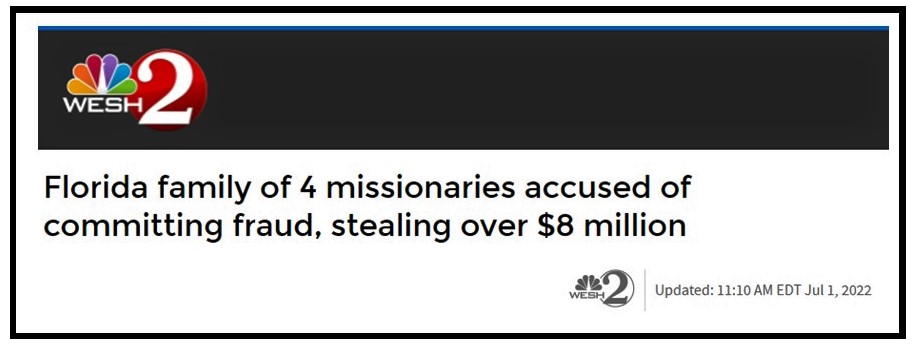
Yes, that would pretty great.

Unfortunately, according to the Mill Canyon Dinosaur Trailhead Interpretive Site website, “Access to the site is currently restricted”:

That’s the aforementioned boardwalk replacement project.

The project completion date is not mentioned on the website, because it’s unknown.

The completion date is unknown due to this:

“…in January, a construction crew working to replace a boardwalk for viewing the dinosaur fossils left marks of their own, damaging some of the specimens and even repeatedly driving over one of them, according to an assessment dated March 8 but made public last week by the Bureau of Land Management, which staffed the crew.”

This crew that did the damage wasn’t a bunch of know-nothing outside contractors hired by the BLM:

They were BLM employees.

Here’s that 14-page March 8, 2022 assessment by Brent H. Breithaupt, BLM Regional Paleontologist, Wyoming State Office:

Breithaupt notes that “…crews drove a truck, trailer and a backhoe with a forklift onto the site to disassemble the old boardwalk…” and, “…that a trace fossil left by a prehistoric crocodile ‘was repeatedly driven over,’ resulting in fractures.  At another area containing footprints from theropods, ornithopods and sauropods, there were tire tracks and signs of heavy foot traffic…”

According to this January 31 story on a Salt Lake City TV station:

The story says that on January 30, Salt Lake County resident Jeremy Roberts traveled to Moab to take photos of the damage – here are two of them:

A third Roberts photo shows one print believed to be more than 116 million years old, shattered:

“It lasted 116 million years until the BLM decided to drive on it,” Roberts said.

In his report, Breithaupt said “that because the BLM did not consult paleontologists on the plans, crew did not know which areas to avoid.”

Wait a minute.

“Did not consult paleontologists”?

Breithaupt works for the BLM.  He’s the BLM Regional Paleontologist in the Wyoming State Office.

And the BLM brainiacs who developed this project never thought to call Breithaupt and say, “We’re going out to the Mill Canyon site to replace a boardwalk and we’re bringing a truck, trailer and a backhoe with a forklift.  Do you maybe want to meet with the crew and, um…sort of point to what they shouldn’t to drive over and damage?”

Maybe the BLM figured Breithaupt was in Wyoming, too far away?

Well, how about calling Jim Kirkland, a Utah Geological Survey paleontologist?

Or how about calling the Lee Shenton, president of the Moab chapter of Utah Friends of Paleontology?  Utah has its own Friends of Paleontology, for Heaven’s sake!

Or maybe the BLM could have called their “Utah Featured Partners,” located right there on the BLM website:
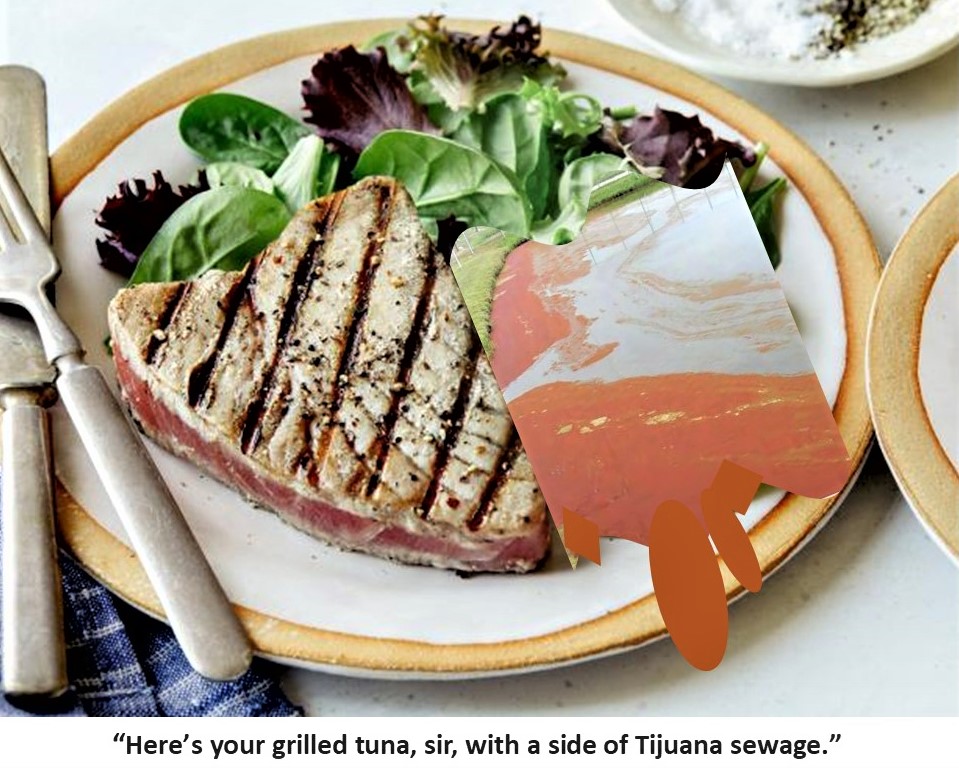
Or – how about Jeremy Roberts, the Utah guy who took the above pictures of the damaged areas?  Jeremy’s 14-year-old son Kenyon was with him that day, and said,

“The only place on earth where we have running tracks of a dromaeosaur-type dinosaur – raptors.  It’s devastating what they have done.”

A 14-year-old knew better.

But that BLM crew didn’t.

So I vote for the BLM crew being included in the next edition of…

Why, some may be wondering, does the Mill Canyon damage matter?

Here’s what I learned from my research:
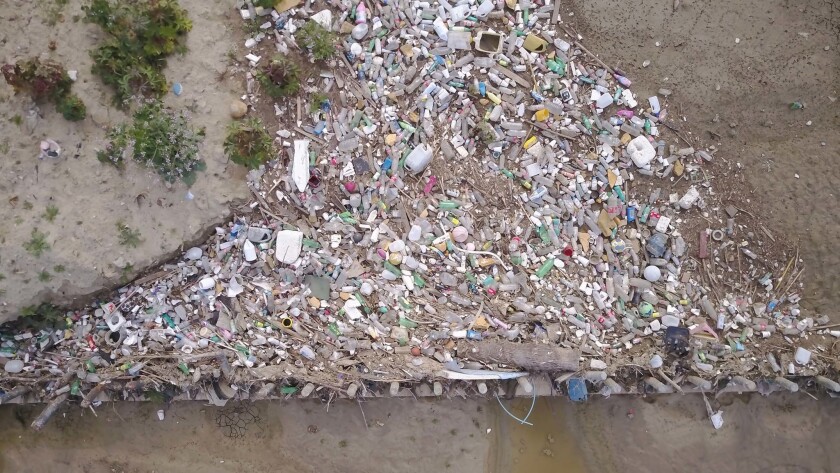
It matters because the Mill Canyon Dinosaur Tracksite is one of the largest and most important Early Cretaceous (about 112 million years ago) tracksites in the world, with more than 200 tracks and trace fossils of at least 10 different animals.

It matters because theropods, sauropods, ornithopods (pictured), ankylosaurs, birds and crocodiles are some of the tracks and fossils.  Some of the animals were unknown to the area before being spotted here. 

It matters because the Mill Canyon Dinosaur Tracksite is ranked as a top-10 dinosaur tracksite in the U.S.

And it matters because – as yet another expert who wasn’t consulted – put it:

“They’re not making any more dinosaurs, so these tracks in some ways are like an endangered species – and we really need to protect them like one.

Patrick Donnelly, Great Basin director at the Center for Biological Diversity, summed this fiasco up succinctly:

“This careless disregard for these irreplaceable traces of the past is appalling.  It really calls into question the bureau’s competence as a land-management agency.”

Back in late January, when the Salt Lake City TV station asked the BLM about the damage, the BLM responded with a statement that said in part,

“During that effort, heavy equipment is on location, but it is absolutely not used in the protected area.”

Then, on February 9, according to this and other articles:

The BLM walked back their late January statement as follows:

“A BLM regional paleontologist conducted a site assessment of the Mill Canyon Dinosaur Tracksite and is finishing a final report.  He has preliminarily determined that some damage occurred to dinosaur footprints at the project site, and this is unacceptable.  Work is stopped at the site until the final paleontological site assessment report is complete, which is expected in three weeks.”

You know what’s “unacceptable?”

This:

The article also said,

“The Bureau of Land Management used one of its own construction engineers in the Moab area to conduct the work and apparently did not flag the site and tracks, which was a provision required under its own analysis.”

Dinosaur fossils that survived for 112 million or more years…

Damaged – some, perhaps, destroyed – in a matter of hours by humans from BLM who apparently ignored the BLM’s “own analysis.”

Cost to us taxpayers?

Immeasurable.

Cost to the Mills Canyon Tracksite?

Unfathomable.

It’s small no comfort that the BLM also said it would take public input and work with paleontologists before resuming construction of the new boardwalk.

Now, after the damage has been done and made public…

Now, the BLM will work with paleontologists on a paleontological site!

Heads-up to the BLM:

Before your crew starts rolling into Mills Canyon again with their truck, trailer and a backhoe with a forklift…

Call Kenyon Roberts.

He’s 14, but clearly has more brains than all of you put together:

Described as a “dinosaur fanatic,” Kenyon Roberts in 2017, holding a model of an Allosaurus claw in his dinosaur-themed room.

Book Review:  The Third Time’s The Charm

Publication date:  January 2022

Category:  Women’s Friendship Fiction

Review, short version:  Four roses out of four.

Review, long version:

I recently read a novel that was the third – all within a month – that featured young women in what I would call unusual circumstances.

The first was Shoulder Season, about a 19-year-old American woman who becomes a Playboy bunny in 1981.  I thought it was dreadful and didn’t finish it.

The second was The Show Girl, about an 18-year-old American woman in 1927 who joins the Ziegfeld Follies.  I thought it, too, was dreadful, but I finished it because I was running out of books to read.

I was beginning to think novels about young women in what I would call unusual circumstances and I were not a good match.

London debutantes in the 1950s – another night out on the town.

The third was The Last Dance of the Debutante, about an 18-year-old English woman in 1958 who is among the select few to be presented to the queen as a debutante – the last time this antiquated ritual would take place.

This I not only finished, but I enjoyed it – very much.

Though not at first.

We meet “bookish” Lily Nicholls whose very distant Mummy and very critical Grandmama insist that she have a “season.”  In Great Britain that meant a presentation to the queen, followed by endless rounds of parties (called “drinks”) and balls where Lily will meet other debutantes and more importantly, meet eligible bachelors (because the whole point of the season is to find a husband, preferably titled and rich).

Lily would rather not.  Lily would rather be preparing for taking her entrance exams to attend Cambridge University.

But – she feels obligated to please Mummy and Grandmama, for reasons that will become clear. 

So we join Lily on her introduction to “Society with a capital S,” as described in this article:

“These royal parties had once been the entire raison d’être of the London Season, that period between April and August when the elite and would-be elite came together at a glittering array of social and sporting occasions from opera to Ascot.  

“A debutante’s presentation at court – the queuing, the nerves, the sovereign acknowledging the practiced curtsey with a glimmer of a smile before the deb was quickly moved on so that the performance could be repeated with the next girl, and the next, and the next – this was what marked a young woman’s coming out into Society with a capital S, her arrival on the marriage market, her transition to adulthood, and her admission to a privileged elite.”

From page one, I experienced two strong feelings:

One – how trivial all this debutante stuff was.  I had to keep reminding myself the story was taking place 64 years ago, and to not view events of 1958 with my 2022 mindset. 

May 1950:  Debutantes at the Queen Charlotte’s Ball, where they were required to bow to a large cake!

Second – I disliked how Lily acquiesced to everything her mother and grandmother demanded.  “Grow a spine!” I kept thinking.

But Lily didn’t need to grow a spine – she already had one.  She just needed to use it.  And when she does, she doesn’t hold back.

Part way into the Season, when her mother orders her not to associate with Leana, a new friend, Lily says:

“I’ve been presented.  I’m going to teas and luncheons and drinks and dances.  I’ll have the same conversations with the same people night after night.  I’ll do whatever you and Grandmama ask of me to help advance myself as a debutante, but I will not stop seeing Leana Hartford…because I’m a woman now.  I should be able to choose my own friends.”

Take that, Mama!

Lily’s journey through Society takes her on an unintended journey into her past, where she discovers things that shock her – and surprised me.  I’m rarely surprised by plot twists, so when I am, it’s a definite plus.

Another plus – as I approached the denouement in The Last Dance of the Debutante, I couldn’t stop reading.  As the saying goes, “I couldn’t put it down!”

I don’t remember the last time I felt that way about a book.

Hope you feel the same.

“No Center Line” – This Is A Good Idea…

Take a look at this image:

It’s a common sight – two very different vehicles sharing the road, one a car and one a bicycle.

What’s the difference between these two vehicles, aside from the obvious car and bike?

In California, to operate their car the owner must pay a vehicle registration fee which includes money for road repair and maintenance.

But to operate their vehicle, the bike owner pays…

Nothing.

Car and bike owners using the same roads, but only car owners pay a vehicle registration fee for the roads.

Now, every state requires owners of motor vehicles to pay a vehicle registration.  But since I live in California, and this story takes place in California, my focus is here.

In California it’s expensive to register a car – we’re the 10th highest in the country.  And that got more expensive in 2018, when the state legislature passed a new “Transportation Improvement Fee (TIF)” based on the value of the vehicle:

The purpose of the TIF is “to provide additional resources for the state to repair infrastructure and for road maintenance.”

And – no surprise here – the TIF is set up to increase every year.

OK, I get that.  As an automobile driver, I use the roads.  I want the roads maintained and improved and made safer, and since I use the roads, I accept paying for that.

Bicyclists also use the roads, and the bike owners pay…

Nothing.

Including no Transportation Improvement Fee.

And yet, in California – and elsewhere – in recent years there’s been a huge and expensive effort to add or upgrade bike lanes for, we’re told, the safety of both bicyclists and motorists.

And I’m all for the safety of both bicyclists and motorists.

But I think this has gotten out of hand.

Here’s one local example that began in 2013:

And by 2021 the cost had morphed into this:

“One thing not in question about bike lanes is the eye-popping nature of the latest estimated cost of the planned 77-mile, regionwide network.  The price tag was once $200 million.  Now…the cost has more than doubled to $446 million.”

“More than one person has done the math:  The new estimate brings the cost of the bike network to $5.79 million per mile.”

The SANDAG headline above says the funding for this is coming “from local sales tax as well as state and federal governments.”

And sure, bicyclists pay those taxes.

So bicyclists are helping to pay for the “77 miles of bikeways.”

I also pay those taxes.

I, however, in my vehicle, cannot use many of those bikeways, when they look like this:

But my taxes help pay for them.

Now let’s go to the story I mentioned earlier, this time about a scaled-down local example of bike lane mania.  I’ve been unable to find a cost for this, but that’s OK, because what I’m focused on is the stupidity of it.

This story is about a road, and bike lanes, and an arrangement not seen before in San Diego:

Now, we’re used to seeing yellow road signs – there are all sorts of yellow signs out there:

But I’m betting you’ve never seen one that says, “No Center Line.”

This contradicts what we learned in driver’s ed, and from our own driving experience:

Two-way roads are divided by center lines:

Broken, double or solid, the lines tell us this is my side of the road, and the other side is for oncoming traffic.

In this case, having a yellow sign that says “No Center Line” means there’s one lane for vehicles coming from both directions.

It’s the same as having a sign like this:

So, where is this road with “No Center Line” and why doesn’t it have one?

It’s in Mira Mesa, a community and neighborhood in San Diego:

Specifically here, and it’s a four-block stretch of Gold Coast Drive:

The yellow “No Center Line” sign is perched atop another, even scarier sign:

“Vehicles Share Center Lane”???

What is this – a city-sanctioned invitation to play chicken in our cars?

Vehicles Share Center Lane???

Well…it’s all to accommodate people on…guess what…

Bicycles.

Here’s the sign in full:

According to a Gold Coast Drive resident, prior to the new signs and paint job on the street:

“We didn’t have a problem.  The bicycle lane [was] in the middle.”

What the resident was referring to is called “sharrows”:

So this four-block stretch of Gold Coast Drive had bike lanes and a divided street. 

Then it all changed.

The new lines – and the signs – suddenly appeared “unannounced,” as this April 4 story put it:

The story was accompanied by a video which shows the – as promised – “No Center Line”:

And residents on this stretch of Gold Coast Drive were, as the above headline suggested, frustrated and confused.

And fearful, according to this April 4 story:

The people who live on this stretch have plenty of reasons to “fear a horrific crash is coming.”

Drivers have plenty of reasons to be fearful, as well.

And so do bicyclists.

In fact, one guy on his bike saw the crew from CBS and said:

“This is fricken asinine!  With distracted drivers, now you have people that have to drive head-on toward each other in cars.  They have to play bumper cars at the last minute to get away.  This is utter lunacy!”

Even a bicyclist thinks this is crazy.

Let’s go back and look at the full sign again:

Now let’s say you’re not familiar with the area and you’re driving on that stretch of Gold Coast Drive.  We all know that for safety’s sake, your eyes shouldn’t leave the road for more than one second, two at most.

You see a road sign that you’ve never seen before.

In that one or two seconds you’re supposed to read, comprehend, and react as needed to a two-part sign with two colors, three messages, and seven images.

And the images indicate that if an oncoming car is sharing your single center lane, you must move to the bike lane unless there’s a bicyclist in the bike lane in which case you’re supposed to drop behind the bicyclist but by the way watch out for those parked cars!

Did you take all that in, in the one to two seconds you spent looking at the sign?

Me, neither.

In this article – speaking of playing chicken – we learned that this setup is called “advisory bike lanes”:

So nobody who lives there knew this was coming, and they aren’t the only ones:

“‘We thought it was a mistake by the striping crew,’ said Councilman Chris Cate who represents the area.  ‘I have never seen these lanes in my life.  I have never been briefed on it, told about it.’”

But it turns out that lots of people knew about the advisory bike lanes.

And when the residents started complaining and the media started doing stories, those people-in-the-know started responding.

They were very-sort-of-not-really sorry they hadn’t bothered to give the residents a heads-up about the change.

In fact, all sorts of people were leapfrogging over each other to offer either apologies or sort-of-not-really apologies. 

Here’s one:

“This is the first time advisory bike lanes have been installed in San Diego.  As such, we acknowledge that more robust community outreach should have been done far sooner to inform neighbors in Mira Mesa about the plans and how the road is used.”  – City Spokesperson Anna Vacchi Hill

Here’s another:

“The Director of Transportation, Jorge Riveros, apologized for not notifying neighbors before last week’s restriping.  He announced all similar bike lane projects are being put on hold.  

“‘I completely understand the frustration that it wasn’t rolled out with a good education and outreach program.  We’re owning that,’ Riveros said.”

This last was from the Director of Transportation.  Then then whole damn Transportation Department apologized in a statement:

“We are sorry.  We neglected to do proper outreach and to seek feedback in advance of this installation.  We will do better.  Signage has been posted and our teams are working to provide more transparency in our process.  Thank you for the opportunity to explain.  We want to collaborate with you.”

Here’s another one:

“CBS 8 asked him [a city spokesperson] how someone could drop the ball on something as important as notifying neighbors that drivers will suddenly being heading straight at each other. “You’re right,” said Jose Ysea. “It’s a major miscommunication.’”

“Ysea says the transportation department was supposed to notify residents before the striping happened, but somehow that slipped through the cracks.”

I love that “somehow slipped through the cracks.”  What he’s actually saying is, “Not my fault!”

Here’s yet another:

And another:

“Mayor Todd Gloria also released a statement to FOX 5 apologizing for the city’s lack of communication and saying in part:

“‘I have directed the transportation department to halt the deployment of this new type of bike treatment until we can appropriately convey what criteria are being used to site these advisory lanes and how residents can be engaged and educated on how to use them safely.’”

You see what I mean about “sort-of-not-really apologies.”

And then there was this guy, whom I really wanted to smack:

“I think it certainly is warranted to say this is – its paint and thermoplastic so there is the option to return if we do find that conditions aren’t right for this particular treatment,” transportation department spokesperson Everett Hauser said.

“We know that humans make mistakes.  There will be crashes, but what we hope is that they are of a slower speed that they are not severe or fatal for any of the participants.”

Heads-up, Everett.  I want you to write this on the blackboard 100 times:

For now, it looks like Mira Mesa and the residents of this stretch of Gold Coast Drive are stuck with this:

And this:

But…we “hope” …

Not this:

In the meantime, remember the TIF – Transportation Improvement Fee for cars?

I recommend that California require a vehicle registration for all bicyclists, and institute a TIF for bicycle operators.

But instead of the amounts being based on the value of their vehicles, let’s make the amounts based on the number of their infractions:

Update:

On April 8 the City of San Diego announced they “will be removing the advisory bike lane recently installed on Gold Coast Drive.  The street will be restriped to its original lane design with bicycle ‘sharrows.’”

Mayor Todd Gloria said,

“Going forward, for other locations in other parts of the city, we need to sit down.  We need to have the conversation to explain it and hopefully come to agreement and support.  In certain cases where that doesn’t happen at least people will be informed.”

Translation:  If residents and drivers and bicyclists don’t like it the new arrangements…

Tough shit.

And when this happens…

Ditto.

Earlier in this post I said I’d been unable to find a cost for this fiasco, but that was OK because my focus was on the stupidity of it.

Now I was wondering about the cost of the doing and undoing and redoing.

I contacted the City of San Diego Department of Transportation and talked to an unidentified staff member who was unauthorized to speak about this event, but did share this contractor invoice:

Some People Like To Make Recipes.  I Like To Make FUN Of Recipes.  Especially When They Have Headlines Like This:

On a weekly basis, my newspaper’s Section C is devoted to food.

As am I, on a daily basis.

I enjoy looking at my newspaper’s color photos of various dishes, and imagining these goodies magically transitioning from page to plate.

My plate.

I also enjoy chortling over the occasional misnomers, like the headline above.

“A little work”?

Let’s see what “a little work” looks like.

I suspect there’s going to be a big difference between what the recipe author calls “a little work…”

And what I call “a little work.”

Here comes the Spicy Chicken Parm, with this caveat…

“Parm” stands for either:

  1. Parmesan cheese
  2. Persistent AntiRadiation Missile (pictured)

How about we all agree that in this instance, we’ll go with #1?

Good.  Here’s the image:

The article starts with an almost-500-word essay – including four bulleted items – about why we should try this recipe, and includes words like “easy” and “friendly.” 

My idea of “easy” is unscrewing a wine bottle cap.

My idea of “friendly” is drinking the wine.

So that’s the why.

Now comes the what – the recipe – and this required a 103-word introduction that reiterated the why, and noted “this recipe can be easily scaled up to feed a crowd.”

A “crowd”?

My idea of feeding a “crowd” is unscrewing several wine bottle caps.

The recipe introduction is followed by the list of ingredients.

There are 21 of them.

Twenty-one ingredients in this “easy” and “friendly” recipe.

I don’t have 21 ingredients in my entire kitchen, unless you count individual packets of sweet-sour sauce.

Now comes the how – how to make Spicy Chicken Parm.

Another 500 words.  After this you can honestly say, “I’ve spent the day reading!”

The how is divided as follows:

For the Chicken
For the Sauce
For the Assembly

For crying out loud!

But before we can start “For the Chicken” et cetera, I see that the author snuck a bunch of verbs into the ingredients list that must come first. 

That can of tomatoes?  They have to be “coarsely crushed by hand.”  The pepper has to be “freshly ground,” the egg has to be “beaten,” and the basil leaves have to be “torn.”  And not just torn, but “torn into small pieces.”

This is work before you start the work.

The how is awash with verbs, all denoting work – I counted eight just in the first paragraph:  cut, separate, trim, discard, pound, repeat, pat, and season.

Hey – if I’d wanted a workout, I’d have gone to the gym.

Not that I’ve ever wanted a workout.

The how also that assumes that your kitchen is as well-stocked with cooking accoutrements as a stage set on a food competition show, starting with a “meat tenderizer.”

Is this a meat tenderizer?

I use this thing only for breaking up the ice in my freezer.

The accoutrements list continues:  A food processor.  Plastic wrap.  A pepper grinder.  An instant-read thermometer.  A baking sheet.  A large nonstick skillet.  A wide spatula. 

What if my only large skillet is sticky?  And my only spatula is narrow?

Sure, this Spicy Chicken Parm looks good.

But to sum it up, if I were to make this Spicy Chicken Parm, for just the prep work I’m figuring three days: 

Day 1:  Read entire article.  Take a nap.
Day 2:  Shop for all 21 ingredients.  Take a nap.
Day 3:  Shop for the kitchen accoutrements I’ll need, which is all of them.  Take a nap.

All this, for a Chicken Parm recipe the author described as “a little work”?

No.

This is “a little work”:

Nice Kitty.  Now, Go Away, Kitty.  Far, Far Away…

The City of Irvine, CA is about 40 miles southeast of Los Angeles and has a population of 304,408.

Make that 304,409.

Here’s the newest resident:

In late March on a nice spring day around 1pm, according to this story and many others:

The mountain lion – they’re also known as cougars – prowled the parking lot, and strolled past these outdoor diners…

…who, instead of looking for a place to hide, stood up like they were at a football game watching their team score the winning touchdown.

At one point an officer shot the cougar with a taser gun…

…but the cougar just kept going and going and going.

Eventually it walked in through the open door of a business and past this employee…

…who survived the encounter unscathed.  The employee had just arrived from Great Britain, and I’m betting he couldn’t wait to get back there.

The mountain lion was a 200-pound male.  Animal control officers were able to sedate him:

The officers took the big cat to a vet whose procedure include this glamour shot:

And lest you have any doubt about how big this cat was:

The mountain lion was pronounced the healthy, and the next day:

He was released back into the wild.

Going back to Tuesday, after the mountain lion was caught, the Irvine Police Department (IPD) – whose motto is “Serve, Protect, and Produce Awful Puns” – crafted this for Facebook:

When The Going Gets Tough, The Tough Go Bowling

Last Thursday evening a new sitcom debuted on CBS called How We Roll.

The only reason I knew this was because it was the cover story of my TV Weekly:

When I opened the magazine there was a story about How We Roll, and the first sentence began:

“In 2008, Tom Smallwood of Saginaw, Michigan…

That caught my eye, because I’m from Michigan.

In case you’re wondering, Saginaw’s population is around 47,500, and it’s located here:

I continued reading about How We Roll and learned that:

  • The TV show is based on a real person.
  • That person is an underdog – a competitor thought to have little chance of winning a fight or contest.
  • This underdog doesn’t stay an underdog.

These are a few of my favorite things.

I love true stories about underdogs, dark horses, longshots – whatever name we call them. 

They’re people – or in some cases, animals – whom everybody knows can’t make it to the top.

But they do.

It turns out that Tom Smallwood from Saginaw, Michigan (pictured) is just such a story.

You saw the TV Weekly cover above – the guy is holding a bowling ball.

Bowling is not an interest of mine, but I’ve been aware of it since I was a kid.  My brothers liked to bowl, at one time to the level of owning their own bowling balls and bowling shoes. 

I tagged along once, and remember those long, smooth wooden lanes, the heavy, dark balls landing on the wood with a loud thud, the rattle as the bowling pins split and scattered.

And the elation bowlers felt when all the pins fell on a first throw:

And the contortions bowlers go through in the process:

And the frustration when things don’t go well:

This bowler’s dad told him to get a regular job or he’d end up in the gutter.  Looks like his dad was right.

Over the years I came to understand that while I didn’t care for bowling, many people did, and do.  According to this article:

“Bowling is the number one recreational activity in the U.S.!  A recent study showed that 67 million people bowled at least once in the prior year.”

Another article said,

“According to The Bowling Foundation, more than 25 percent of Americans bowl each year, making it the nation’s largest participation sport.  Today, bowling is a $4 billion industry with nearly 3,000 bowling centers in the United States.”

And I’ve learned that bowling is big business – show business and money business. 

Show business:  One example – an article on 11thframe.com said “The 2020 PBA (Professional Bowlers Association) Tournament of Champions TV finals on FOX drew an average of 1,464,000 viewers…”

Money business:  According to this article:

The average top pro bowlers with PBA memberships “clear around $250,000 to $300,00 a year,” not including sponsorships.

Which brings us back to Tom Smallwood of Saginaw, Michigan.

Tom wasn’t earning his living bowling.  He liked to bowl and had since he was a kid.  He bowled in college, then in bowling leagues in and around Saginaw, and he dreamed of bowling professionally. 

But Tom was also a realist. 

His bio on Wikipedia says,

“Smallwood found a job at a metal shop since his then-girlfriend (now wife) Jennifer would not marry a man without a regular paycheck.  At age 30, Tom had decided he was ‘done’ with trying to be a full-time bowler.  He then got a job at the General Motors Pontiac East Assembly Plant in the spring of 2008.”

As this article put it:

“…he was able to get a job installing screws into seat belt assemblies on Chevy Silverados, twisting in 1,200 screws a day on 400 Silverados for $16 an hour.”

In 2008 Tom had a wife and a child and a job at GM.

On December 23, 2008 he was laid off from his GM job.

On December 13, 2009 he won the PBA World Championship:

As this 2010 Sports Illustrated article put it:

“From the assembly line to the unemployment line to the PBA championship”

Of course, Tom didn’t just hop from underdog to top dog.

Again, according to the Michigan Live article, after Tom lost his job:

“He sent resumes to Lowe’s and Home Depot.  While waiting for a response, Smallwood practiced [bowling] hour after hour, day after day at State Lanes in Saginaw, working his way toward the May PBA trials and hoping to finish in the Top 8 and earn a PBA exemption for the upcoming season.

“He was third.”

Of course I didn’t know what a PBA exemption was, so I looked online:

“Bowlers want to earn exemptions because it means they can bowl in all PBA events for the length of their exemptions without having to go through the Tour Qualifying Round (TQR).  An exempt bowler can pick and choose any PBA Tour events and is guaranteed a spot.”

I’m not sure I understand that, but there’s a lot I don’t understand about a sport where getting three strikes in a row is a “turkey,” four strikes in a row is a “four-bagger,” and a “boomer” is a bowler who throws a hooking ball.

Whatever that is.

Since that 2009 championship Tom, now 44, has three PBA Tour titles, two of which are majors.  He’s finished runner-up in two other PBA major championships and won more than $600,000.

And I’ve gotten two very strong impressions from the many articles I’ve read about Tom.

First:  The loving support Tom got – and continues to get – from his wife Jennifer is a huge part of why his dream came true.  I’m sure it helps that she’s a bowler, too – in fact, they “began their romance in a bowling alley,” according to this 2010 article:

It took time for Tom to qualify for that 2009 PBA World Championship, and then time to get to the event in Wichita, Kansas – driving, the article notes, “for 15 hours, with 31 bowling balls in his car.”

Tom came, he bowled, he conquered.

“For him to be an assembly worker,” said Jennifer, “and fall back on a talent that has been there and to work hard and have another door open for us – it’s wonderful.”

My second strong impression?

That after all the titles and wins and money and media coverage – and now, a TV show based on his success – Tom is still a modest, unassuming guy who doesn’t take his success for granted.  In the many articles I’ve read, he’s consistently, refreshlingly modest:

On winning that 2009 PBA World Championship:

“‘Every emotion you could possibly imagine went through my head.  [I] tried to fight back tears, I mean, because this is a dream.  I mean, to hold that trophy…it’s a dream come true.’”  – Michigan Live, December 14, 2009

In 2013, on winning the Scorpion Championship for his second PBA Tour title:

“‘I thought if I ever made another show and won, I’d bawl like a baby, but I was so emotionally drained, I didn’t have any emotions left.’

“‘It’s amazing.  I never dreamed in my life I’d have one (title), so to have two?  As a kid, all I ever wanted was a chance to be there.  I watched these guys on TV forever.’”  – BowlingDigital.com, 11/3/13

About his 2022 season:

“‘It’s been a so-so season so far.  I’ve been bowling OK, but there’s definitely room for improvement.”  – Michigan Live, March 29, 2022

Finally, here’s another great quote – this from the CBS description of How We Roll:

“Here’s the thing Tom Smallwood knows about bowling:  You get two chances.  No matter what you do with the first ball, you get another roll to make it right.  A story of the ultimate second chance…”

A Hero Named Halvorsen

I have an acquaintance, Karin, who emigrated to San Diego from Germany in the 1970s.  She was born in Berlin during World War II – not a good place to be. 

According to my research, during the war Berlin, the capital of Nazi Germany, was attacked with 363 air raids – by Great Britain, the U.S., France and the Soviets:

Berlin, post World War II.

Among the memories Karin has shared with me is one from after the war ended in 1945:  of U.S. planes flying over West Berlin and dropping candy, the first candy ever tasted by many Berlin children.

A sweet memory out of so many bad.

Her story came to mind when I read this article:

After World War II, Gail Halvorsen became known as the “Candy Bomber,” and he may even have been the pilot who dropped the candy that Karin had savored and still remembered.

Halvorsen (pictured) was part of a huge post-war effort:  the Berlin Airlift. It began in June 1948 with planes from the U.S. and Great Britain making nearly 300,000 flights to bring supplies to the more than two million starving people in West Berlin. 

World War II had officially ended in 1945, so why the need for the Berlin Airlift in 1948?

I’d heard of the Berlin Airlift and wondered about it, and now it was time to go for some semblance of understanding.  I went to many websites, crosschecking information, and here’s how I’ve summed it up for myself.

Caveat:  For my own understanding, I’ve simplified.  This is no more than the bare bones of a very complex chapter in our history.

The Berlin Airlift Began with an End – the End of World War II

It’s hard to believe – especially in these current times – that the Soviet Union was the ally of the U.S. and Great Britain during World War II.

It didn’t start out that way.  In August 1939, shortly before the war broke out in Europe, Nazi Germany (led by Adolph Hitler) and the Soviet Union (led by Joseph Stalin) signed the German-Soviet Nonaggression Pact, in which the two countries agreed to take no military action against each other for the next 10 years.

Stalin, left, and Hitler.

Then, in June 1941, Nazi forces invaded the Soviet Union, and the German-Soviet Nonaggression Pact fell apart.

The Soviet Union became a U.S. ally, and the three great Allied powers – Great Britain, the United States, and the Soviet Union – formed a Grand Alliance that was the key to victory.

But when it came to Stalin, no one ever confused “ally” with “friend.”

Despite their wartime alliance, tensions between the Soviet Union, and the United States/Great Britain, intensified rapidly as the war came to a close and the leaders discussed what to do with Germany.  Post-war negotiations took place at two conferences in 1945, one before the official end of the war, and one after.  These conferences set the stage for the beginning of the Cold War and a divided Europe.

The first conference was in February 1945 Yalta, Crimea.  Though the war hadn’t ended, the Allies were confident of a victory, and U.S. President Franklin D. Roosevelt, British Prime Minister Winston Churchill and Stalin met to discuss the reorganization of post-WWII Europe:  

Front row, left to right: Churchill, Roosevelt and Stalin.

A number of outcomes emerged from the conference, and the one I’m focused on is this:

Unconditional surrender of Nazi Germany, the division of Germany and Berlin into four occupational zones controlled by the United states, Great Britain, France and the Soviet Union.

Hitler committed suicide on April 30, 1945, ending the war in Europe.

The second conference was in July 1945 in Potsdam, Germany.  There was a change in the conference participants:  Roosevelt had died in April, so his successor, President Harry Truman, represented the United States.  Churchill returned to represent Great Britain, but his government was defeated midway through the conference and newly elected Prime Minister Clement Attlee took over.  Stalin returned as well:

Front row, left to right: Attlee, Truman, and Stalin.

Here are the two outcomes I’m focused on:

The decentralization, demilitarization, denazification and democratization of Germany.

The division of Germany and Berlin, and Austria and Vienna into the four occupations zones outlined at the Yalta Conference.

So the Allies divided Germany into occupational zones controlled by the United States, Great Britain, France and the Soviet Union:

Here’s one of the many problems:

Berlin, the capital of Germany, was located in the Soviet Zone.

So the powers also divided Berlin into four zones:

And there we have post-war Germany: 

A Divided City, a Divided Country and the Beginning of the Cold War

The term “cold war” was coined by presidential advisor Bernard Baruch in 1947.  He was giving a speech in the South Carolina House of Representatives about industrial labor problems in the country, but the media picked up on the phrase as an apt description of the situation between the United States and the Soviet Union:  a war without fighting or bloodshed, but a battle nonetheless.

In Berlin – the divided city in the divided country – relations between the Western powers and the Soviet Union had gone from allies to hostile.  There was great worry about whether the western occupation zones in Berlin would remain under Western Allied control or whether Stalin would absorb the whole city into Soviet-controlled eastern Germany.

This led to the first Berlin crisis of the Cold War:  In an attempt to squeeze the U.S., Britain and France out of the capital city within Soviet-occupied eastern Germany, on June 24, 1948, Soviet forces blockaded rail, road, and water access to Allied-controlled areas of Berlin.  The Soviets cited the cause as “technical difficulties.” 

The only way for the Allies to get food, fuel and other necessities into those Allied-controlled areas of Berlin was by airlift from Allied airbases in western Germany.

We call this magnificent effort…

The Berlin Airlift

The United States launched “Operation Vittles” on June 26, 1948 when 36 U.S. cargo planes laden with milk, flour, and medicine took off for Berlin.  The United Kingdom followed suit two days later with “Operation Plainfare.”

For 18 months, American and British aircrews literally flew around the clock bringing coal, food, medicine, and all the other necessities of life to the two million+ inhabitants of war-ravaged West Berlin:

By prior arrangement before the Soviet blockade, the U.S., Britain, and France had secured air rights to three narrow 20-mile-wide corridors over east Germany into Berlin.  The shortest was 110 miles long.  Aircraft were flown into Berlin along the northern and southern corridors.  All planes leaving the city used the central corridor:

To the immense relief of the Western powers, the Soviets made no effort to shoot the aircraft down.  The only resistance they offered was occasional harassment – like sending fighters to “buzz” the cargo planes, flying close to them in an effort to frighten the pilots.

Shipments during the first week were light, averaging no more than 90 tons of supplies per day.  By the second week, they had increased to an average of 1,000 tons per day.  The number of planes assigned to the airlift steadily grew during the summer, so that by mid-August, the supplies reaching West Berlin had reached an average of 4,500 tons daily.

Gail Halvorsen – The Candy Bomber

I talked about Gail Halvorsen earlier on in this post.

He was one of the Berlin Airlift pilots.

According to the AP article at the top of this post:

“After the United States entered World War II following the attack on Pearl Harbor, Halvorsen trained as a fighter pilot and served as a transport pilot in the south Atlantic during World War II before flying food and other supplies to West Berlin as part of the airlift.”

Halvorsen had mixed feelings about the mission to help the United States’ former enemy after losing friends during the war, but that changed when he met a group of children behind a fence at Tempelhof airport in West Berlin:

“He offered them the two pieces of gum that he had, broken in half, and was touched to see those who got the gum sharing pieces of the wrapper with the other children, who smelled the paper.  He promised to drop enough for all of them the following day as he flew, wiggling the wings of his plane as he flew over the airport, Halvorsen recalled.

“He started doing so regularly, using his own candy ration, with handkerchiefs as parachutes to carry them to the ground.  Soon other pilots and crews joined in what would be dubbed ‘Operation Little Vittles.’”

Then-Lt. Gail Halvorsen demonstrates how handkerchief parachutes were used to drop sweets (at an interview in New York in 1949).

“Allied pilots flew 278,000 flights to Berlin, carrying about 2.3 million tons of food, coal, medicine and other supplies.

“Finally, on May 12, 1949, the Soviets realized the blockade was futile and lifted their barricades.  The airlift continued for several more months, however, as a precaution in case the Soviets changed their minds.”

After returning home in January 1949, Halvorsen remained in the Air Force and retired in 1974.

Halvorsen won numerous awards and international acclaim, and was beloved and venerated in Berlin.  He last visited in 2019 when the city celebrated the 70th anniversary of the day the Soviets lifted their post-World War II blockade cutting off supplies to West Berlin with a big party at the former Tempelhof airport in the German capital.

Throughout his retirement he continued to lead an active life, including as founding director of the Gail S. Halvorsen Foundation starting in 2016:

The foundation was organized by a group of Civil Air Patrol (CAP) members in Utah to promote the Candy Bomber story to future generations and to encourage interest in aviation.  CAP and the foundation share a common interest:  to help children gain a passion for science, technology, engineering and mathematics disciplines.

I was particularly struck by this image from the website, with numbers from both “Operation Vittles” and “Operation Little Vittles”:

Halvorsen died from respiratory failure in Provo, UT on February 16, 2022, at the age of 101.

So now I know the bare bones of the Berlin Airlift – the who, what, where, when and why.

I also know that Gail Halvorsen would be pleased that my acquaintance Karin, a child from post-war Berlin, fondly remembers and still talks about the American “candy bombers.”

A sweet memory out of so many bad.

This Is One Of Life’s Strange Juxtapositions

Homelessness is a problem in every state in our country.

According to the National Alliance to End Homelessness, this map shows the homeless count in the U.S. as of January 2020, “just a few weeks before COVID-19 was declared a national emergency.  Thus, the data does not reflect any of the changes brought about by the crisis”:

Because I live in California, I looked at our numbers:

And because I live in San Diego County, I’m more aware of local stories.

Like this recent story:

The homeless situation in the City and County of San Diego is dire, and getting worse.

And I will leave it to wiser heads than mine to offer and implement solutions.

Instead, what I’m thinking about is a juxtaposition that struck me as strange, here in this area of so many homeless people.

The estimate for San Diego County homeless humans run as high as 8,000, while also in San Diego…

Apparently $2.8 million is being spent at Birch Aquarium…

On housing…

For penguins.

These Little Blue penguins:

And it sounds like they’re going to have quite a nice place to live.  According to the Birch Aquarium website,

“This 2,900-square-foot exhibit will include rocky and sandy shore habitat and an 18,000-gallon pool where guests will observe the penguins socializing, interacting, and nest building.  The exhibit also includes a small amphitheater for guests to observe birds swimming, and a discovery cave to closely observe Little Blue Penguins on land and inside a nesting box!”

Here are some artist renderings:

Now, I’m not suggesting that we taxpayers are funding this.  On the contrary, money is being raised to build the penguins’ new home.

For example, the habitat’s name is Beyster Family Little Blue Penguins in honor of a $1 million gift from the Beyster Family.  Other “generous gifts” are also mentioned on the aquarium website.

Another source of funds is naming rights for 10 of the penguins:

And a Birch Aquarium news release said, “There are still many opportunities for the community to support the Little Blue Penguins habitat.”

I wish the aquarium good luck with their fundraising, and I wish the penguins a lovely time in their new home.

It’s just that…

The juxtaposition of 8,000 homeless humans…

…and a $2 million+ home for 10 penguins…

Well, I think Scarlett O’Hara in Gone With the Wind said it better than I could:

That morning Will had taken the horse to Jonesboro to get him shod.  Scarlett thought grimly that things were indeed at a pretty pass when horses had shoes and people’s feet were as bare as yard dogs.

Two In One Day Was…

This is a memo to all media:

Local and network television, cable, radio, print, online, billboards, bus cards, and all other deliverers of news.

Stop it.

Stop it right now.

I’ve talked about this before and you obviously weren’t paying attention.

So now I’m going to get tough about it.

Tough about this:

About you misleading your news consumers with headlines like this:

To most eyes this looks like an innocuous headline.

And I’m not suggesting you’re spreading disinformation.

I don’t think you’re doing this intentionally or maliciously or for profit.

But as I said – misleading.

Oh, yes.

Let’s go back and look at that headline again:

“San Diego paying out $2.3 million.”

No, no, no.

Here’s the correct wording for that headline:

It’s the taxpayers who are paying – not “San Diego.”

You members of the media put this misinformation out at all levels:

City:

County:

State:

Federal:

But cities and counties and states and the federal government don’t pay.

We pay, with our…

And when stories appear about this city “paying” or that branch of the military “paying,” it lulls us into the mistaken notion that it’s not costing us anything.

And we say,“Did you see what the city is paying out for such-and-such?”

As though “the city” was some sort of entity that has some source of revenue that has nothing to do with us…

Taxpayers.

I want you purveyors of news to stop saying entities “pay,” and start saying that taxpayers pay.

I especially want you purveyors of news to stop saying entities “pay” TWICE in one day – this first, about an $85 million payout supposedly by the County of San Diego:

And this, about a payout supposedly by the Department of Justice:

Two in one day was two too many.

And once you stop, maybe…maybe…some of us taxpayers will start becoming more focused on where our tax dollars are going, and start asking our politicians…

“Why am I paying for that?”

And while I’m ranting about the media misleading news consumers, here’s another example, this one not tax-related:

The Catholic church doesn’t “pay” for anything.

The church’s money comes from its members.

Its 1.3 billion members who make what the church euphemistically calls “donations.”

Donations, meaning, “Pay up, or you’re going straight to…”

Donations, meaning those ubiquitous collection baskets seen wherever two or more Catholics are gathered together…

You know – where the guy with the basket gives you the stink eye if he thinks your “donation” isn’t large enough.

But the church doesn’t limit itself to just the collection basket at Sunday services.

While I was doing research for this post, I encountered a rather creative and very lucrative revenue stream the church has devised:

Sainthood!

Everyone’s heard of saints:  Saint Mary, Saint Joseph, Saint Cunegonde – well, maybe not that last one, so I included her picture above.  The church has thousands of saints; according to Britannica.com, “There are more than 10,000 saints recognized by the Roman Catholic Church.”

And you, too, can become a saint, or nominate someone for sainthood.

The latter is exactly what members of Our Lady of Victory National Shrine & Basilica in Lackawanna, NY have done, according to this 2015 article:

These suckers folks have…

“…raised over $250,000 in an effort to canonize its former priest, Father Nelson Baker.

“The funds cover the publication of materials about Baker, prayer cards, communication between the church and the Vatican, travel costs for visits to and from Rome and the fees of a canon lawyer.”

You can bet the church is collecting a hefty part of that $250,000.

When that article was written in 2015, it noted that “The church first appealed to Rome to have Baker canonized in 1987.  The case was approved in 2011.”

It took 24 years just to get an “OK, we’ll think about it” from the church.

That was the first step; there are more to go before the deceased is declared a saint.

It’s called The Canonization Game:

It looks like a board game, right?  Kind of a scaled-down version of Parcheesi, maybe?

Instead, this is from a book that details the canonization process, and you can buy it for just $4!

Here’s the website:

The folks in Lackawanna, NY have also have a website, this one all about the late Father Baker’s long road to sainthood:

A website where you, too, can donate money…

…to “Father Baker’s Cause for Canonization” because…

“The journey leading to canonization is long and costly, and much needed prayer and financial support needed along the way.”

They aren’t kidding about that “long” part.  This process started in 1987, and now – 35 years later – ole Father Baker is marooned in Step 2, “Beatification,” awaiting…

“…a miracle attributed to the potential saint’s intercession to be verified by the Vatican.”

These folks are – literally – waiting for the late Father Baker to perform a miracle.

And while they’re waiting…and asking for more money…and spending even more money…

The Catholic church…

FYI – after Step 2, there’s a Step 3, which requires yet another miracle.

And more money.

What’s it all mean?

It means that please, all of you news outlets, no more headlines this entity paying out money:

Or this entity paying out money:

Whether it’s taxpayers or church members or whoever is being parted from their money, please…

Just stop with the misinformation and…

This Quote is SO Me

Why is this Socrates quote SO me?

Because on a regular basis, I learn I know nothing about so many things.

If I had a dollar for every time I said, “I didn’t know that,” I’d be rich.

So I listen and watch and read and learn, and recently I learned something huge in what may seem an unlikely place:

An advice column.

Though some people sneer at the idea of reading advice columns – “What do they know?” – I don’t.

I’m a faithful reader of Carolyn Hax’s (pictured) advice column in my Sunday newspaper.

I like her because she’s smart, and tactful, and sympathetic, but doesn’t pull her punches.  She tells it like she sees it, and I think she sees things pretty clearly.

So I was especially glad when I read a recent column of hers, because a light bulb went on.  It wasn’t only good advice.

It was advice I needed.

The topic was setting boundaries, something I’ve always struggled with. 

Struggled with?

Hell, I didn’t even know I could set boundaries until I was an adult, and that was an adult with plenty of years, and plenty of bad experiences due to boundaries not set.

Online articles abound about why women struggle setting boundaries.  I believe it all comes down to this:

  1. I was raised to be a good girl, and expected – because I’m female – to be polite, please others, look a certain way, play by the rules, and never complain.
  2. A good girl sacrifices her own needs and well-being for others, otherwise, you’re selfish.  
  3. A good girl never hurts anyone’s feelings because that would not be nice.
  4. A good girl doesn’t set boundaries.

So a good girl can be taken advantage of, and disrespected, and left wondering, “Why do people treat me this way?”

First, I had to discover that there was such a thing as boundaries:

“Boundaries can be described as how emotionally close you let people get to you.  They are also where you draw the line within a relationship.  They say how much you are willing to give or take before requiring that things change or deciding to call it quits.”

Simple to define, but so difficult to enact.

Second, I had to learn how to set boundaries.

Third, I had to set a boundary.

And the first time I did, I was amazed.

The sky didn’t fall in.  The earth didn’t split apart.  There was a consequence – the relationship ended – but I was OK with that.

The person who’d been disrespecting me was no longer in my life.

I haven’t set many boundaries since, but now I knew I could do it.

Then I read Hax’s advice column, and found out I was doing it all wrong.

The person who wrote to Hax talked about her sister:

“I have repeatedly asked my sister not to discuss certain topics with me [such as my parenting] because I find her approach offensive and insulting.”

I could identify – most of us have a family member, friend, neighbor, coworker, someone in our lives who does the same or similar thing.

“When I try to establish boundaries, she blows them off, and tells me I have to accept the way she likes to talk about everything.”

Yup.  Sounds familiar.

Hax’s response went right to my heart:

“Your boundaries aren’t working because you’re setting them for your sister, when they need to be for you.”

“This is a common misconception.  It’s natural to think of boundaries as a kind of fence we put up to keep people out.  ‘Here is my new fence,’ we tell people.  ‘Do not go over it!’  You want to keep your sister out of certain topics, so you built your fence and told her to stay on her side of it.”

“The thing is, we can’t make people stop saying what they want to say.”

Effective boundaries, says Hax, aren’t about their behavior – they’re about our behavior.

Instead of telling the person to stop saying or doing something, Hax suggested saying:

“‘I will not discuss my parenting with you.’  It’s a tiny rephrase with a massive effect.  I will not discuss.”

Because that – what you say or do – is what you can control.

“She can criticize you as usual, every day, all day, and in response you can:  change the subject, ignore her text, delete her email, hang up the phone, leave the room, put in earbuds, crank the TV, practice your kazoo, start speaking in tongues.  You can employ whatever means you have available to ensure she’s talking to herself.”

This, said Hax, is disrespect-proof.

“Who cares if she ‘ignores any terms I have’ because your terms are for you and you will live by them no matter how badly she takes it when you leave her in the kitchen, talking to herself.  You can be available to her again, to have a relationship again, sure.  You just won’t be there to listen to her [stuff].”

After I read this, I started reflecting on the boundaries I’d set and how I could have done it differently. 

And I will do it differently next time, if I’m in another situation where I need to set boundaries.

They’ll be boundaries for me, not for her or him.

I started this post with the quote from Socrates, but that was only a partial quote – here it is in full.

It’s a comforting thought:

This Story Should Have Gotten A Lot More Attention

Throughout the pandemic we’ve been regaled with stories about new hobbies people picked up to while away some of those long hours being spent at home:

Many of those hobbies were unsurprising – reading, baking, cooking, gardening, mediation, writing.

There was also an interest in the surprising hobbies people started, and it became something of a contest to see who could outdo whom:

Similar articles listed suggestions including “disinfecting your collection of pens,” “alphabetizing your underwear” and, “listing everything you hate about Justin Bieber” (pictured), and invited readers to share their new, weird pandemic hobbies.

But the pandemic hobby I want to talk about is one I recently read about, and I think it’s a story that should have gotten a lot more attention.

Not only because of what the hobby is, but because of who is doing it:

Now, before you think this “dad” is some whack job doing unspeakable things with his vacuum – he isn’t.

He’s creating vacuum art:

Yes, that’s Trump.  An unfortunate choice of subject, but masterfully executed.

The dad is Tom Quirk, 36, a farrier – that is, a specialist in equine hoof care – in the Forest of Dean, located in the in the western part of the county of Gloucestershire, England.

Here’s Tom with his trusty vacuum:

Here’s more of his art.  Tom started with patterns:

After that, there was no holding him back:

I think Tom’s vacuum art shows real creativity.  And think of the money he’s saving on paint and brushes and canvases!  Create the work, take a picture, enjoy it, then just smooth it out and start over.

But the reason I think Tom’s story is particularly noteworthy?

Let’s go back to Tom’s picture:

This is a man holding a vacuum.

He’s holding it correctly.

He is no stranger to vacuums, or vacuuming:

“…my wife was working all day.  I was getting on with the housework and noticed how the lines showed up really well when vacuuming with our Shark vacuum.”

Tom was “getting on with the housework.”

Housework sounds like a normal, unremarkable part of his life.

But I think it’s worth remarking on, especially since there are so many articles about men not doing housework, including this – not from 50 years ago but just a few weeks ago:

Though I’d challenge the author on his phraseology.  “Help around the house” implies that housework is the female’s job, and the man should be helping her with it.

My premise is simple:

You live here, you clean here.

Housework is the job of everyone who inhabits the house.

Tom Quirk knows it. 

Here’s how his vacuum art began:

“It started a couple of years ago when I went to Dunelm and bought a new rug.”

Tom was doing his vacuuming and…

“I started just doing stripes then it kind of escalated from there, the following weekend I did curves, followed by different patterns and then a random one of the Silverstone F1 circuit as it was the British grand prix weekend.  From there I decided to have a go at famous faces…

“You have to hoover the rug all over in just one direction first so it gives you an all-over light image.”

I love how he uses “hoover” as a verb.  So very British!

I also love that Tom not only knows his way around a vacuum, he knows vacuum attachments:

“Then I remove the hose and add the thin attachment to the end and drag the long fibres the opposite direction to get the shadows of faces.”

“Fibres.”  Again, so very British!

And so very creative.  Have you ever been vacuuming and suddenly had a vision that the vacuum tracks could form a face?  A recognizable face?

Me, neither.

My vision is abandoning the vacuuming and pouring a glass of wine.

Tom even compared creating his art to Da Vinci’s process – though only in terms of time:

“It normally takes me about 15 to 20 minutes, which isn’t bad considering it took Leonardo Da Vinci four years to do the Mona Lisa.”

I love his quirky sense of humor.

(You know I had to say that.)

I found lamentably few online stories about Tom’s artistic endeavors (endeavours if you’re British), so I went online to see if anyone else was creating vacuum art.

I found no one.

But don’t despair.

Tom did mention he has dogs.

And Tom did that image of Trump.

And that inspired me to create vacuum art of my own:

Flying On A Commercial Carrier Has Become Even Less Attractive – If That’s Possible

Once upon a time, long, long ago…

Flying on a commercial airline was fun.

You’re skeptical, I know.

It sounds like something out of a fantasy.

But it’s true.

This will take a lot of your imagining, but let’s give it a go.

Imagine this:

A wide-body aircraft.  Let’s choose the DC-10, which was taken out of commercial service in 2007.

Well, like I said – it was “long, long ago.”

The DC-10 was so wide, it had a middle section with five seats:

A middle section where you could lift the arm rests and stretch out across those five seats for a nice nap.

And you could take a nice nap, because commercial planes often flew half – or more – empty.

There was plenty of food, and yes, it was airplane food, but it was pretty good.

And unlike today, it was free.

You didn’t pay $14 for a sandwich that looked like this:

And speaking of free, back when flying was fun, there were few – if any – of what the airlines today call ancillary fees, including:

And, there were few – if any – of what the airlines today call “incidents,” like we see today:

Though I think this recent event merits a stronger word than “incident”:

According to the article – and I’m quoting at length because it’s worth knowing the extent of how dangerous this “incident” was:

“Juan Remberto Rivas, a 50-year-old man who stood at 6 feet 3 inches and weighed 240 pounds, began creating disturbances on the plane and threatening flight attendants.

“The report said he walked into the cockpit area and grabbed a plastic knife, holding it in his shirt sleeve ‘like a shank.’  He also grabbed a champagne bottle and attempted to break the bottle on the counter.  He proceeded to kick and shove the service cart into the flight attendants.

“Rivas tried to open the aircraft exit door, pulling hard on the handle with one hand, at first, and then with both of his hands.  A flight attendant grabbed a coffee pot and smashed it on Rivas’ head, and several passengers came forward to assist the flight attendants.  One of the passengers, a police officer, pulled him away from the door, and another punched Rivas in the jaw as a third passenger grabbed his neck and pulled him to the floor, according to the report.  Passengers and flight attendants restrained Rivas with zip ties and duct tape.”

The article goes on to say,

“By the end of 2021,5,981 cases of unruly passengers were reported, 4,290 of which were mask-related, according to data from the Federal Aviation Administration.” 

Back in those long, long ago days, dangerous behavior on commercial aircraft was very rare.

Dangerous passengers are a big reason the fun has gone out of flying.

But here are two other situations that make me wonder how anyone can fly these days.

From dangerous passengers – to a dangerous pilot:

The pilot’s “blood alcohol content was found to be four times the limit for pilots.”

Apparently “a Transportation Security Administration officer noticed that he ‘may have been impaired,’ airport officials said in a statement.”

How many other pilots who “may” be impaired are not escorted off an aircraft and instead, fire up those engines and take off, risking hundreds of lives on the plane, and on the ground?

How many other pilots think a drink or two or eight won’t hurt – yes, according to an article on NBCNews.com, this Jet Blue pilot said he had “seven or eight drinks before he got on the aircraft…”

How about the pilot on your next flight?

Which leads me to others getting on an aircraft who have no business getting on an aircraft.

Specifically, this other:

Meet Marilyn Hartman (in assorted mug shots), also known as the “Serial Stowaway,” who has a long history of trying – and sometimes succeeding – to sneak on commercial airline flights:

On February 15, 2014:  At San Francisco International Airport, Hartman makes it through a Transportation Security Administration (TSA) checkpoint and onto a plane bound for Hawaii even though she doesn’t have a ticket.  When the person whose seat she’s occupying arrives, Hartman is caught. 

How does someone “make it through” a TSA checkpoint with no ticket?  TSA staff are government employees, highly trained to be alert, watchful, aware of everything and everyone one around them.

Aren’t they?

August 4, 2014:  Hartman sneaks onto a plane at Mineta San Jose International Airport in California and is arrested at Los Angeles International Airport.

January 14, 2018:  At O’Hare International Airport Hartman makes it past two Transportation Security Administration officers by hiding her face with her hair, then tries unsuccessfully to board a plane to Connecticut.  She then boards a shuttle bus to the international terminal and sleeps there overnight before sneaking onto a plane, sitting in an empty seat, and flying to London’s Heathrow Airport.  Caught, flown back to O’Hare International and arrested.

These are just three of 22 incidents involving Hartman recounted in this article:

In between her successes, Hartman was arrested numerous times at airports for violating a court order and trespassing, fraud by impersonation, misdemeanor reckless conduct, violation of bond, felony theft and other offences.

Recently, Hartman was once again in the news:

My point is – how did Hartman make it through the Transportation Security Administration’s check, the check-in at the desk in the boarding area, and that last check just before she headed down the jetway…

All that checking where you and I must show our legal ID and boarding pass over and over again…

How?

And how many other people are doing the same thing, but aren’t getting caught?

Dangerous pilots, dangerous passengers, dangerous stowaways.

I seriously do not ever want to spend time on a commercial aircraft again.

Hell, I don’t even want to be in an airport, especially when this happens:

And airports look like this:

Flying is dangerous enough – we get stuffed into a long metal tube that can weigh 100 tons and we’re flying 30,000 feet above terra firma and we have no control over any of it…

No.

Instead – and I admit, this is a fantasy – I’ll wait.

I’ll wait to travel until I can do it like Captain Kirk and the Star Trek crew.

Until I can simply say…